Why prove Taylor's theorem with p(x)=q(x)−((b−a)^n/(b−x)^n)q(a)?

  • Context: Undergrad 
  • Thread starter Thread starter PLAGUE
  • Start date Start date
  • Tags Tags
    Calculas Taylor series
Click For Summary
SUMMARY

This discussion focuses on the proof of Taylor's theorem using the function defined as p(x) = q(x) - ((b-a)^n/(b-x)^n)q(a), where q(x) is derived from the Taylor series expansion. Participants clarify the application of Rolle's theorem in proving Taylor's theorem and express confusion regarding the derivation of p(x) compared to h(x) used in the mean value theorem. The conversation emphasizes the need for clear mathematical notation, particularly LaTeX formatting, to enhance understanding of the proofs presented.

PREREQUISITES
  • Understanding of Taylor series and Taylor's theorem
  • Familiarity with Rolle's theorem and its applications
  • Knowledge of LaTeX for mathematical notation
  • Basic calculus concepts, including derivatives and limits
NEXT STEPS
  • Study the derivation of Taylor's theorem using integration techniques
  • Learn how to format mathematical expressions in LaTeX
  • Explore the relationship between the mean value theorem and Rolle's theorem
  • Investigate alternative proofs of Taylor's theorem using different mathematical approaches
USEFUL FOR

Students and educators in mathematics, particularly those studying calculus and analysis, as well as anyone interested in understanding the proofs of Taylor's theorem and related concepts.

PLAGUE
Messages
36
Reaction score
2
TL;DR
I am using a book where they prove Taylor's theorem with p(x)=q(x)−((b−a)^n/(b−x)^n)q(a). I have included a proof of mean value theorem where they shows how they get h(x) = f(x) – f(a) – {(f(b)-f(a))/(b-a)} (x - a). Is there any similar way to show how they come up with the p(x)?
Here is a proof of mean value theorem:

Consider a line passing through the points (a, f(a)) and (b, f(b)). The equation of the line is

y-f(a) = {(f(b)-f(a))/(b-a)} (x-a)

or y = f(a)+ {(f(b)-f(a))/(b-a)} (x-a)

Let h be a function that defines the difference between any function f and the above line.

h(x) = f(x) – f(a) – {(f(b)-f(a))/(b-a)} (x-a)

Using “Rolle’s theorem”, we have

h'(x) = f'(x) – {(f(b)-f(a))/(b-a)}

Or f(b) - f(a) = f'(x) (b - a). Hence, proved.

The source of this proof is here.
It is clear why and how they used h(x) = f(x) – f(a) – {(f(b)-f(a))/(b-a)} (x-a).

Now here is a proof of Taylor's theorem:
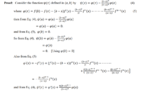
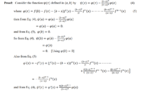
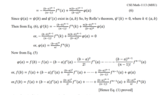
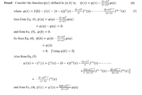
Consider the function $p(x)$ defined in (a, b) by p(x)=q(x)−((b−a)^n/(b−x)^n)q(a) where q(x) = f(b) - f(x) - (b - x)f'(x) - {(b-x)/2!}f''(x) -... {(b-x)^{n-1}/(n-1)!}) f^{n-1}(x)

Then they show that, p(a)=p(b)=0 and apply roll's theorem and proves Taylor's theorem. I understand this part.

I don't understand why they use, p(x)=q(x)−((b−a)^n/(b−x)^n)q(a). When proving mean value theorem, they first derived h(x) = f(x) – f(a) – {(f(b)-f(a))/(b-a)} (x-a) and then applied rolls theorem. My question is what is the derivation of p(x)=q(x)−((b−a)^n/(b−x)^n)q(a). p(x)=q(x)−((b−a)^n/(b−x)^n)q(a) and h(x) = f(x) – f(a) – {(f(b)-f(a))/(b-a)} (x-a) seems similar to me. Can we derive p(x) the same way as they did for h(x)?
 
Physics news on Phys.org
This is very hard to read. Could you write the formulas with LaTeX, see how here ...
https://www.physicsforums.com/help/latexhelp/
Just spend a lot of ## and \dfrac{}{}. And it is Rolle's theorem. It has nothing to do with rolls.I have a derivation of Taylor by the mean value theorem of integration and integration by parts, would this help?
 
Last edited:
PLAGUE said:
TL;DR Summary: I am using a book where they prove Taylor's theorem with p(x)=q(x)−((b−a)^n/(b−x)^n)q(a).
I am not familiar with the formula you quote
p(x)=q(x)−\frac{(b−a)^n}{(b−x)^n}q(a)
where x is included in denominator. p(a)=0. p(b) diverges.
Is the above LaTex formula same as your textbook ?
 
Last edited:
anuttarasammyak said:
I am not familiar with the formula you quote
p(x)=q(x)−\frac{(b−a)^n}{(b−x)^n}q(a)
where x is included in divider. p(a)=0. p(b) diverges.
Is the above LaTex formula same as your textbook ?
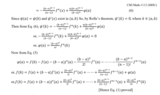
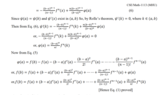
Here is the proof:
 

Attachments

  • Screenshot 2023-11-18 181659.png
    Screenshot 2023-11-18 181659.png
    26.4 KB · Views: 98
  • Screenshot 2023-11-18 181724.png
    Screenshot 2023-11-18 181724.png
    30.3 KB · Views: 105
fresh_42 said:
This is very hard to read. Could you write the formulas with LaTeX, see how here ...
https://www.physicsforums.com/help/latexhelp/
Just spend a lot of ## and \dfrac{}{}. And it is Rolle's theorem. It has nothing to do with rolls.I have a deviation of Taylor by the mean value theorem of integration and integration by parts, would this help?
 

Attachments

  • Screenshot 2023-11-18 181659.png
    Screenshot 2023-11-18 181659.png
    26.4 KB · Views: 114
  • Screenshot 2023-11-18 181724.png
    Screenshot 2023-11-18 181724.png
    30.3 KB · Views: 128
Can you tell us the location where you have the problem, in the same terms as in the pictures?

The proof basically goes like this:
  • the partial sum (plus correction terms) of the Taylor series at ##x=a## minus the partial sum (plus correction terms) of the Taylor series at ##x=b##,
  • where the correction terms make the expression zero at both ends of the interval ##[a,b]##
  • such that the theorem of Rolle can be applied to find ##\psi'(k)=0##
  • so that with some elementary algebra we get the Taylor series of ##f(x)## developed at the point ##x=a.##
I admit that this approach isn't very insightful. One would need to find a good compromise between what I have just written and what the textbook says plus all lines between the equations (1) - (4).

A different approach that uses integration instead of differentiation and the mean value theorem of integration instead of Rolle can be found here:
https://www.physicsforums.com/insights/series-in-mathematics-from-zeno-to-quantum-theory/#Functions
 
PLAGUE said:
Here is the proof:
Upside down
p(x)=q(x)−\frac{(b−x)^n}{(b−a)^n}q(a)? Then p(a)=p(b)=0.
 
Last edited:
anuttarasammyak said:
Upside down
p(x)=q(x)−\frac{(b−x)^n}{(b−a)^n}q(a)? Then p(a)=p(b)=0.
 

Attachments

  • Screenshot 2023-11-18 181659.png
    Screenshot 2023-11-18 181659.png
    26.4 KB · Views: 111
  • Screenshot 2023-11-18 181724.png
    Screenshot 2023-11-18 181724.png
    30.3 KB · Views: 121
1700371273198.png

Is this the part you quote ? It coincides with #7 where x is in numerator.
 
  • #10
yes it is
 

Similar threads

  • · Replies 6 ·
Replies
6
Views
2K
  • · Replies 5 ·
Replies
5
Views
3K
  • · Replies 4 ·
Replies
4
Views
1K
  • · Replies 11 ·
Replies
11
Views
2K
  • · Replies 9 ·
Replies
9
Views
3K
  • · Replies 6 ·
Replies
6
Views
3K
  • · Replies 5 ·
Replies
5
Views
3K
  • · Replies 3 ·
Replies
3
Views
2K
  • · Replies 19 ·
Replies
19
Views
4K
  • · Replies 20 ·
Replies
20
Views
4K