Why there are summer and winter seasons?

  • Context: High School 
  • Thread starter Thread starter Hectix
  • Start date Start date
  • Tags Tags
    Seasons Summer
Click For Summary
SUMMARY

The discussion clarifies the reasons behind the four seasons, emphasizing the significance of the Earth's axial tilt and its elliptical orbit. In the northern hemisphere, winter begins as the Earth approaches perihelion around January 3, while summer peaks during aphelion in July. The axial tilt causes extreme variations in daylight, particularly in polar regions, where summer experiences continuous daylight for six months, contrasting with six months of darkness in winter. The Earth's orbital eccentricity, approximately 0.017, results in a maximum distance variation of about 5 million kilometers from the sun.

PREREQUISITES
  • Understanding of Earth's axial tilt and its impact on seasons
  • Basic knowledge of orbital mechanics, specifically perihelion and aphelion
  • Familiarity with the concept of orbital eccentricity
  • Awareness of solar radiation variations due to Earth's position
NEXT STEPS
  • Research the effects of Earth's axial tilt on climate patterns
  • Explore the implications of orbital eccentricity on seasonal changes
  • Study the relationship between solar radiation and Earth's distance from the sun
  • Investigate seasonal variations in different geographical regions
USEFUL FOR

Students of Earth sciences, educators explaining seasonal changes, and anyone interested in the mechanics of climate and astronomy.

Hectix
Messages
2
Reaction score
0
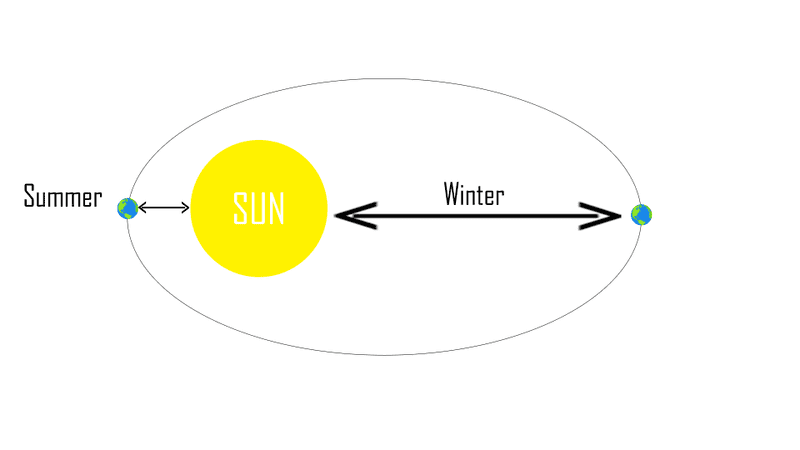
Hello guys, can someone explain me the four seasons ? Why they repeat in same intervals every year ? I think of this:

Thanks
Untitled-1.png
 
Astronomy news on Phys.org
Hectix said:
Hello guys, can someone explain me the four seasons ? Why they repeat in same intervals every year ? I think of this:

ThanksView attachment 93000
That picture is not the reason for the seasons (at least, not the whole story).

In fact, in the northern hemisphere, winter is just getting started when the Earth passes thru the perihelion (closest approach to the sun), somewhere along about January 3 or so. When summer is at its height in July in the northern hemisphere, the Earth is passing thru its aphelion (farthest point away from the sun). What is this sorcery?

https://en.wikipedia.org/wiki/Perihelion_and_aphelion

It's explained here:

https://en.wikipedia.org/wiki/Season
 
Thanks
 
As you suggested, the Earth's orbit is not perfectly circular, but it's not as an extreme elipse as your diagram suggests.
While that does make some difference to the overall amount of solar radiation arriving on Earth, that effect is vastly less than the effect produced by the Earth's axial tilt.
The effect of the axial tilt is such that in the northern hemisphere, 'Summer' in the polar regions is 6 months of continuous daylight, and winter is 6 months of darkness.
The same thing happens at the South pole, but the opposite way around, Summer in the northern hemisphere is winter in the south.
Outside of the polar regions there are longer days in summer, but the Sun does set for a while every day.
 
Last edited:
rootone said:
As you suggested, the Earth's orbit is not perfectly circular, but it's not as an extreme elipse as your diagram suggests.
While that does make some difference to the overall amount of solar radiation arriving on Earth, that effect is vastly less than the effect produced by the Earth's axial tilt.
The effect of the axial tilt is such that in the northern hemisphere, 'Summer' in the polar regions is 6 months of continuous daylight, and winter is 6 months of darkness.
The same thing happens at the South pole, but the opposite way around, Summer in the northern hemisphere is winter in the south.
Outside of the polar regions there are longer days in summer, but the Sun does set for a while every day.

The orbital eccentricity of the Earth is about 0.017, which means that the Earth's max. and min distances from the sun differ by about 5 million km (out of about 150 million km average distance)

https://en.wikipedia.org/wiki/Earth
 

Similar threads

  • · Replies 4 ·
Replies
4
Views
2K
  • · Replies 56 ·
2
Replies
56
Views
6K
  • · Replies 26 ·
Replies
26
Views
2K
  • · Replies 10 ·
Replies
10
Views
2K
  • · Replies 4 ·
Replies
4
Views
3K
  • · Replies 16 ·
Replies
16
Views
3K
  • · Replies 1 ·
Replies
1
Views
2K
  • · Replies 10 ·
Replies
10
Views
3K
  • · Replies 5 ·
Replies
5
Views
6K
  • · Replies 8 ·
Replies
8
Views
5K