Why Won't My Mousetrap Car Move?

  • Thread starter Thread starter theOkilla
  • Start date Start date
  • Tags Tags
    Car Mousetrap car
Click For Summary

Discussion Overview

The discussion revolves around the challenges faced by a participant in building a mousetrap car for a science project. The focus is on the mechanics of the car, specifically the pulley system, wheel selection, and friction issues that prevent the car from moving effectively.

Discussion Character

  • Exploratory
  • Technical explanation
  • Debate/contested
  • Homework-related

Main Points Raised

  • One participant describes their mousetrap car design, including a pulley system and the use of vinyl records as wheels, but reports that the car does not move when set down.
  • Another participant suggests examining the bearing surfaces for friction issues and minimizing friction at those points.
  • A different participant questions whether the wheels spin easily when loaded individually and suggests checking for binding due to axle bending under load.
  • Concerns are raised about using CDs as wheels, noting that their small contact area and smooth surface may lead to insufficient traction, which could prevent effective movement.
  • One participant mentions that while larger diameter wheels may provide higher speeds, they also require more energy to turn, suggesting that substituting CDs could reduce energy requirements.
  • The original poster expresses uncertainty about switching to CDs and considers using rubber bands for added traction on the wheels.

Areas of Agreement / Disagreement

Participants express differing opinions on the best wheel material and design for the mousetrap car, with no consensus reached on the optimal solution. Some suggest using CDs, while others caution against their effectiveness due to traction issues.

Contextual Notes

Participants discuss various factors affecting the car's performance, including wheel material, bearing friction, and the impact of weight on the axle, but do not resolve the underlying mechanical challenges.

Who May Find This Useful

Individuals interested in building simple mechanical devices, students working on science projects, and those exploring principles of physics related to motion and friction.

theOkilla
Messages
4
Reaction score
0
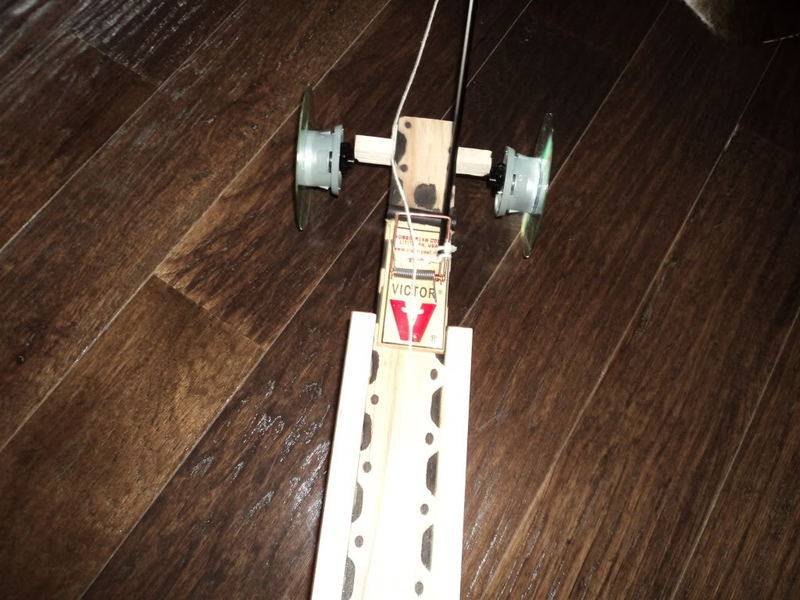
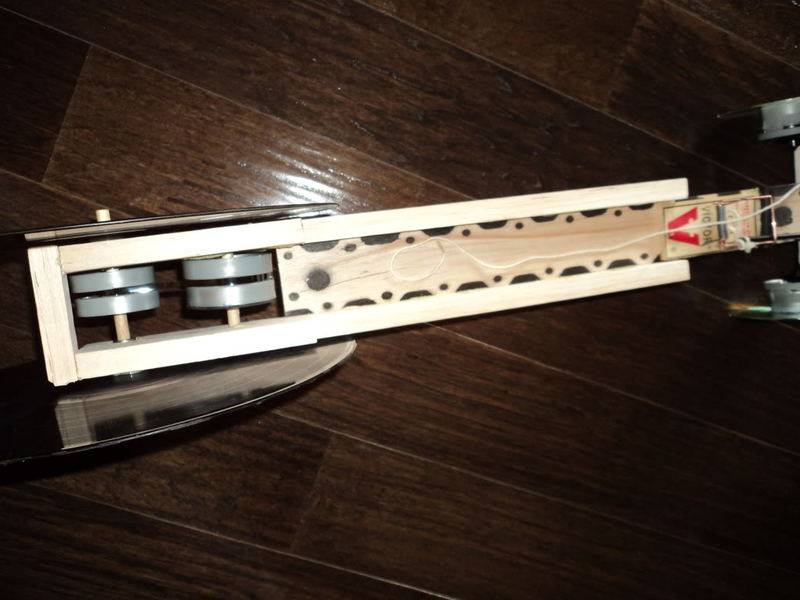
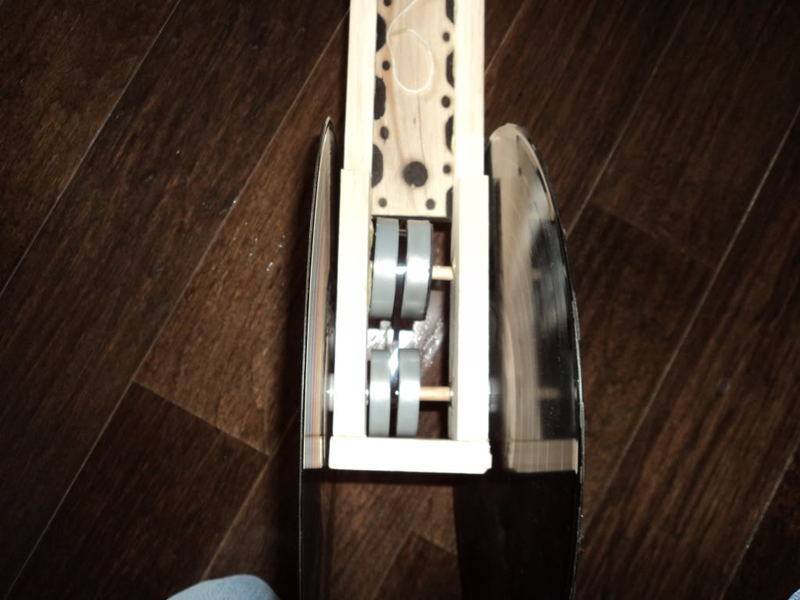
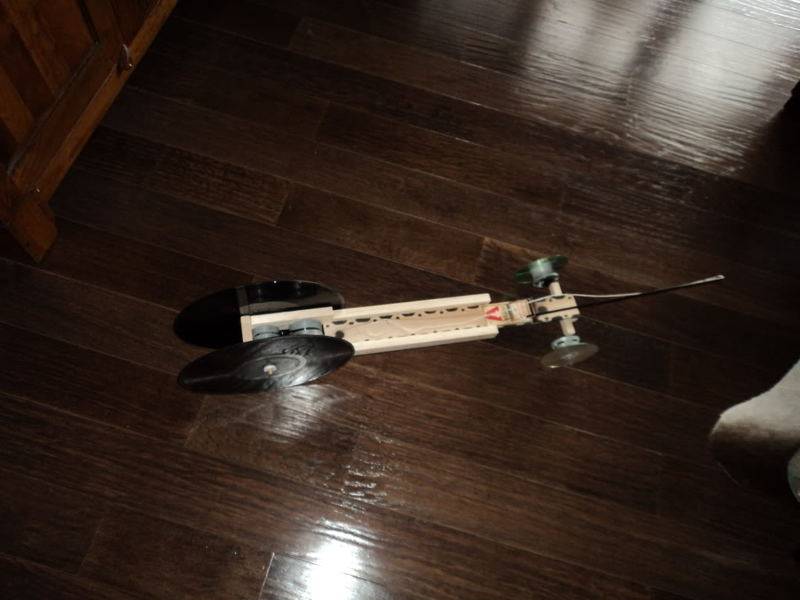
Hey guys! I'm new to Physics Forum and I have a question. I am building a mousetrap car for my 8th grade science class and have run into a problem. I have built a pretty sophisticated pulley system using a cassette tape. The lever arm and string turn the cassette tape which turns the drive axle. I am using two records as my back wheels, and I fear that they are too heavy. Whenever I arm the car and set it down, nothing happens. It does spin very quickly if I give it a little spin.

I will post some pictures of what it looks like.
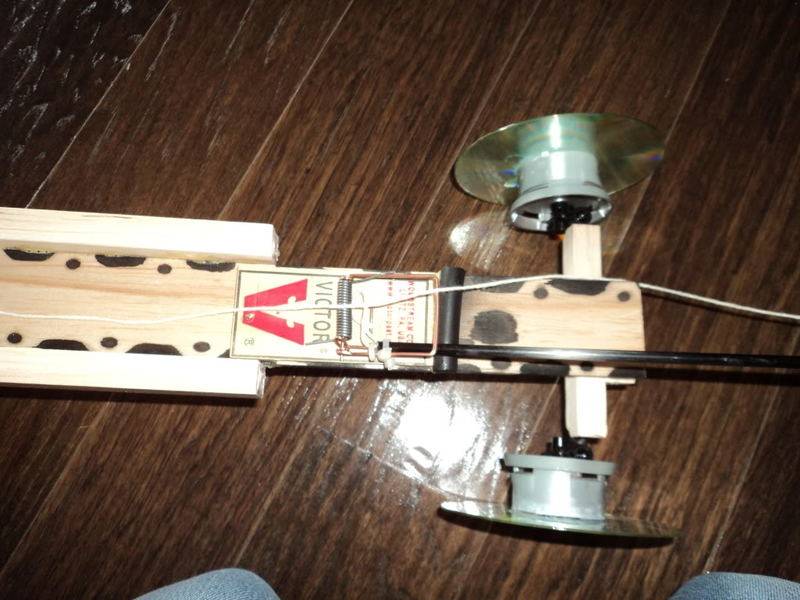
DSC00246.jpg


DSC00245.jpg


DSC00244.jpg


DSC00243.jpg


DSC00242.jpg
 
Last edited:
Engineering news on Phys.org
Welcome to the PF. What are your bearing surfaces for the axles/wheels? Wood-on-wood? Or something that gives lower friction.

You need to find where the friction problems are, and figure out how to minimize friction at those bearing surfaces...
 
I have bearings like on skateboard wheels for that and my axles are wood. I can get the wheels to spin very quickly while holding it, but when I set it down it won't spin.

Should I try and grease up the bearings?

Thanks
 
theOkilla said:
I have bearings like on skateboard wheels for that and my axles are wood. I can get the wheels to spin very quickly while holding it, but when I set it down it won't spin.

Should I try and grease up the bearings?

Thanks

Do the wheels spin easily when you load each on individually when spinning it with your finger? If individual loading is okay, look to see what is diffferent when you set the car down. Like, do the wood axles bend under load, making them bind a bit on the bearings?

Or, if you just sit the car on the ground and rock it gently back and forth with your finger, does it move easily? If it does, the problem may be in your string/pulley system. What are you using for bearings there? How does it feel to your fingers as you apply load to the string?
 
Using CDs for the drive wheels may not be the best choice to convert the torque input to the driven axle into a "driving force". What I'm trying to say is that there only a very small contact area between the edge of the CD and the surface on which the car rests. In addition, the edge of the CD is very smooth. In a real car, wide tires give better traction and the material of the tire is formulated to have a high coefficient of friction. Road surfaces are also designed so that sufficient friction is available so that the rotation of the tire is converted into thrust to drive the car. In a car where the coefficient of friction is very low, application of torque to the driving wheel causes the tire to spin without producing any driving thrust. This is why driving on wet or icy roads is potentially dangerous: the vehicle wants to slide and the driver loses control.
 
The wheels don't spin that easily when I use my finger. My parents keep telling me that I should take the records off and use CD's on all 4 wheels. What do you think?

And thanks for your help so far.
 
SteamKing said:
Using CDs for the drive wheels may not be the best choice to convert the torque input to the driven axle into a "driving force". What I'm trying to say is that there only a very small contact area between the edge of the CD and the surface on which the car rests. In addition, the edge of the CD is very smooth. In a real car, wide tires give better traction and the material of the tire is formulated to have a high coefficient of friction. Road surfaces are also designed so that sufficient friction is available so that the rotation of the tire is converted into thrust to drive the car. In a car where the coefficient of friction is very low, application of torque to the driving wheel causes the tire to spin without producing any driving thrust. This is why driving on wet or icy roads is potentially dangerous: the vehicle wants to slide and the driver loses control.
Oh great idea. Thanks! I'm going to try and put some rubber or something around the wheels for some extra traction. I will start by putting rubber bands around the CDs
 
From the photos posted I couldn't clearly see it, but it appears you are using vinyl records for the driven wheels. What I said in my previous post would also apply to the vinyl records. The larger diameter vinyl records could give you a higher top speed, but they do take a lot of energy to turn. If speed is not important for your demonstration, then substituting CDs for the vinyl at the driven wheels would reduce the amount of energy it takes to get your car rolling with the mousetrap mechanism.
 

Similar threads

  • · Replies 1 ·
Replies
1
Views
7K
Replies
4
Views
14K
Replies
2
Views
2K
  • · Replies 16 ·
Replies
16
Views
9K
  • · Replies 1 ·
Replies
1
Views
3K
  • · Replies 2 ·
Replies
2
Views
7K
  • · Replies 4 ·
Replies
4
Views
3K
  • · Replies 15 ·
Replies
15
Views
4K
  • · Replies 12 ·
Replies
12
Views
7K
  • · Replies 9 ·
Replies
9
Views
8K