Word problem : income tax and mixture

Click For Summary

Discussion Overview

The discussion revolves around solving word problems related to income tax and a mixture of teas, focusing on setting up equations based on given monetary systems. Participants explore different approaches to formulate and solve these problems, which involve both mathematical reasoning and conceptual understanding.

Discussion Character

  • Exploratory
  • Mathematical reasoning
  • Conceptual clarification
  • Homework-related

Main Points Raised

  • Some participants express difficulty in understanding the problems, particularly the lack of specific amounts in the mixture problem.
  • One participant proposes a method to solve the income tax problem using a single variable, leading to a solution of 8750 pounds for income tax below 100 pounds.
  • Another participant suggests a different approach to the mixture problem, setting up equations for the costs of inferior and superior teas.
  • There is a discussion about the monetary system, specifically the conversion of pence to shillings and the implications for the calculations.
  • Participants clarify the meaning of the selling price and how it relates to the cost price, particularly in terms of percentage increase.
  • Some participants question the setup of equations and the interpretation of the problem statements, seeking further clarification on the relationships between variables.

Areas of Agreement / Disagreement

Participants generally agree on the need for clarity in variable definitions and problem statements, but multiple competing views remain regarding the best approach to solving the problems. The discussion on the mixture problem and its equations is particularly unresolved, with participants expressing differing interpretations.

Contextual Notes

There are limitations in the clarity of the problem statements, particularly regarding the original cost per pound of the mixture and the definitions of variables. Some participants express confusion over the monetary conversions and the relationships between the quantities involved.

Who May Find This Useful

This discussion may be useful for students working on similar word problems in mathematics, particularly those involving income tax calculations and mixtures, as well as those interested in understanding historical monetary systems.
NotaMathPerson
Messages
82
Reaction score
0
Hello everyone!

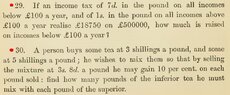
I need help on setting the equations for these problems.View attachment 5643

For prob 30. I could not solve it because there's no given amount in lbs of the mixture.
For prob 28 I really had no idea what it is asking.

Please bear with the monetary unit used those problems. These problems are from very old book.
Thanks!
 

Attachments

  • algberatodEX.jpg
    algberatodEX.jpg
    41.8 KB · Views: 157
Mathematics news on Phys.org
Using this monetary system, there are 12 pence (d) in a shilling (s) and 20 shillings, or 240 pence, in a pound (£).

Let's look at problem 29 first, and use the pound as the monetary unit Let's let $A$ be the income tax raised on incomes below 100 and $B$ be the income tax raised on incomes above 100. We will then let $C$ be the total incomes below 100 and $D$ be the total incomes above 100. So we may write:

$$A=\frac{7}{240}C$$

$$B=\frac{1}{20}D$$

$$A+B=18750$$

$$C+D=500000$$

Since we are being asked for $A$, let's substitute for $C$ and $D$ in the last equation using the first 2 equations:

$$A+B=18750$$

$$\frac{240}{7}A+20B=500000$$

Now, let's multiply the first equation by -140 and second equation by 7:

$$-140A-140B=-2625000$$

$$240A+140B=3500000$$

Now, adding these two equations, what do you find?
 
MarkFL said:
Using this monetary system, there are 12 pence (d) in a shilling (s) and 20 shillings, or 240 pence, in a pound (£).

Let's look at problem 29 first, and use the pound as the monetary unit Let's let $A$ be the income tax raised on incomes below 100 and $B$ be the income tax raised on incomes above 100. We will then let $C$ be the total incomes below 100 and $D$ be the total incomes above 100. So we may write:

$$A=\frac{7}{240}C$$

$$B=\frac{1}{20}D$$

$$A+B=18750$$

$$C+D=500000$$

Since we are being asked for $A$, let's substitute for $C$ and $D$ in the last equation using the first 2 equations:

$$A+B=18750$$

$$\frac{240}{7}A+20B=500000$$

Now, let's multiply the first equation by -140 and second equation by 7:

$$-140A-140B=-2625000$$

$$240A+140B=3500000$$

Now, adding these two equations, what do you find?

I edited it.

Hello! solving for A =8750 pounds

How about the prob 30?
 
Last edited:
Let's let $i$ be the number of pounds of the inferior tea needed and $S$ be the number of pounds of the superior. Thus, the total amount spent $T_S$ per pound on the two teas (in shillings) is:

$$T_S=\frac{3I+5S}{I+S}$$

The total amount he is to receive per pound is 3.4, and that is to be equal to 110% of the amount spent per pound:

$$\frac{11}{10}\cdot\frac{3I+5S}{I+S}=3.4$$

Can you now find $I$ in terms of $S$?
 
Hello!

As I was studying your solution for prob 29, I came up with a method that uses only one variable

Let $x=$ income tax for all incomes below 100 pounds.
$18750-x=$ income tax for all incomes above 100 pounds

$\frac{240}{7}x+20(18750-x)=500000$

Solving for x I get $x=8750$ pounds which agrees with the first method.

And also is it okay if I don't call the unknown as "income tax raised on incomes below..." and just call it plainly as "income tax below..."? Because I think that part of the statement gave me trouble solving this problem not to mention english is not my primary language.

And for problem 30 yes I was able to come up for an equation for I. But I am still at a loss as to where you get 3.4? And the 110%?
Can you make me understand first what's really going on in the problem? Thank you and I really appreciate your help!
 
NotaMathPerson said:
...And also is it okay if I don't call the unknown as "income tax raised on incomes below..." and just call it plainly as "income tax below..."? Because I think that part of the statement gave me trouble solving this problem not to mention english is not my primary language...

Yes, you can label your variables however you like, as long as it makes sense to you and each variable represents a relevant quantity.

NotaMathPerson said:
And for problem 30 yes I was able to come up for an equation for I. But I am still at a loss as to where you get 3.4? And the 110%?
Can you make me understand first what's really going on in the problem? Thank you and I really appreciate your help!

There are 20 pence per shilling, so 3s 8d is 3.4s. The problem states that the seller is to gain 10% per pound sold, so we take the amount paid and increase if by 10% to get the selling price. To increase something by 10% we multiply it by 11/10.
 
MarkFL said:
Yes, you can label your variables however you like, as long as it makes sense to you and each variable represents a relevant quantity.
There are 20 pence per shilling, so 3s 8d is 3.4s. The problem states that the seller is to gain 10% per pound sold, so we take the amount paid and increase if by 10% to get the selling price. To increase something by 10% we multiply it by 11/10.

Hello! Sorry, I can't still follow. Can you show me how it is done using only one variable? From there, I may be able to do it.

And also fo 3.4 do you mean 3.67? Because 8d is 8 pence and there is 12 pence in 1 shilling so 8/12 =2/3s.

Thanks!
 
Yes, sorry 12 pence in a shilling (there are 20 shillings per pound), so adjust the equation accordingly...the method is the same.
 
MarkFL said:
Let's let $i$ be the number of pounds of the inferior tea needed and $S$ be the number of pounds of the superior. Thus, the total amount spent $T_S$ per pound on the two teas (in shillings) is:

$$T_S=\frac{3I+5S}{I+S}$$

The total amount he is to receive per pound is 3.4, and that is to be equal to 110% of the amount spent per pound:

$$\frac{11}{10}\cdot\frac{3I+5S}{I+S}=3.4$$

Can you now find $I$ in terms of $S$?

Hello.

Solving for I, $I=25s$ where will I plug this in?
 
  • #10
NotaMathPerson said:
Hello.

Solving for I, $I=25s$ where will I plug this in?

You should get:

$$I=5S$$

And this tells you that there needs to be 5 times as much of the inferior tea in the mixture as there is the superior tea. Thus, for every pound of superior tea used in the mix, 5 pounds of inferior tea much be used.
 
  • #11
MarkFL said:
Let's let $i$ be the number of pounds of the inferior tea needed and $S$ be the number of pounds of the superior. Thus, the total amount spent $T_S$ per pound on the two teas (in shillings) is:

$$T_S=\frac{3I+5S}{I+S}$$

The total amount he is to receive per pound is 3.4, and that is to be equal to 110% of the amount spent per pound:

$$\frac{11}{10}\cdot\frac{3I+5S}{I+S}=3.4$$

Can you now find $I$ in terms of $S$?

Why didnt you multiply the rhs by 1.1?
 
  • #12
NotaMathPerson said:
Why didnt you multiply the rhs by 1.1?

We are told what the selling price/lb. is to be, so why would we increase that by 10%? We are told that this given selling price/lb. will be 10% greater than the price paid/lb. So, we increase the price paid by 10%, and then set it equal to the given selling price.
 
  • #13
MarkFL said:
We are told what the selling price/lb. is to be, so why would we increase that by 10%? We are told that this given selling price/lb. will be 10% greater than the price paid/lb. So, we increase the price paid by 10%, and then set it equal to the given selling price.

Is 3s. 8d the price paid/lb of the mixture?
 
  • #14
NotaMathPerson said:
Is 3s. 8d the price paid/lb of the mixture?

That's the price per/lb. the mixture is to be sold.
 
  • #15
MarkFL said:
That's the price per/lb. the mixture is to be sold.
Hello! Now I see. The original cost per/lb of the mixture was not given. I thought it was 3s. 8d.
In 3s. 8d , included are the original cost per/lb of the mixture plus 10% of original cost per/lb. Am I correct on this?

And also, can you help me set up an equation where only one variable is present? Because this exercise is from a topic of problems leading with one vriable equation. Thanks a lot.
 
  • #16
NotaMathPerson said:
Hello! Now I see. The original cost per/lb of the mixture was not given. I thought it was 3s. 8d.
In 3s. 8d , included are the original cost per/lb of the mixture plus 10% of original cost per/lb. Am I correct on this?

And also, can you help me set up an equation where only one variable is present? Because this exercise is from a topic of problems leading with one vriable equation. Thanks a lot.

Yes, the price/lb. paid for the mixture must be computed by taking the toal amount paid, and dividing by the combined weight, resulting in a weighted average.

There are two unknowns here...that aren't related by a given total weight. Since we are being asked to find how many pounds of the inferior tea must be mixed with each pound of the superior (which we'll call $k$), we could go about it this way:

Let:

$$S$$ = the weight of the superior tea purchased.

$$kS$$ = the weight of the inferior tea purchased.

Then we may state the total price paid per pound as:

$$\frac{3kS+5S}{kS+S}=\frac{3k+5}{k+1}$$

Now we are down to 1 variable...

Then, marking this up by %10 and equating it to the stated selling price/lb.:

$$\frac{11}{10}\cdot\frac{3k+5}{k+1}=\frac{11}{3}$$

$$9k+15=10k+10$$

$$k=5$$

And so we conclude 5 pounds of the inferior tea must be mixed with each pound of the superior.
 
  • #17
Thanks very much for your help!
 

Similar threads

  • · Replies 2 ·
Replies
2
Views
2K
  • · Replies 4 ·
Replies
4
Views
2K
  • · Replies 4 ·
Replies
4
Views
2K
  • · Replies 7 ·
Replies
7
Views
3K
  • · Replies 7 ·
Replies
7
Views
2K
  • · Replies 21 ·
Replies
21
Views
2K
  • · Replies 1 ·
Replies
1
Views
2K
  • · Replies 5 ·
Replies
5
Views
2K
  • · Replies 8 ·
Replies
8
Views
2K
  • · Replies 3 ·
Replies
3
Views
2K