Algebra word problem: finding the distance

  • Context:
  • Thread starter Thread starter NotaMathPerson
  • Start date Start date
  • Tags Tags
    Algebra Word problem
Join the discussion
Ask a follow-up here, or get your own question answered by working scientists, mathematicians and engineers — people, not an autocomplete.
Real named experts · corrections over time · the nuance an AI answer skips
5 replies · 2K views
NotaMathPerson
Messages
82
Reaction score
0
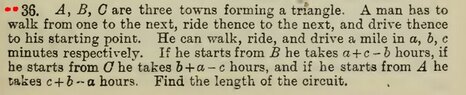
View attachment 5654

Hello! Please help continue solving tye problem I got stuck.

This is my attemptlet $d=$ length of the circuit
$\frac{60}{a}$mph --- speed for walking
$\frac{60}{b}$mph ----speed for riding
$\frac{60}{c}$mph ---- speed for driving

$d = \frac{60}{a}t_{1}+ \frac{60}{b}t_{2} + \frac{60}{c}t_{3}$

From here I cannot continue. Kindly help me. Thanks!
 

Attachments

  • Q36hallXXIV.jpg
    Q36hallXXIV.jpg
    28.7 KB · Views: 129
Mathematics news on Phys.org
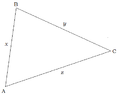
I would begin this problem by drawing a diagram:

View attachment 5655

Now, what we want to find is the distance $d$ where:

$$d=x+y+z$$

Using the information given in the problem, we may write:

$$\frac{x}{a}+\frac{y}{b}+\frac{z}{c}=c+b-a$$

$$\frac{y}{a}+\frac{z}{b}+\frac{x}{c}=a+c-b$$

$$\frac{z}{a}+\frac{x}{b}+\frac{y}{c}=b+a-c$$

What do you get when you add these 3 equations?
 

Attachments

  • circuit_prob.png
    circuit_prob.png
    1.7 KB · Views: 129
MarkFL said:
I would begin this problem by drawing a diagram:
Now, what we want to find is the distance $d$ where:

$$d=x+y+z$$

Using the information given in the problem, we may write:

$$\frac{x}{a}+\frac{y}{b}+\frac{z}{c}=c+b-a$$

$$\frac{y}{a}+\frac{z}{b}+\frac{x}{c}=a+c-b$$

$$\frac{z}{a}+\frac{x}{b}+\frac{y}{c}=b+a-c$$

What do you get when you add these 3 equations?

This is what I get

$\left(x+y+z\right)\left(\frac{1}{a}+\frac{1}{b}+\frac{1}{c}\right)=a+b+c$
 
NotaMathPerson said:
This is what I get

$\left(x+y+z\right)\left(\frac{1}{a}+\frac{1}{b}+\frac{1}{c}\right)=a+b+c$

Yes, good! (Yes)

I chose to write this as:

$$d\left(\frac{1}{a}+\frac{1}{b}+\frac{1}{c}\right)=a+b+c$$

Now, solve for $d$. :)
 
MarkFL said:
Yes, good! (Yes)

I chose to write this as:

$$d\left(\frac{1}{a}+\frac{1}{b}+\frac{1}{c}\right)=a+b+c$$

Now, solve for $d$. :)

I thought of it too. But solving for d only gives me letters. In my book the answer is 60 miles. Why is that?

And can you explain why do we need to add the 3 eqns? Thanks.
 
NotaMathPerson said:
I thought of it too. But solving for d only gives me letters. In my book the answer is 60 miles. Why is that?

And can you explain why do we need to add the 3 eqns? Thanks.

I didn't read the question thoroughly (regarding the 3 velocities being given in minutes instead of hours)...what we get instead is the system:

$$\frac{ax}{60}+\frac{by}{60}+\frac{cz}{60}=c+b-a$$

$$\frac{ay}{60}+\frac{bz}{60}+\frac{cx}{60}=a+c-b$$

$$\frac{az}{60}+\frac{bx}{60}+\frac{cy}{60}=b+a-c$$

Now when we add the equations, we obtain:

$$\frac{d}{60}(a+b+c)=a+b+c\implies d=60$$