Wording question regards angles

  • Context: High School 
  • Thread starter Thread starter Benn
  • Start date Start date
  • Tags Tags
    Angles
Click For Summary
SUMMARY

This discussion addresses the differentiation of angles θ and θ₁ in the context of geometry. The conventional method involves referencing angles using three points to denote their orientation within a triangle, such as angle ABC. For advanced differentiation, understanding concepts like the determinant and wedge product in three-dimensional vector algebra is essential. This approach allows for the identification of leftward and rightward facing angles through vector representation.

PREREQUISITES
  • Understanding of basic geometry and triangle properties
  • Familiarity with three-dimensional vector algebra
  • Knowledge of determinants and wedge products
  • Experience with cross-products in vector mathematics
NEXT STEPS
  • Study the properties of angles in triangle geometry
  • Learn about determinants and their applications in geometry
  • Explore the wedge product and its significance in vector algebra
  • Investigate the cross-product and its role in determining vector orientation
USEFUL FOR

Mathematicians, geometry enthusiasts, and students studying vector algebra who seek to understand angle differentiation and orientation in geometric contexts.

Benn
Messages
34
Reaction score
0
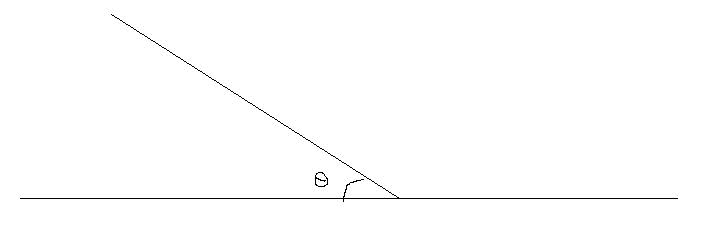
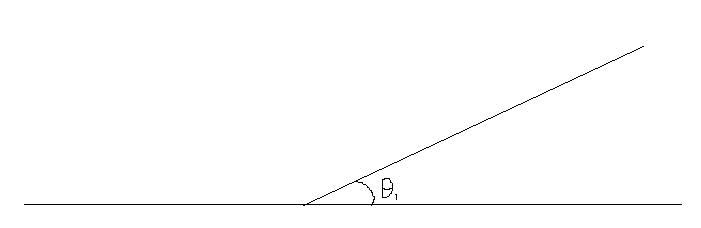
I have two angles:

[itex]θ[/itex]:
2r4kdbc.jpg


and [itex]θ_{1}[/itex]:
24c5qo1.jpg


[itex]θ_{1}[/itex] = [itex]θ[/itex]

How do I differentiate the two angles? I want to say "leftward facing" and "rightward facing", but I'm not sure how to "mathematically." Note that I must talk about the angle that's between 0-90 degrees.

Thanks,
Ben
 
Last edited:
Mathematics news on Phys.org
Hey Benn and welcome to the forums.

In terms of an 'angle' as a quantity, we don't differentiate them in the way that you have described.

However what is done in geometry is that we can reference an angle in terms of three points. The three points denote a triangle where the order of the point denotes the angle and its orientation. For example if we denote ABC as an angle then given points A, B, and C the angle is formed by looking at the interior of the triangle ABC where the angle is between the points A and C.

The idea can be applied to higher levels of geometry where orientation comes in, but for your kind of geometry that you are describing, it probably might be better if you use the above convention.

If you are interested in orientation in high level geometry, then you need to understand the determinant and the wedge product. It would help you to understand three-dimensional vector algebra which includes the cross-product which helps identify methods to incorporate orientation (your left facing and right facing angles) in a way that one orientation produces one vector and the reverse orientation produces a vector that is opposite to that vector.

If you are going to do the above, you have to treat your lines as vectors and speak about things in that context.

Have you ever learned about vectors or vectors and geometry before? What mathematical background do you have?
 
If in your context, your angles are going to be in specific places, maybe you want to refer to one of them as being in the first quadrant and the other one in the second...maybe?
 

Similar threads

  • · Replies 7 ·
Replies
7
Views
3K
  • · Replies 10 ·
Replies
10
Views
2K
  • · Replies 7 ·
Replies
7
Views
3K
  • · Replies 13 ·
Replies
13
Views
3K
  • · Replies 12 ·
Replies
12
Views
5K
  • · Replies 24 ·
Replies
24
Views
3K
  • · Replies 7 ·
Replies
7
Views
6K
  • · Replies 7 ·
Replies
7
Views
2K
  • · Replies 5 ·
Replies
5
Views
2K