Work done on a falling elevator by a spring + gravity

6 replies · 3K views · last reply
simphys
Messages
327
Reaction score
46
Homework Statement
An elevator cable breaks when a 925-kg elevator
is 22.5 m above the top of a huge spring
at the bottom of the shaft. Calculate
(a) the work done by gravity on the elevator before it hits the
spring; (b) the speed of the elevator just before striking the
spring; (c) the amount the spring compresses (note that here
work is done by both the spring and gravity).
Relevant Equations
WE principle + w=Fd
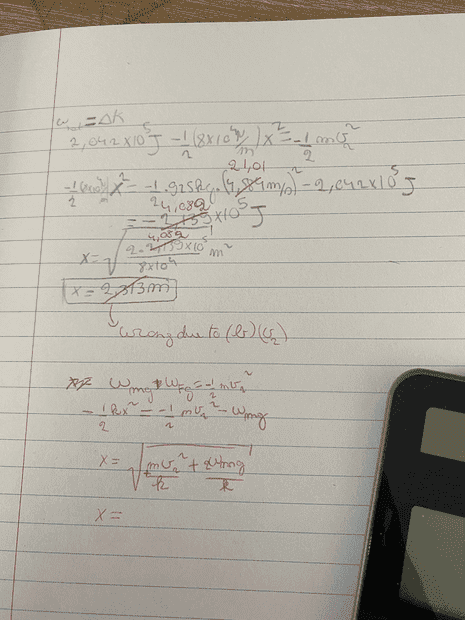
I don't understand what I have done wrong in part (c) I have the initial velocity for the second part of the motion and have the final velocity zero and then the net work done is W_mg + W_Fs and the actual answer for x is 2.37m
Could I get some help/tips please, thanks in advance.

Here is my solution
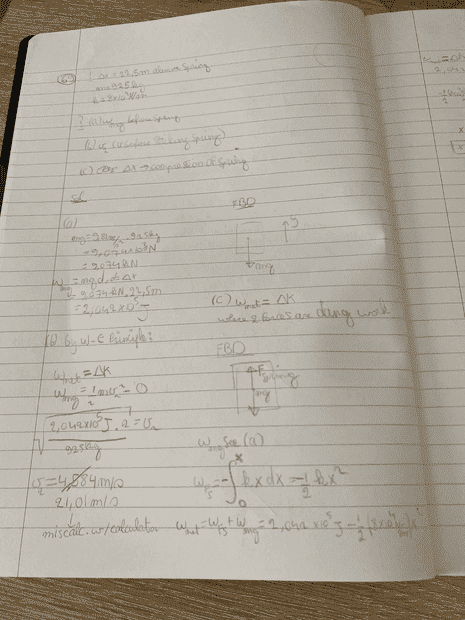
Handwritten physics solution on lined notebook paper: givens for a 3,500 kg elevator and spring, parts (a) and (b) with energy and work calculations, and free-body diagrams labelled FBD with forces F_s and mg.

Handwritten physics working on lined paper: energy equation 2.042x10^5 J minus one half 8x10^4 kg times x squared equals minus one half m v squared, then a line solving for x equals 2.13 m with a note reading wrong due to v2, and a rearranged expression for x with a calculator at the lower right.

small edit: After getting V_2 = 21m/s, x = 3.19m and the ,(comma) is a decimal point here! .(dot) is multiplication
 
Last edited:
  • Like
Likes   Reactions: Delta2
I think I see the problem.. I used the work done by gravity from the free fall motion part.
for the second part it actually is W_mg = mgx (if I am not mistaking)
 
I got the following: ##-4E4*x^2 + 9.074E3*x + 2.04E5=0 ##
which I solved with the calculator directly, but using the quadractic formula would be a lot of writing, is there another way I can look at this problem or something?
 
simphys said:
I got the following: ##-4E4*x^2 + 9.074E3*x + 2.04E5=0 ##
which I solved with the calculator directly, but using the quadractic formula would be a lot of writing, is there another way I can look at this problem or something?
I cannot read the value of k in the posted image, but I deduce it must be 8E4 N/m.
I agree with your quadratic. There's no simpler approach.
 
  • Like
Likes   Reactions: simphys
haruspex said:
I cannot read the value of k in the posted image, but I deduce it must be 8E4 N/m.
I agree with your quadratic. There's no simpler approach.
Thank you! I thought that there may be a way to just use the initial and final position instead of breaking it up into part, but I didn't try. I supposed that it might've work that is why I asked.
 
simphys said:
Thank you! I thought that there may be a way to just use the initial and final position instead of breaking it up into part, but I didn't try. I supposed that it might've work that is why I asked.
Sorry, I thought you were just asking about solving the quadratic at the end.
Yes, if you only had to solve part c you could just write the conservation of energy equation straight off:
##(h+x)mg=\frac 12kx^2##
and get the quadratic from that.
 
  • Like
Likes   Reactions: simphys
haruspex said:
Sorry, I thought you were just asking about solving the quadratic at the end.
Yes, if you only had to solve part c you could just write the conservation of energy equation straight off:
##(h+x)mg=\frac 12kx^2##
and get the quadratic from that.
Oh right, way faster thus. Thank you!