Would an exploded planet change earths orbit (see graphic)

Click For Summary
SUMMARY

The discussion centers on the hypothetical scenario of an exploded planet in the asteroid belt affecting the orbits of inner planets, particularly Earth and Mars. Participants argue that the gravitational influence of such an explosion would not cause planets to migrate outward, contradicting the original post's speculation. The consensus emphasizes that planets do not explode and that any mass falling into the Sun would actually draw planets closer rather than push them outward. The conversation concludes with a reminder that personal theories lacking scientific support are not permitted in the forum.

PREREQUISITES
  • Understanding of orbital mechanics and gravitational dynamics
  • Familiarity with the faint young Sun paradox
  • Knowledge of planetary formation and atmospheric evolution
  • Awareness of scientific discourse standards in academic forums
NEXT STEPS
  • Research the faint young Sun paradox and its implications for planetary atmospheres
  • Study gravitational dynamics and their effects on planetary orbits
  • Examine the formation and evolution of the asteroid belt
  • Explore established theories on planetary migration and stability
USEFUL FOR

Astronomers, astrophysicists, planetary scientists, and anyone interested in the dynamics of solar system formation and the implications of gravitational interactions on planetary orbits.

Edward Barrow
Messages
25
Reaction score
1
If a hypothetical planet was once where the asteroid belt is now, and was removed (for example exploded and fell inwards towards the sun where it got burnt up), would this cause the inner planets to migrate outwards into new orbits due to the orbital resonance lost by this hypothetical planet?

Wouldn't the new orbits be circular rather than elliptical? I'm assuming the effects of orbital resonance off each other would ensure they are kept circular, even in the range of 1000's of years after the exploded planet has been removed.
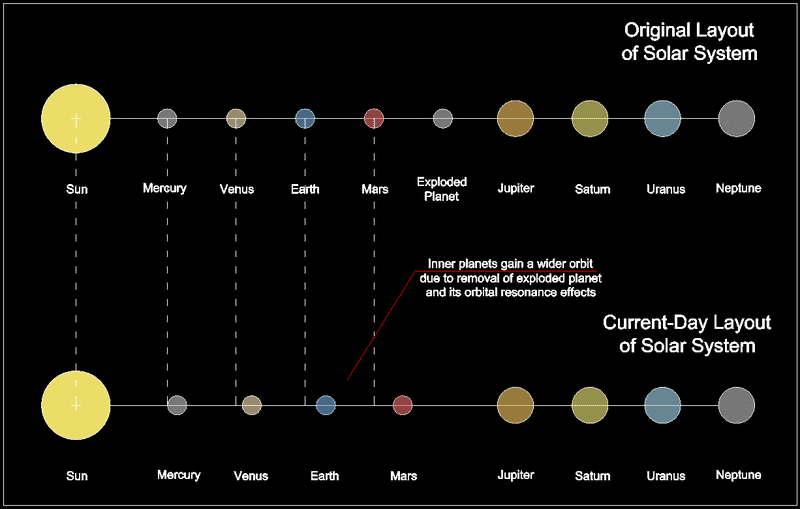
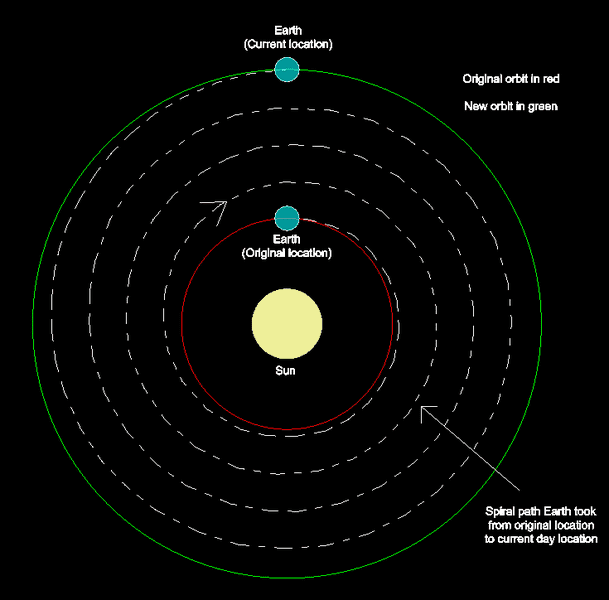
2yovdie.png


154j7s4.png
 

Attachments

  • 2yovdie.png
    2yovdie.png
    19.7 KB · Views: 809
  • 154j7s4.png
    154j7s4.png
    19.8 KB · Views: 832
Last edited:
Astronomy news on Phys.org
PF deals with science from standard textbooks and major publications, this post looks like it does not have that kind of support. Can you please cite some standard literature to back up what you have? Personal speculation is not allowed on our forums. Just so you know.
 
Edward Barrow said:
... for example exploded and fell inwards towards the sun
It would be QUITE a trick for an exploding planet's pieces to all head off in the same direction and fall into the sun
 
Edward Barrow said:
If a hypothetical planet was once where the asteroid belt is now, and was removed (for example exploded and fell inwards towards the sun where it got burnt up), would this cause the inner planets to migrate outwards into new orbits due to the orbital resonance lost by this hypothetical planet?

putting aside for a moment that planets don't explode

for an object ... a planet, moon, a satellite, must be given extra energy to be able to attain a higher orbit
So where would the inner planets get that extra energy from ?Dave

PS and noting @jim mcnamara 's comments
 
jim mcnamara said:
PF deals with science from standard textbooks and major publications, this post looks like it does not have that kind of support. Can you please cite some standard literature to back up what you have? Personal speculation is not allowed on our forums. Just so you know.

I'm postulating that if the Earth was closer to the sun in the solar systems past, and then moved outwards, this might be an explanation for the faint young sun paradox.

phinds said:
It would be QUITE a trick for an exploding planet's pieces to all head off in the same direction and fall into the sun

I'm not saying they all fell in towards the sun. Maybe a large chunk fell in towards the sun (after coming close to one of the inner planets, which swung the chu trajectory in towards the sun). Some pieces then formed the asteroid belt.
 
davenn said:
for an object ... a planet, moon, a satellite, must be given extra energy to be able to attain a higher orbit
So where would the inner planets get that extra energy from ?

If a large chunk of the exploded planet passed by the inner planets as it fell in towards the sun, its gravitational pull might have pulled some of the planets outwards (depending on the exact way it passed by the planets). Or maybe just one planet was affected - planet earth.
 
Edward Barrow said:
If a large chunk of the exploded planet passed by the inner planets as it fell in towards the sun, its gravitational pull might have pulled some of the planets outwards (depending on the exact way it passed by the planets). Or maybe just one planet was affected - planet earth.
I think you need to go back and read post #2 again.
 
  • Like
Likes   Reactions: davenn
Edward Barrow said:
If a large chunk of the exploded planet passed by the inner planets as it fell in towards the sun, its gravitational pull might have pulled some of the planets outwards (depending on the exact way it passed by the planets). Or maybe just one planet was affected - planet earth.

no
phinds said:
I think you need to go back and read post #2 again.

Agreed
 
phinds said:
I think you need to go back and read post #2 again.

I'm postulating that if the Earth was closer to the sun in the solar systems past, and then moved outwards, this might be an explanation for the faint young sun paradox.

I'm trying to find a scenario that could have caused the planets (or even just planet earth) to move outwards in the solar systems past. Mars has the same problem as Earth with regard to the faint young sun paradox. Research shows Mars once had running water. But if the sun was fainter in the solar systems past, then Mars should have been even colder back then than it is today (hence running water there would have been an impossibility). If a mechanism could be found that caused the planets to migrate outwards in the solar systems past, it would help provide one explanation for this mystery.
 
  • #10
Edward Barrow said:
I'm postulating ...
You are SERIOUSLY not listening. Go back and read post #2 again. And again. Until you understand what it says.
 
  • #11
Mass falling into the Sun from outside will make the orbits of planets get closer to the Sun. Not by a relevant amount, but still: Wrong direction.

Mars, as every planet, started hot from its formation and with a thicker atmosphere.
 
  • #12
Edward Barrow said:
I'm postulating that if the Earth was closer to the sun in the solar systems past, and then moved outwards, this might be an explanation for the faint young sun paradox.
We have plausible explanations for the faint young sun paradox based upon one or more greenhouse gases as well as less well supported and somewhat esoteric hypotheses. Explanations based upon exploding planets (planets don't explode) and imaginative orbital dynamics (totally lacking in evidential support) are unecessary, unscientific and contrary to forum rules.

Edward Barrow said:
Mars has the same problem as Earth with regard to the faint young sun paradox. Research shows Mars once had running water.
A problem that has been solved by noting the much denser atmosphere present in the Pre-Noachian and Noachian periods. This atmosphere was subsequently largely removed, mostly by the impact of the solar wind.
 
  • Like
Likes   Reactions: russ_watters, mfb and Bandersnatch
  • #13
We are closing the thread. Our function here at PF is to support existing science - not to point why personal theory is has problems. There are other forums for this kind of thing.
 

Similar threads

  • · Replies 2 ·
Replies
2
Views
3K
  • · Replies 30 ·
2
Replies
30
Views
3K
  • · Replies 7 ·
Replies
7
Views
3K
Replies
17
Views
4K
  • · Replies 14 ·
Replies
14
Views
4K
  • · Replies 11 ·
Replies
11
Views
4K
  • · Replies 3 ·
Replies
3
Views
3K
  • · Replies 5 ·
Replies
5
Views
3K
  • · Replies 3 ·
Replies
3
Views
5K
  • · Replies 21 ·
Replies
21
Views
5K