SUMMARY
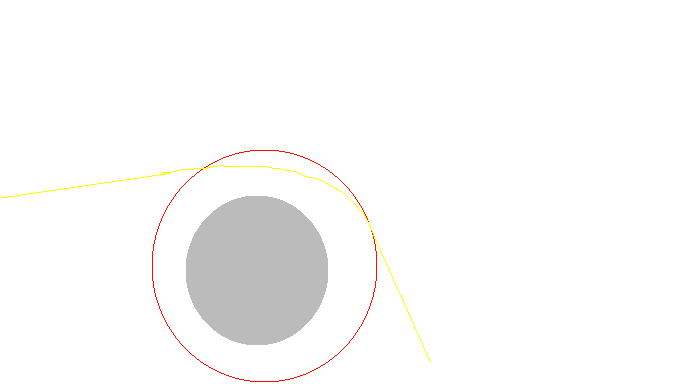
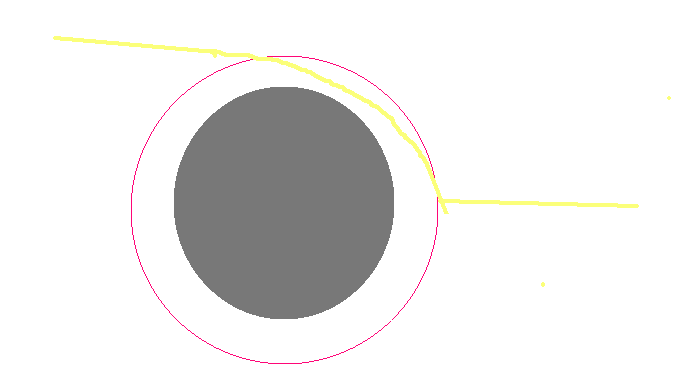
The discussion centers on the behavior of light in the presence of massive objects and gravitational fields. It is established that light follows a geodesic in spacetime, which means it travels in a straight line through curved spacetime, rather than changing its angle. The trajectory of light is affected by gravity, but it does not change direction; rather, the space it traverses is what is curved. The conversation clarifies that while light appears to bend around massive objects, it continues on a straight path in spacetime, and this effect diminishes with distance from the mass.
PREREQUISITES
- Understanding of general relativity and spacetime concepts
- Familiarity with the term "geodesic" in physics
- Basic knowledge of gravitational effects on light
- Awareness of the concept of light as a massless particle (photon)
NEXT STEPS
- Study the principles of general relativity, focusing on spacetime curvature
- Explore the concept of geodesics in both 3D and 4D contexts
- Investigate the effects of gravity on light propagation using simulations
- Review the implications of gravitational lensing in astrophysics
USEFUL FOR
Physicists, astronomy students, educators, and anyone interested in the effects of gravity on light and the principles of general relativity.