ZapperZ's Great Outdoors Photo Contest

  • Thread starter Thread starter Astronuc
  • Start date Start date
Click For Summary
SUMMARY

The forum discussion centers around the ZapperZ's Great Outdoors Photo Contest, where participants share stunning outdoor photography. Key highlights include images of Moxie Falls, Bash Bish Falls, and various scenic locations in Norway, showcasing the beauty of nature. Users express admiration for each other's work, with specific mentions of techniques like bracketing and the use of digital cameras for capturing fall colors. The conversation also touches on the nostalgia of outdoor travels and the desire to convert old slides to digital formats.

PREREQUISITES
  • Understanding of basic photography concepts such as composition and lighting.
  • Familiarity with digital photography techniques, including bracketing and post-processing.
  • Knowledge of outdoor locations and their photographic potential.
  • Experience with digital image scanning for converting slides and negatives.
NEXT STEPS
  • Research Nikon Coolscan 4000 for high-quality slide scanning.
  • Explore advanced photography techniques like HDR imaging and bracketing.
  • Learn about digital post-processing software such as Adobe Photoshop for enhancing outdoor photos.
  • Investigate popular outdoor photography locations and their seasonal characteristics.
USEFUL FOR

Outdoor photographers, nature enthusiasts, and anyone interested in improving their photography skills or sharing their outdoor experiences through images.

  • #721
A couple more pictures.
We traversed this slope all the way over to the low point on the right skyline. It was very comforting to see that we had a track to follow. If you look carefully, you can see it in this picture. To get an idea of the scale, the "trail" is about a foot wide.
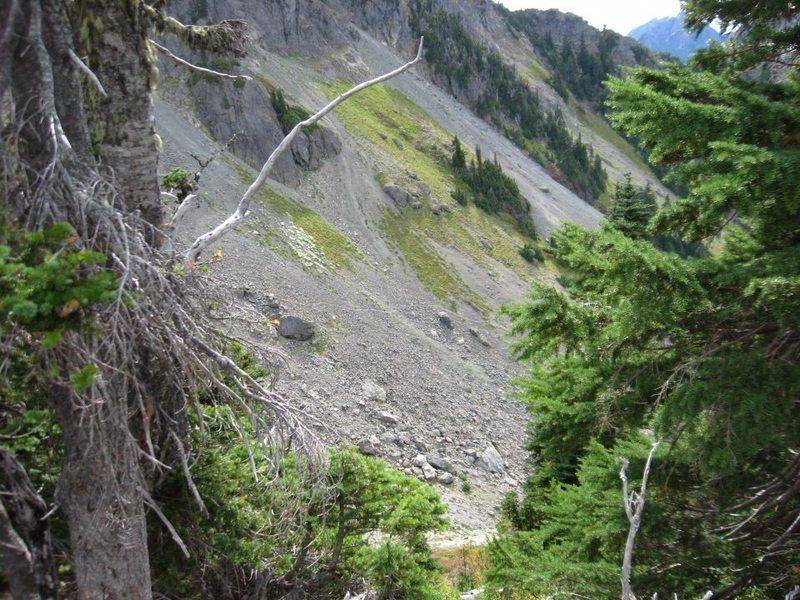
IMG_1200.JPG


The basin where the bull elk and his lady friends were hanging out -- the name is actually Elk Basin. We camped just above the basin one night after spending the afternoon trying to figure out how to get up on the ridge behind us and to the left in this picture.
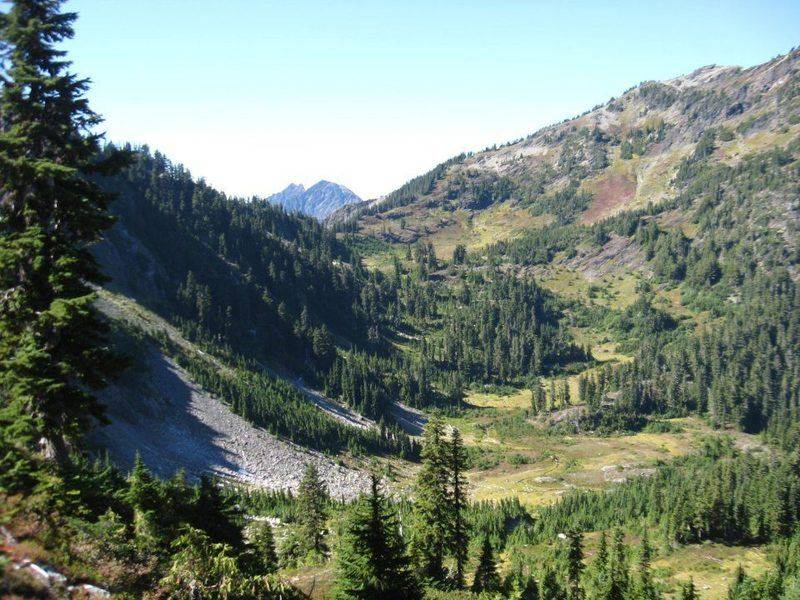
IMG_1193.JPG
 
  • Like
Likes   Reactions: Astronuc, Borek and Borg
Physics news on Phys.org
  • #722
Here's one taken Thursday, showing the area we were in. We had followed an elk trail that left us on a narrow ridge with no easy way of further progress, so we headed back down almost to the basin with the elk herd.
IMG_1194.JPG


The next morning (Friday), we headed up to this ridge, making our way up the extreme right edge of the picture, and following yet another elk trail. The ridge was probably about 500' vertical above where we camped. For scale, the smaller of the two snowfields in the middle of the picture is about 100' long (total guess, though).
IMG_1195.JPG
 
  • Like
Likes   Reactions: Astronuc
  • #723
Mark44 said:
Can you spot the trail?
Looks like it might be here...?

Elk Trail.jpg
 
  • Like
Likes   Reactions: Pepper Mint
  • #724
OCR said:
Looks like it might be here...?

No, the one I meant is more in the middle of the picture, and two segments of it are visible. What your arrow points to could be a different trail, or it could be the start of a creek.
 
  • #725
Mark44 said:
No, the one I meant is more in the middle of the picture, and two segments of it are visible.
Yeah, I'd thought about that, too... it's right about in the middle of that scree slope... ?
 
  • #726
Yes, and there's another segment that shows coming out of the strip of trees, and running into a shadow.
 
  • #727
Mark44 said:
Yes, and there's another segment...
:ok:... I see that.

BTW, nice pictures... pretty rough looking country, too.
 
  • #728
OCR said:
BTW, nice pictures...
Thanks!
OCR said:
pretty rough looking country, too.
Yep. It was pretty challenging, especially since we're not spring chickens. I just turned 72, and my buddy Steve just turned 63, and had a hip replacement four years ago.

There were basically three sections: hiking up a trail for 13 miles, going from 800' to about 5000'; 5 miles cross country (as in the pictures); 4 miles hiking down a trail from about 5300' down to 1600'. The most challenging part was figuring out the best way to get up to the ridge that led us to our lake destination. Once on the ridge, it was relatively smooth sailing. Another difficult part was trying to follow animal trails though about a one mile section of forest that burned six years ago.
 
  • Like
Likes   Reactions: Pepper Mint and OCR
  • #729
Nearly five years later since the last post.

http://www.rando-marche.fr/_f8262_561_escalade-pic-du-maupas-arete-ouest

http://www.rando-marche.fr/_f8262_561_escalade-pic-du-maupas-arete-ouest#gallery-3

Some spectacular scenery and hiking trails in the Pyrenees on the border of Spain and France.

This is near the area where experienced British hiker, Esther Dingley, disappeared. Her partner found her nine months later after a long search, called off during the winter due to heavy snow in the area. Dingley apparently fell.
https://www.msn.com/en-us/lifestyle/lifestyle-buzz/the-story-behind-the-disappearance-and-death-of-hiker-esther-dingley-who-vanished-on-a-solo-mountain-trek/ar-AANlhHJ
 
  • Like
Likes   Reactions: DennisN
  • #730
Hiking the three longest continuous hiking trails within one year.
https://www.latimes.com/california/...students-conquered-the-triple-crown-of-hiking

A thunderstorm in Colorado sent the two college students racing for cover down a mountain ridge. A black bear charged at one of them in Washington state. A wildfire’s flames spurred a harrowing escape in Northern California. And a raging infection waylaid the travelers for days in the Wyoming wilderness.

While much of the world was locked down during the first year of the pandemic, Jackson Parell and Sammy Potter were busy planning their escape. The Stanford University students had weathered shared Coronavirus infections and quarantines. And after spending months cooped up in online classrooms, they were itching to break free.

So they hatched an ambitious plan: to hike three of the nation’s most arduous trails — the Appalachian, Pacific Crest and Continental Divide — all in a single year.
 
  • Like
Likes   Reactions: DennisN
  • #731
Avalanche Awareness - mountain and backcountry safety.

Low-angle avalanche accidents like this require a convergence of snow conditions and human error, and they are common when there’s been heavy snowfall and strong winds after a period of dry and cold weather. In the Hoosier Pass slide, the hillside above the trail showed a layer of basal facets: incohesive snow that was formed early in the season. More recent storms buried that weak layer with feet of wind-deposited snow, and the conditions formed a huge slab on a leeward-facing slope above the trail.

https://www.outsideonline.com/outdoor-adventure/exploration-survival/avalanche-safety-hoosier-pass/
 

Similar threads

  • · Replies 23 ·
Replies
23
Views
3K
  • Poll Poll
  • · Replies 6 ·
Replies
6
Views
3K
  • Poll Poll
  • · Replies 2 ·
Replies
2
Views
2K