What is new with Koide sum rules?

  • Context: Graduate 
  • Thread starter Thread starter arivero
  • Start date Start date
  • Tags Tags
    Rules Sum
Click For Summary

Discussion Overview

The discussion centers on recent developments related to Koide sum rules in particle physics, particularly concerning quark masses and their relationships to lepton masses. Participants explore theoretical implications, empirical findings, and potential generalizations of the Koide relations, with references to recent papers and ongoing research in the field.

Discussion Character

  • Exploratory
  • Technical explanation
  • Debate/contested
  • Mathematical reasoning

Main Points Raised

  • Some participants note that recent work by Werner Rodejohann and He Zhang suggests that the quark sector does not need to match triplets following weak isospin, allowing for the construction of triplets from either massive or massless quarks.
  • Another researcher from the same institute has proposed a six-quark generalization of the Koide relations.
  • One participant discusses the relationship between the phases and masses of strange, charm, and bottom quarks compared to electron, muon, and tau leptons, suggesting a factor of three is significant.
  • There is a mention of Howard Georgi and Cecilia Jarlskog's work on mass relationships in grand unified theories (GUT), proposing that the factor of three may arise from color charge considerations.
  • Some participants speculate about the implications of charge and mass being linked, and how this might relate to gravity and strong forces in anti-de Sitter space (AdS).
  • One participant presents a mathematical formulation involving Koide triplets and discusses the orthogonality of Koide-Foot vectors, proposing a method to derive quark masses from lepton masses using the Koide sum rule.
  • There is a reference to Kartavtsev's generalization of the Koide relations, with a suggestion that including neutrinos may not diminish the validity of the formula.
  • Another participant mentions historical context and previous work related to the Koide relations and quark masses, indicating that some ideas have been explored since the late 1970s.

Areas of Agreement / Disagreement

Participants express a range of views, with some supporting the recent findings and generalizations of the Koide relations, while others raise questions and propose alternative interpretations. No consensus is reached on the implications or correctness of the various models discussed.

Contextual Notes

Participants acknowledge the complexity of the relationships between quark and lepton masses and the potential influence of various factors, such as color charge and electromagnetic corrections. Some mathematical steps and assumptions remain unresolved, and the discussion reflects ongoing exploration rather than established conclusions.

Who May Find This Useful

This discussion may be of interest to researchers and students in particle physics, particularly those focused on mass relations, theoretical models, and the implications of the Koide sum rules in contemporary physics research.
  • #331
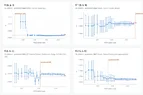
Time ago the hard printed edition of the pdf had a last page with an illustration of how the measures had evolved across editions. Remembering that, I have setup a similar evolution for the Koide tuples

https://arivero.github.io/pdghist/predictions.html

HIYzs7yXgAADPGB.webpHIYzzhvW0AAI7xB.webp
 
Last edited:
  • Like
Likes   Reactions: ohwilleke
Physics news on Phys.org
  • #332
ohwilleke said:
How do these papers fit into a larger research program of either of the authors?
Neither author has prior work on Koide that I can see. Hübner did some QCD and thus he knows QFT topics like renormalization schemes. Shulga worked on qubits from a physical rather than computational perspective (e.g. superconducting qubits), and maybe something there inspired his mechanism. But otherwise it seems a coincidence that two independent authors had their (very different) first Koide papers released on arxiv on the same day.
 
  • Like
Likes   Reactions: ohwilleke
  • #333
mitchell porter said:
it seems a coincidence that two independent authors had their (very different) first Koide papers released on arxiv on the same day.
Actually three :oldbiggrin: Mine was removed because just resending now causes an autodelete, even if the resend includes doi and journal. It is a sort of peak surely caused by the AI leverage, but still funny.
 
  • Haha
Likes   Reactions: ohwilleke
  • #334
I've been looking at the geometric origin of the phase ##\delta = \pi/12## (15°) that appears in the Koide parametrization for charged leptons.

In 4D Euclidean space, the rotation group decomposes as ##SO(4) \cong SU(2)+ \times SU(2)-## (isoclinic decomposition).
If you have a helical structure with ##C_3## symmetry (three-phase, 120° shifts), the closure condition at a nodal surface forces a total twist of ##\pi/2##.
The three-phase offset accounts for ##\pi/3## of that, leaving a residual of ##\pi/6##, distributed equally between the two isoclinic planes: ##\pi/12## per plane.

This gives ##\delta = \pi/12## as a geometric necessity, not a fit. The factor 3 between leptons (##\pi/12##) and quarks (##\pi/4 = 3 \times \pi/12##) would then correspond to the three color directions in the transverse space.

Has anyone explored the connection between the isoclinic decomposition of ##SO(4)## and the Koide phase? The coincidence ##\pi/12 \leftrightarrow 15°## seems too precise to be accidental, especially given that ##SO(4) \cong SU(2) \times SU(2)## is unique to 4 dimensions.
 
  • #335
π/12 appears as part of a formula for a Koide phase in the neutral leptons (see Brannen's "Koide Mass Formula for Neutrinos"), not charged leptons. The phase for the latter is 2/9 radians (no appearance of π). The neutrino masses are not known with great precision and so there is no empirical confirmation of this π/12 formula, the way there is for the 2/9 formula, it is more theory-driven. It would be interesting to try to adapt Shulga's mechanism, mentioned in immediately preceding posts, and which introduces and then cancels factors of π, to the Brannen neutrino phase. And it would be miraculous to find an "isoclinic" origin of 2/9!
 
  • #336
Thank you for the correction — you're right that the Brannen phase for charged leptons is 2/9 radians (no π), not π/12. I was imprecise.

Let me reformulate the observation more carefully.
The connection I'm exploring is indirect: in 4D Euclidean space with a three-phase helical structure (##C_3## symmetry, 120° shifts), the closure of the helix at a nodal surface forces the gradient perpendicular to the axis (total angle ##\pi/2##).
The three-phase offset accounts for ##\pi/3## of that rotation. The residual ##\pi/6##, distributed equally between the two isoclinic planes of ##SO(4) \cong SU(2)_+ \times SU(2)_-##, gives ##\pi/12## per plane.

This ##\pi/12## doesn't claim to be the Brannen phase. Rather, it enters the coherent closure condition as ##7\pi/12 = 2\pi/3 - \pi/12## (the target phase for counter-rotating closure). When this closure is imperfect (small mismatch ##\delta##), the forced precession onto one of the three ##C_3## directions introduces a correction of the form ##\sqrt{m_i} \propto 1 + A\cos(\theta_0 + 2\pi(i{-}1)/3)##, and the trifase identity ##\sum_{\tau=0}^{2}\cos^2(\theta_0 + 2\pi\tau/3) = 3/2## then gives ##K = 3/2## exactly independently of ##A## and ##\theta_0##.

So the question I should have asked is: has anyone explored the isoclinic decomposition of ##SO(4)## as the geometric origin of the closure condition from which a Koide-type parametrization can emerge?
The factor 3 between leptons and quarks would then correspond to the number of transverse directions (color), not to the phase itself.

Regarding Shulga's mechanism, interesting. His compact dimension with antiperiodic boundary conditions and the Casimir-like shift producing 2/9 is structurally reminiscent of a closure condition on a cycle.
I'd be curious whether his "a-field" dressing could be reinterpreted as a frame connection on a helical structure.
 
  • #337
they are a lot of elegant results that are just generic of the theory of quadrics. Basically it is possible, except for the integrality, to repreoduce all the symmetries of https://en.wikipedia.org/wiki/Markov_number Markow trees of tuples, find the critical coefficient where the atractor of the tree becomes fractal, look for accumulation points. A loot of very pretty geometry, but that really one can do with different kinds of quadrics.
 
  • #338
Your post seems to be related to your Zenodo papers. I’d like to remind you that these questions are okay as stand-alone questions but not if they bring in your unpublished Zenodo papers. PF explicitly state that we only discuss peer-reviewed papers from reputable journals. Sadly, zenodo does not count as either a published paper nor as a reputable journal.

If the discussion does extend into your Zenodo papers then the PF mentors will be forced to delete your relevant threads and give you a personal speculation warning or personal theory site ban.

Please take some time to read our site global guidelines.
 
  • Like
Likes   Reactions: pines-demon
  • #339
Noted. My posts in this thread discuss the isoclinic decomposition of SO(4) and its relation to closure conditions, standard differential geometry. No personal papers are referenced or needed to follow the argument.
 
  • Like
Likes   Reactions: jedishrfu
  • #340
Linking the question of Pavani with mine, the point is that here there is a fine thread for Mathematics that somehow is not fully exposed in online forums: to characterise the solutions of permutation invariant equations Q(x_1,x_2,...x_n)=0. Markov's
[tex]x^2 + y^2 + z^2 - K x y z = 0[/tex]
have been very studied because it has Diophante solutions when K=3.
Koide generalisations
[tex](x^2 + y^2 + z^2 )+ K \times (xy + yz + zx) = 0[/tex]
are fine objects too, but they have no such elegant diophantine solutions and it is not easy to find studies going concrete with this, or at least digitised ones. This history goes as deep as Newton and Girard, and of course linked to the problem of having all the solutions as roots of a single cubic equation. Pure maths, anyway.
 
Last edited:
  • Like
Likes   Reactions: Roberto Pavani

Similar threads

  • Poll Poll
  • · Replies 12 ·
Replies
12
Views
6K
  • · Replies 12 ·
Replies
12
Views
6K
  • · Replies 0 ·
Replies
0
Views
406
  • · Replies 62 ·
3
Replies
62
Views
12K
  • · Replies 1 ·
Replies
1
Views
2K
  • · Replies 4 ·
Replies
4
Views
2K
  • · Replies 2 ·
Replies
2
Views
3K
  • · Replies 3 ·
Replies
3
Views
2K
  • · Replies 4 ·
Replies
4
Views
4K
Replies
7
Views
2K