Two spaceships in opposite direction at near c
- Context: Graduate
- Thread starter stu dent
- Start date
-
- Tags
- Direction
Join the discussion
Registration is free. Ask a follow-up in this thread, or start your own.
56 replies · 22K views
Physics news on Phys.org
Science Advisor
Gold Member
- 5,122
- 150
Ok, here's the one for the black spaceship's IRF:K^2 said:It might be useful to have the same diagram in IRF of each of the ships as well.
Notice that the blue spacestation is now traveling at -0.8c and the red spaceship is traveling at -0.9756c. The time dilation for the spaceship is 1.6667 and for the red spaceship is 4.5556. The light signal, emitted by the red spaceship at its one-minute mark, travels in this IRF at c to the black spaceship at its nine-minute mark, just like in the original IRF.
And here's the one for the red spaceship's IRF:
The blue spacestation is traveling at 0.8c and the black spaceship is traveling at 0.9756c. The time dilation for the spaceship is 1.6667 and for the black spaceship is 4.5556. The light signal, emitted by the red spaceship at its one-minute mark, travels in this IRF at c to the black spaceship at its nine-minute mark, just like in the other two IRF's.
We could also pick any other IRF to show all the same events and they would all be in agreement. There is nothing special about any particular IRF, even one for which any observer is at rest--what we call its own IRF. That's the whole point of Special Relativity.
Attachments


Science Advisor
- 2,470
- 33
Of course. This just happens to be a very nice illustration to point to. It shows, visually, how the velocities add, how the times of events are different in each coordinate system, and how despite that, the proper time for each intercept remains the same. It'll be nice to point to if anybody else asks related questions. Thanks for taking the time.ghwellsjr said:We could also pick any other IRF to show all the same events and they would all be in agreement. There is nothing special about any particular IRF, even one for which any observer is at rest--what we call its own IRF. That's the whole point of Special Relativity.
bobc2
- 842
- 7
ghwellsjr said:Ok, here's the one for the black spaceship's IRF:
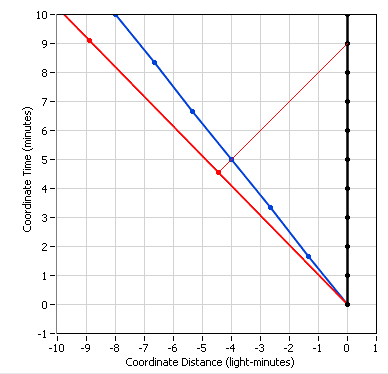
Notice that the blue spacestation is now traveling at -0.8c and the red spaceship is traveling at -0.9756c. The time dilation for the spaceship is 1.6667 and for the red spaceship is 4.5556. The light signal, emitted by the red spaceship at its one-minute mark, travels in this IRF at c to the black spaceship at its nine-minute mark, just like in the original IRF.
And here's the one for the red spaceship's IRF:
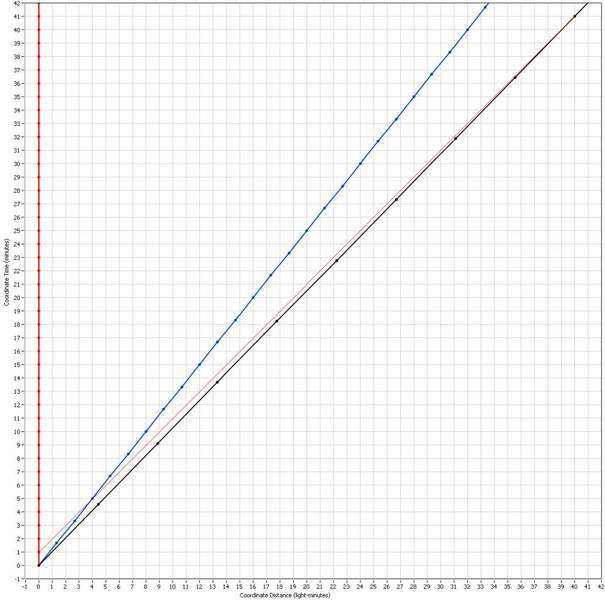
The blue spacestation is traveling at 0.8c and the black spaceship is traveling at 0.9756c. The time dilation for the spaceship is 1.6667 and for the black spaceship is 4.5556. The light signal, emitted by the red spaceship at its one-minute mark, travels in this IRF at c to the black spaceship at its nine-minute mark, just like in the other two IRF's.
We could also pick any other IRF to show all the same events and they would all be in agreement. There is nothing special about any particular IRF, even one for which any observer is at rest--what we call its own IRF.
Great job witht the space-time diagrams, ghwellsjr!
ghwellsjr said:That's the whole point of Special Relativity.
That may be a little bit of an overstatement, but the intended spirit of it works fine, and you did make very good points.
Vandam
- 126
- 0
Gwelsjr,
I really appreciate your effort drawing diagrams. Good job.
Unfortunately I am not too happy with your text.
The way you explain it is as if the time dilation occurs due to the further dots pacing of clockticks on the clock worldline.
There is also a danger of interpreting your diagrams as if timedilation happens because of the taking into account of the lightbeams.
Let me put it this way:
You have drawn three different diagrams, but to see how timedilation works it is better to look at one diagram only with more information on it. I did it for you:
(For simplicity I omited what red says):
Blue notices black (and red) time dilation because when his blue clock ticks 15 (not 13 as you wrote;)), in his BLUE frame (=3D spaceworld) the black and red clock show 9.
So far so good.
Now what black says:
Black notices time dilation of blue time because "when his black clock ticks 9 seconds, IN HIS BLACK FRAME (=3D spaceworld) the blue clock is only at 5,399 sec. (9 / 1,6667).
And still IN HIS BLACK 3D world the blue 'time dilation' means: red clock is only at 1,975 sec (9 / 4,5556).
Here you see clearly that the 'slowing down' of the blue and red clock have NOTHING to with the further spacing of blue or red dots relative to the black dots (red dots are equally spaced as black, blue dots are less spaced relative to the black ones!).
On a Loedel diagram (I'm now too lazy too make one) you would see that the time dilation has nothing to do with the further spacing of clock ticks on the worldline of a clock. Time dilation is about relativity of simultaneity. (And that's only possible if you consider all events out there as observer independent entities time indications included (block universe).
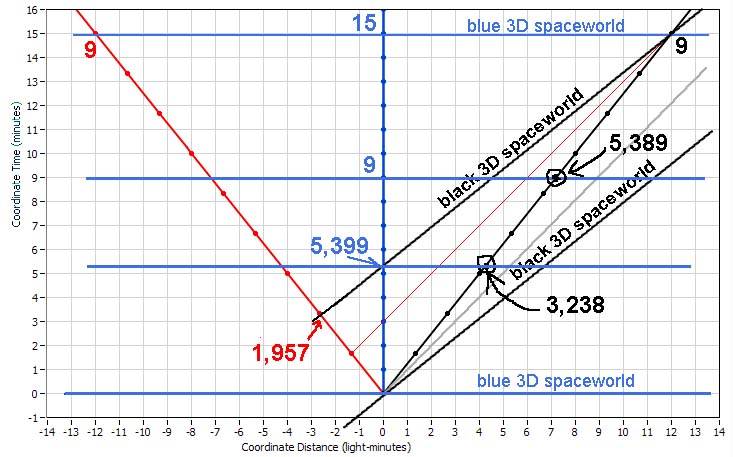
Just in case you wonder what the reciprocal time dilation is for blue at 9 (see sketch below):
in blue 3D space black clock is at 5,389.
In blue 3D space when blue clock is at 5,399 the black clock is at 3,238 (= 5,399 : 1,667 ).
3D cuts through 4D block spacetime!
Mentor
- 37,082
- 16,125
He said "compared to coordinate time", which is completely correct.Vandam said:The way you explain it is as if the time dilation occurs due to the further dots pacing of clockticks on the clock worldline.
No, his statement is still correct. The black dots are the most closely spaced "compared to coordinate time" for black. The blue dots are further spaced and the red dots even further. "Compared to coordinate time" measures only distance normal to the lines of simultaneity, what you have labeled "spaceworld".Vandam said:Here you see clearly that the 'slowing down' of the blue and red clock have NOTHING to with the further spacing of blue or red dots relative to the black dots (red dots are equally spaced as black, blue dots are less spaced relative to the black ones!).
This is also true, but doesn't make ghwellsjr's statements wrong. The relativity of simultaneity is what changes the meaning of "compared to coordinate time" for the different frames.Vandam said:On a Loedel diagram (I'm now too lazy too make one) you would see that the time dilation has nothing to do with the further spacing of clock ticks on the worldline of a clock. Time dilation is about relativity of simultaneity.
Vandam
- 126
- 0
DaleSpam said:He said "compared to coordinate time", which is completely correct.
No, his statement is still correct. The black dots are the most closely spaced "compared to coordinate time" for black. The blue dots are further spaced and the red dots even further. "Compared to coordinate time" measures only distance normal to the lines of simultaneity, what you have labeled "spaceworld".
This is also true, but doesn't make ghwellsjr's statements wrong. The relativity of simultaneity is what changes the meaning of "compared to coordinate time" for the different frames.
I only wanted to point out there was a danger of misinterpreting his diagrams and/or text because of the further spacing of the dots on the worldline, a feature of Minkowski diagrams. I never said his statements were 'wrong'. The 'further spacing of the dots relative to coordinate time' would still be valid if the spacing of the dots on the worldline would be equal. That's my point. (And that's why I prefer Loedell diagrams where possible).
bobc2
- 842
- 7
Vandam said: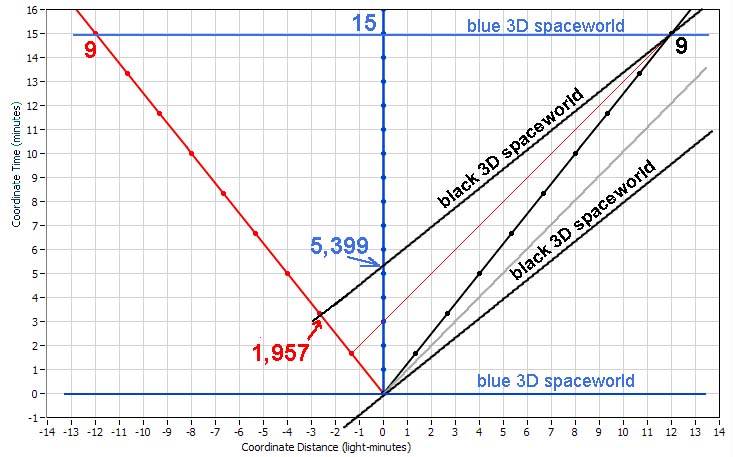
Gwelsjr,
I really appreciate your effort drawing diagrams. Good job.
Unfortunately I am not too happy with your text.
The way you explain it is as if the time dilation occurs due to the further dots pacing of clockticks on the clock worldline.
There is also a danger of interpreting your diagrams as if timedilation happens because of the taking into account of the lightbeams.
Let me put it this way:
You have drawn three different diagrams, but to see how timedilation works it is better to look at one diagram only with more information on it. I did it for you:
(For simplicity I omited what red says):
Blue notices black (and red) time dilation because when his blue clock ticks 15 (not 13 as you wrote;)), in his BLUE frame (=3D spaceworld) the black and red clock show 9.
So far so good.
Now what black says:
Black notices time dilation of blue time because "when his black clock ticks 9 seconds, IN HIS BLACK FRAME (=3D spaceworld) the blue clock is only at 5,399 sec. (9 / 1,6667).
And still IN HIS BLACK 3D world the blue 'time dilation' means: red clock is only at 1,975 sec (9 / 4,5556).
Here you see clearly that the 'slowing down' of the blue and red clock have NOTHING to with the further spacing of blue or red dots relative to the black dots (red dots are equally spaced as black, blue dots are less spaced relative to the black ones!).
On a Loedel diagram (I'm now too lazy too make one) you would see that the time dilation has nothing to do with the further spacing of clock ticks on the worldline of a clock. Time dilation is about relativity of simultaneity. (And that's only possible if you consider all events out there as observer independent entities time indications included (block universe).
Just in case you wonder what the reciprocal time dilation is for blue at 9 (see sketch below):
in blue 3D space black clock is at 5,389.
In blue 3D space when blue clock is at 5,399 the black clock is at 3,238 (= 5,399 : 1,667 ).
3D cuts through 4D block spacetime!
Very impressive insight, Vandam. I hadn't noticed that. Thanks for that observation. I think it is very good to point this out. You do a very good job of keeping the focus on the fundamental concept. Too often we get involved with the numbers and miss the underlying concept.
Vandam
- 126
- 0
bobc2 said:That may be a little bit of an overstatement, but the intended spirit of it works fine, and you did make very good points.
Bob, I was wondering about ghwellsjr statement too...
I think we might have the same thoughts about this, but to me the whole point about the coordinate systems is that whatever coordinate system you use (apply to the outside observer independent events) then SR's 'relativity of simultaneity' shows you that reality out there is a 4D block spacetime/universe. But this is not allowed to be discussed here.

Science Advisor
Gold Member
- 5,122
- 150
Thanks.Vandam said:...
Gwelsjr,
I really appreciate your effort drawing diagrams. Good job.
The feeling is mutual.Vandam said:Unfortunately I am not too happy with your text.
Time dilation occurs due to the speed of a clock in a given Inertial Reference Frame (IRF). Just as speeds of objects are different in different IRF's, so are time dilations. The time dilations for each of the space ships/stations in the three IRF's I drew are different. I illustrate the time dilation by marking off equal ticks of each observer's clock with dots along the path of each observer. I think it's a great way to explain it and I think it's very easy to see and comprehend for a newby which is what I was trying to do. Until some newbies comment about this, we'll never know if I'm right or wrong.Vandam said:The way you explain it is as if the time dilation occurs due to the further dots pacing of clockticks on the clock worldline.
Are you talking about Relativistic Doppler?Vandam said:There is also a danger of interpreting your diagrams as if timedilation happens because of the taking into account of the lightbeams.
I started out drawing just one diagram, not to show anything about time dilation but rather to show how light travels at c, not 2c like jartsa was promoting in post #27 as a way to explain SR to newbies. You need to read my first response to him in post #29 to understand the context of my first diagram in post #30.Vandam said:Let me put it this way:
You have drawn three different diagrams, but to see how timedilation works it is better to look at one diagram only with more information on it.
I later drew two more diagrams in response to K^2's request in post #31. In each of these, the signal going from the red spaceship at his 1-minute mark is received by the black spaceship at his 9-minute mark, even though the light signal takes a varying amount of time in each IRF but still travels at c in each of them and not with respect to the speeds of the spaceships. This was the whole point of these diagrams in support of my comment to jartsa in post #29:
ghwellsjr said:In an Inertial Reference Frame (IRF) in which two spaceships are traveling in opposite directions at nearly the speed of light and one of them sends a light signal to the other one, the light signal travels at c relative to the IRF, not relative to either spaceship.
First off, I did not make a mistake with regard to 13 versus 15. I was not talking about time dilation. I was talking about how long it took for the signal to get from the red spaceship to the black spaceship at the speed of light and I said "it took over 13 minutes according to the IRF". In the other two IRF's it took 4.5 minutes and 40 minutes. Light is not time dilated. I was not talking about time dilation. Please read my comments carefully before responding to them.Vandam said:(For simplicity I omited what red says):
Blue notices black (and red) time dilation because when his blue clock ticks 15 (not 13 as you wrote;)), in his BLUE frame (=3D spaceworld) the black and red clock show 9.
So far so good.
And now to my main point: The blue spacestation cannot notice the black (or red) spaceship's time dilation. Time dilation is not observable by anyone anywhere anytime. It is a calculation related to the speed of an object in a given IRF. If it were ever observable, then the observer would know which arbitrary IRF we were using. Or, more significantly, if it were observable, then we could identify the an absolute ether rest state and all of Special Relativity would be out the window.
Again, the black spaceship cannot notice the time dilation of the blue spacestation for the reasons I stated before.Vandam said:Now what black says:
Black notices time dilation of blue time because "when his black clock ticks 9 seconds, IN HIS BLACK FRAME (=3D spaceworld) the blue clock is only at 5,399 sec. (9 / 1,6667).
And still IN HIS BLACK 3D world the blue 'time dilation' means: red clock is only at 1,975 sec (9 / 4,5556).
Here you see clearly that the 'slowing down' of the blue and red clock have NOTHING to with the further spacing of blue or red dots relative to the black dots (red dots are equally spaced as black, blue dots are less spaced relative to the black ones!).
Just because I drew three IRF's in which one of the observer's was a rest, you should not extapolate that observer's observations to what is assigned by the IRF, such as the time dilation related to the speed of the other objects. I could just as easily have drawn another diagram in which none of the observers was a rest, for example one in which the black spaceship and the blue spacestation are traveling at the same speed in opposite directions. Then how would you explain time dilation?
I wasn't wondering and I have no idea what your diagram is attempting to convey. Maybe a newby can explain it to me.Vandam said:On a Loedel diagram (I'm now too lazy too make one) you would see that the time dilation has nothing to do with the further spacing of clock ticks on the worldline of a clock. Time dilation is about relativity of simultaneity. (And that's only possible if you consider all events out there as observer independent entities time indications included (block universe).
Just in case you wonder what the reciprocal time dilation is for blue at 9 (see sketch below):
in blue 3D space black clock is at 5,389.
In blue 3D space when blue clock is at 5,399 the black clock is at 3,238 (= 5,399 : 1,667 ).
3D cuts through 4D block spacetime!
Look, the reciprocal time dilation is very easily illustrated by looking at each of the IRF's for each observer and my text succinctly states what it is. For example, in the first IRF, blue's rest frame (post #30), I state that gamma for red and black is 1.6667 and I show their dots spaced by that amount with respect to the coordinates which also happens to be with respect to blue since blue is stationary in this IRF. Then if you go to the next IRF, black's rest frame (the first small IRF in post #32), I state in the text that the time dilation for the spacestation (incorrectly identified as the spaceship) is 1.6667 and you can see the exact same spacing of the blue dots in this IRF as you do for the black dots in the first IRF. You can do the same thing for each of the other pairs of space ships/station.
Science Advisor
Gold Member
- 5,122
- 150
Each IRF presents a different set of coordinates for each event. The time coordinate defines simultaneity.Vandam said:Bob, I was wondering about ghwellsjr statement too...
I think we might have the same thoughts about this, but to me the whole point about the coordinate systems is that whatever coordinate system you use (apply to the outside observer independent events) then SR's 'relativity of simultaneity' shows you that reality out there is a 4D block spacetime/universe. But this is not allowed to be discussed here.
For example, in the first IRF (post #30), minute five for the blue spacestation is simultaneous with minute three for the black and red spaceships. However in the other two IRF's (post #32) these three events occur at different coordinate times and so are not simultaneous. But minute three for the blue spacestation is simultaneous with minute five for one or the other of the two spaceships in these other two IRF's.
What are you guys concerned with?
Vandam
- 126
- 0
My point was: I think it is not a great way to show time dilation by stressing the fact that the dots are further spaced on the worldline (unfortunately that's a minkoski fiagram feature)ghwellsjr said:Thanks.
The feeling is mutual.
Time dilation occurs due to the speed of a clock in a given Inertial Reference Frame (IRF). Just as speeds of objects are different in different IRF's, so are time dilations. The time dilations for each of the space ships/stations in the three IRF's I drew are different. I illustrate the time dilation by marking off equal ticks of each observer's clock with dots along the path of each observer. I think it's a great way to explain it
It's far more correct to explain time dilation by means which clock indication (event) pops up in a selected frame (3D space), whether the dots are spaced or not is besides the point. (That's why a loedel diagram is beter to show time dilation.)
The time dilation occurs because the worldlines take a different direction in 4D spacetime, and hence the lines of simultaneity take other directions...
If you talk about gamma and showing time diltation by means of further spacing of dots on a worldline, I do not see why I may not address the issue of time dilation.and I think it's very easy to see and comprehend for a newby which is what I was trying to do. Until some newbies comment about this, we'll never know if I'm right or wrong.
Are you talking about Relativistic Doppler?
I started out drawing just one diagram, not to show anything about time dilation but rather to show how light travels at c, not 2c like jartsa was promoting in post #27 as a way to explain SR to newbies. You need to read my first response to him in post #29 to understand the context of my first diagram in post #30.
I later drew two more diagrams in response to K^2's request in post #31. In each of these, the signal going from the red spaceship at his 1-minute mark is received by the black spaceship at his 9-minute mark, even though the light signal takes a varying amount of time in each IRF but still travels at c in each of them and not with respect to the speeds of the spaceships. This was the whole point of these diagrams in support of my comment to jartsa in post #29:First off, I did not make a mistake with regard to 13 versus 15. I was not talking about time dilation.
I was talking about how long it took for the signal to get from the red spaceship to the black spaceship at the speed of light and I said "it took over 13 minutes according to the IRF". In the other two IRF's it took 4.5 minutes and 40 minutes. Light is not time dilated. I was not talking about time dilation. Please read my comments carefully before responding to them.
Time dilation is not observable?And now to my main point: The blue spacestation cannot notice the black (or red) spaceship's time dilation. Time dilation is not observable by anyone anywhere anytime. It is a calculation related to the speed of an object in a given IRF. If it were ever observable, then the observer would know which arbitrary IRF we were using. Or, more significantly, if it were observable, then we could identify the an absolute ether rest state and all of Special Relativity would be out the window.
I do not get your point at all.Again, the black spaceship cannot notice the time dilation of the blue spacestation for the reasons I stated before.
Just because I drew three IRF's in which one of the observer's was a rest, you should not extapolate that observer's observations to what is assigned by the IRF, such as the time dilation related to the speed of the other objects. I could just as easily have drawn another diagram in which none of the observers was a rest, for example one in which the black spaceship and the blue spacestation are traveling at the same speed in opposite directions. Then how would you explain time dilation?
I wasn't wondering and I have no idea what your diagram is attempting to convey. Maybe a newby can explain it to me.
Look, the reciprocal time dilation is very easily illustrated by looking at each of the IRF's for each observer and my text succinctly states what it is. For example, in the first IRF, blue's rest frame (post #30), I state that gamma for red and black is 1.6667 and I show their dots spaced by that amount with respect to the coordinates which also happens to be with respect to blue since blue is stationary in this IRF. Then if you go to the next IRF, black's rest frame (the first small IRF in post #32), I state in the text that the time dilation for the spacestation (incorrectly identified as the spaceship) is 1.6667 and you can see the exact same spacing of the blue dots in this IRF as you do for the black dots in the first IRF. You can do the same thing for each of the other pairs of space ships/station.
Maybe it does make sense mathematically. I was thinking physics, what's out there to be measured by any coordinate systems. Maybe your diagrams are only mathematical models, mine a representation of what's out there. But I know that defending an observer independent reality is not appreciated here...
bobc2
- 842
- 7
Vandam, I feel like your point was very well placed and fully appropriate to the discussion. Not to take away from the basic point ghwells was making--that was a good response to the original post. But, you certainly brought additional valuable insight to the discussion. Your emphasis on relativity of simultaineity really needed to be presented. It's always good to put the discussion in the context of the foundational physical concepts available to us with special relativity theory.
Science Advisor
Gold Member
- 5,122
- 150
Bob, why did you think there needed to be an additional emphasis on relativity of simultaneity after I explained this fully in post #41 (as if it needed any further explanation):bobc2 said:Vandam, ... Your emphasis on relativity of simultaineity really needed to be presented. It's always good to put the discussion in the context of the foundational physical concepts available to us with special relativity theory.
ghwellsjr said:Each IRF presents a different set of coordinates for each event. The time coordinate defines simultaneity.
For example, in the first IRF (post #30), minute five for the blue spacestation is simultaneous with minute three for the black and red spaceships. However in the other two IRF's (post #32) these three events occur at different coordinate times and so are not simultaneous. But minute three for the blue spacestation is simultaneous with minute five for one or the other of the two spaceships in these other two IRF's.
What are you guys concerned with?
bobc2
- 842
- 7
ghwellsjr said:Bob, why did you think there needed to be an additional emphasis on relativity of simultaneity after I explained this fully in post #41 (as if it needed any further explanation):
You did a good job, ghwellsjr. Your comparative time increments in the three inertial reference frames was a good direct reponse to the confusion with the 2c expressed in the earlier posts. I hope my original post reinforced the correctness of your analysis, particularly with your illustrations using the space-time diagrams. There didn't really need to be any further explanation on that point. I simply acknowledged that Vandam's additional presentation that included the hyperplanes of simultaneity was helpful as well. I think the supplemental sketches provided by Vandam, showing graphically the hyperplanes of simultaneity--with the actual time dilation values shown on the sketches, provided additional helpful information. But, again, I have no quarrel with your response to the prior posts.
Beyond that I thought perhaps you may have over emphasized the significance of the derived basis of the "measurement" of time dilation:
"And now to my main point: The blue spacestation cannot notice the black (or red) spaceship's time dilation. Time dilation is not observable by anyone anywhere anytime. It is a calculation related to the speed of an object in a given IRF. If it were ever observable, then the observer would know which arbitrary IRF we were using. Or, more significantly, if it were observable, then we could identify the an absolute ether rest state and all of Special Relativity would be out the window."
Last edited:
bobc2
- 842
- 7
p.s. Vandam also made the very significant observation that for the red and black guys going in opposite directions with the same relativistic speed, the spacing of the minute marks on the two time axes are the same. So, you could not use the spacings to tell you anything at all about time dilation. His emphasis of the use of the hyperplanes of simultaneity was quite appropriate. The hyperplanes of simultaneity are always different in the 4-dimensional universe for any two observers moving with respect to each other. And their space-time diagram minute mark spacings may or may not be the same, depending on the choice of charts used in the diagram. Penrose highlights this even for two observers just walking past each other (his Andromeda Paradox).
Science Advisor
Gold Member
- 5,122
- 150
When I first read this, I was amazed that you could make such a statement. I explained how time dilation works in post #29:bobc2 said:p.s. Vandam also made the very significant observation that for the red and black guys going in opposite directions with the same relativistic speed, the spacing of the minute marks on the two time axes are the same. So, you could not use the spacings to tell you anything at all about time dilation. His emphasis of the use of the hyperplanes of simultaneity was quite appropriate.
And I illustrated it in post #30 with further explanation:ghwellsjr said:...However, since the spaceships are traveling at a very high speed in the IRF, their clocks are running very slowly compared to the coordinate time of the IRF...
Think of speeds relative to an IRF, not relative to observers and you'll have no problem. ...
So how could you say my diagram does not show anything at all about time dilation? Of course the spacing of the dots for the red and black spaceships is the same. That's because, as you said, they are traveling at the same speed and the time dilation is based on the speed.ghwellsjr said:I've drawn a diagram to show what happens in an IRF with two spaceships traveling in opposite directions at 0.8c. They both leave the blue spacestation at time 0 when they all set their clocks to 0. The dots mark off one-minute intervals for each spaceship and the spacestation. At 0.8c, gamma is 1.6667 so the dots for the spaceships are farther apart by that amount compared to the coordinate time...
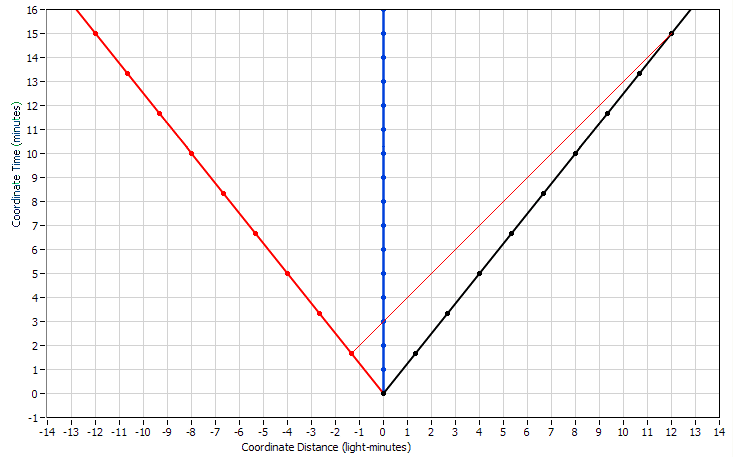
But then it finally dawned on me. Apparently you and Vandam take the viewpoint that time dilation is calculated based on the relative speed between the clock and the observer, not between the clock and the coordinate time of the IRF.
When I said in another thread:
Vandam responded by saying:ghwellsjr said:For example, let's say you are moving in an IRF at some high speed.
So apparently he and maybe you, believe that time dilation cannot be calculated based on the speed of an observer/clock in an IRF, correct? Is this why you said that my first graph did not show anything at all about time dilation?Vandam said:You never move in your IRF. Never.
Last edited:
Vandam
- 126
- 0
Ghwellsjr,
You show us 3 sketches but apparently have big problems of reading my sketch of post #35.
No offence, but do you know how to read a 4D Minkowski spacetime diagram?
I never said your IRF charts are wrong. But if you would be able to read your 3 charts all in one spacetime diagram only, then you would immediately see what's really going on, in 4D.
You show us 3 sketches but apparently have big problems of reading my sketch of post #35.
No offence, but do you know how to read a 4D Minkowski spacetime diagram?
I never said your IRF charts are wrong. But if you would be able to read your 3 charts all in one spacetime diagram only, then you would immediately see what's really going on, in 4D.
Science Advisor
Gold Member
- 5,122
- 150
If you are asking about diagrams promoting the block universe concept like the ones on the first page of this thread, I already gave you a thorough answer here. But if you are asking about legitimately drawn Minkowski diagrams with correct labeling (not your sketches on my graphs in post #35) which are nothing more than combining two or three IRF's like the ones I drew on this thread, then, yes, I can read those but I think they are much more difficult for a newby to understand because of the multiple axes that are combined on one chart.Vandam said:Ghwellsjr,
You show us 3 sketches but apparently have big problems of reading my sketch of post #35.
No offence, but do you know how to read a 4D Minkowski spacetime diagram?
Then why did you feel the need to mark one of them up along with complaints about my text? If you had it to do all over again, would you have not made post #35? Will you promise to not make negative comments about my charts or explanations again, unless I make a legitimate mistake?Vandam said:I never said your IRF charts are wrong.
This is where the problem lies. You believe that combining the information from three separate charts on to one diagram creates or reveals additional meaning about reality.Vandam said:But if you would be able to read your 3 charts all in one spacetime diagram only, then you would immediately see what's really going on, in 4D.
Vandam
- 126
- 0
ghwellsjr said:This is where the problem lies. You believe that combining the information from three separate charts on to one diagram creates or reveals additional meaning about reality.
You simply do not get it. Of course there is more to reality than different observations (charts)!
Let me give you an analogy.
A draftsman showes you a bunch of technical drawings. Lots of sheets of paper. Two-dimensional drawings.
You say: "Awesome! 2D drawings is what architecture is about. Nothing else."
An architect has a glimp at it and says:
"The 2D drawings are fine, but... they are all 'only" sections and elevations/façades of a building. The building is reality, your 2D drawings only observations. Let me quickly sketch you the 3D perspective of the house so that you can grasp what you are working on."
Draftsman reaction: "All this 3D stuff is ridiculous.'
... Sigh.
But what then happens is even more pathetic: the more the architect explains how it all works, the more the draftsman holds tight on his 2D drawings. But that's normal behavior. Draftsmen are very good technical experts, they protect what they are good at. But they are, or become very seldom good architects.
Oh yes, sorry,... architects are probably philosophers, artistic lunatics. Isn't it?
(By the way: our two eyes capture 2D images. 2D observations. Are you going to tell me there is no 3D building out there to be observed?)
Science Advisor
Gold Member
- 5,122
- 150
Let me give you an analogy: A movie maker hands you an old 2D movie (on film). Instead of watching the movie using a projector and a screen, you cut the film into the individual frames and then you stack them one next to the other and you claim that you have discovered the 3D reality of the movie and anyone who actually watches the movie is stuck in a 2D world.
Vandam
- 126
- 0
The difference is that I give you an explanation where the 2D drawings come from. You do not tell me where de 2D frames come from.
Science Advisor
- 2,470
- 33
Vandam, the 4D space contains no information that's lost in a 2D section here. All of the physics of SR can be described in arbitrary N+1 space. You get identical time-dilation and space-contraction effects with absolutely identical formulae and absolutely identical explanations for any natural N. This is a 2D problem. One time and one coordinate.
Mentor
- 37,082
- 16,125
Vandam, as you admitted in 37 both ghwellsjr's text and drawings are correct. The fact that they don't conform to your preferences is a matter of little consequence.
- 32,819
- 4,724
Thread is starting to veer away from physics. It is now done.
Zz.
Zz.
Similar threads
Undergrad Solving Special Relativity Problem w/ Two Spaceships
- universal2013
- · Replies 3 ·
- Special and General Relativity
- Replies
- 3
Graduate Relative velocity of two spaceships passing each other
- inkskin
- · Replies 1 ·
- Special and General Relativity
- Replies
- 1
Undergrad If two spaceships are moving toward each other at the 0,9c
- eldrun
- · Replies 4 ·
- Special and General Relativity
- Replies
- 4
High School Travel Faster than Light? Opposite Direction Objects
- mav_sd_
- · Replies 1 ·
- Special and General Relativity
- Replies
- 1
Graduate If Two Spaceships close at a speed of 1.4c ?
- Lightheavyw8t
- · Replies 35 ·
- Special and General Relativity
- Replies
- 35
Undergrad Speed of two spaceships relative to each other observed by an earth observer
- salmise
- · Replies 3 ·
- Special and General Relativity
- Replies
- 3
Graduate Two beams of light traveling in opposite directions=2c
- abbott287
- · Replies 13 ·
- Special and General Relativity
- Replies
- 13
Graduate Twins flying at the speed of light in opposite directions
- kinimod
- · Replies 68 ·
- Special and General Relativity
- Replies
- 68
Graduate Two Spaceships, .90c - Why No Faster Than Light?
- Somedude99
- · Replies 38 ·
- Special and General Relativity
- Replies
- 38
Graduate Speed of light from two spaceships moving toward and away from Earth
- keepitmoving
- · Replies 1 ·
- Special and General Relativity
- Replies
- 1