Central NZ Earthquakes in Cook Strait: A Complex Tectonic Region

  • Thread starter Thread starter davenn
  • Start date Start date
Click For Summary
SUMMARY

The recent seismic activity in the Cook Strait region of New Zealand has been characterized by a series of earthquakes, including a significant M6.5 event. This area is a complex tectonic zone where oblique slip transitions to a subduction zone, impacting both the North and South Islands. The USGS moment tensor analysis supports the identification of a NW-SE striking fault. The region has experienced over 300 aftershocks following the main events, highlighting ongoing tectonic activity.

PREREQUISITES
  • Understanding of tectonic plate interactions, specifically subduction and oblique slip.
  • Familiarity with seismic event magnitudes and their implications.
  • Knowledge of the geological features of New Zealand, including the Southern Alps and Cook Strait.
  • Experience with seismographic data interpretation and analysis.
NEXT STEPS
  • Research the geological history of the Southern Alps and its formation through tectonic processes.
  • Study the mechanics of subduction zones and their role in earthquake generation.
  • Learn about the USGS moment tensor analysis and its applications in understanding seismic events.
  • Explore the impact of tectonic activity on landforms and ecosystems in New Zealand.
USEFUL FOR

Geologists, seismologists, and anyone interested in understanding the tectonic dynamics of New Zealand, particularly those studying earthquake patterns and their geological implications.

davenn
Science Advisor
Gold Member
Messages
9,715
Reaction score
11,713
hi Gang :)

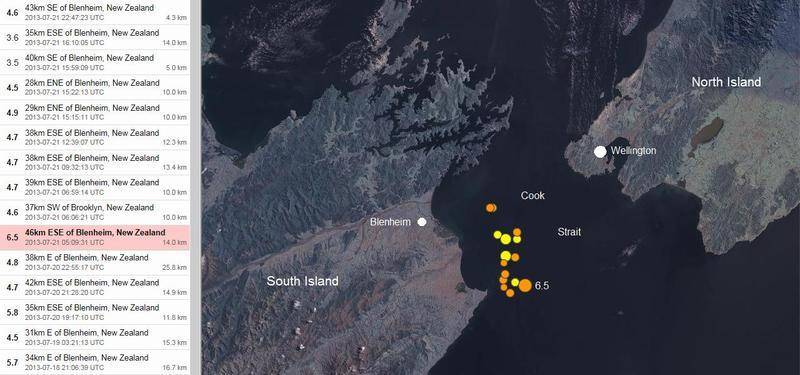
interesting set of earthquakes in the central NZ region in Cook Strait, between the 2 main islands
attachment.php?attachmentid=60408&stc=1&d=1374463036.jpg


the last M6+ event that I recall in this area ( and almost in the same spot) was a 6.2 in the 1980's. This a complex tectonic region where there is a change from oblique slip across the South Island changing to a subduction zone under the northeastern most corner of the South Island and under the North Island.
These events have occurred in the centre of that zone and appear to delineate a fault striking approx. NW-SE. The USGS moment tensor supports this conclusion.

I was in Christchurch, some 400km to the SW at the time of the M5.7 ( the first event) but didn't feel it. It would appear that only a few people in Christchurch felt the M6.5.
The first event (M5.7) was preceded by several foreshocks of ~M1.5 - M2.5 in the 2 day before the event. The 5.7, 5.8 and 6.5 had their own good set of aftershocks so far totally in excess of 300 events.
Unfortunately my digital seismograph computer decided to have a hard drive failure at the time of the M6.5 so am unable to show you a seismogram of the event.

Regards
Dave
 

Attachments

  • 2013-07 Cook Str. Events.JPG
    2013-07 Cook Str. Events.JPG
    49.7 KB · Views: 1,147
Last edited:
Earth sciences news on Phys.org
the last M6+ event that I recall in this area ( and almost in the same spot) was a 6.2 in the 1980's. This a complex tectonic region where there is a change from oblique slip across the South Island changing to a subduction zone under the northeastern most corner of the South Island and under the North Island

So does that mean that NZ is getting smaller, and the two isalnds will evenually meet up. Is the Cook Straight a result of the subduction. I am just wondering if the two islands have relative motion to one another or are experiencing uplift or whatnot.

Unfortunately my digital seismograph computer decided ...
At home I assume. That is interesting. I always had the idea to set something up but never ever got around to it. I am now having moments of regret.
 
Hi 256

256bits said:
So does that mean that NZ is getting smaller, and the two isalnds will evenually meet up. Is the Cook Straight a result of the subduction. I am just wondering if the two islands have relative motion to one another or are experiencing uplift or whatnot.

Both the North and South Islands are under compression but by different methods. As a result they are both shortening in they East-West dimension


attachment.php?attachmentid=48772&d=1341058127.gif


in the above image, Nth Is. cross-section the tectonics motion is primarily subduction with a bit of a strike slip component. Most of that subduction shortening is taken up by the uplift of the coastal ranges ( east coast) through reverse faulting. A lot of that east coast material (land) is Pacific seafloor that has been accreted to the Nth Is mainland.

attachment.php?attachmentid=48773&d=1341058245.gif


In this cross-section of the Sth Is., the tectonics is oblique slipping its roughly a 3:1 ratio. That is for every 3 metres of horizontal motion there's ~ 1 metre of vertical motion.
The Southern Alps mountain chain is one of the youngest in the world at ~ 5 - 8 million years.
Prior to then there was extensional tectonics across the Sth Is., resulting in a lot of volcanism


At home I assume. That is interesting. I always had the idea to set something up but never ever got around to it. I am now having moments of regret.

Yes at home. have a look here for info my system

cheers
Dave
 
Last edited:
StevieTNZ said:
There is more discussion over the recent earthquakes here - https://www.physicsforums.com/showthread.php?t=702290

I'm based in a suburb of Lower Hutt; ~8-10 minutes drive from Wellington.

yeah I happened to see that the other day :)
that discussion would have probably been better off in the Earth forum ;)
I always wondered when in NZ you were

Dave
 
Dangit, only just got my online seismo running for several days and my www site host decides to do some changes to their servers and now the images are not uploading.
Am still fighting with them trying to sort it out.

Dave
 
Didn't feel this morning's 5.4.
 
deep sleeper huh ;)

I see the USGS only gave it a M4.9, but they are often quite low in their magnitudes for NZ events

and a M4.7 in upper Canterbury this afternoon

cheers
Dave
 
  • #10
Hi Dave,

I was struck by the difference in tectonic regime between the N and S islands in your diagrams. After looking into it seems as though New Zealand is the stage of an epic battle between the Pacific and the Australian plates! They are colliding and are fighting to remain afloat. To the North the Australian plate is winning, but to the south the Pacific remains afloat.

fig2.gif
 
  • #11
Hi Billiards

yes, NZ is a geologists "field of dreams" or is that nirvana ? LOL
I loved doing my geology studies there, there's just so much variety packed into such a small landmass

and yes something I didn't point out was in the lowest corner South Island and further down south through the Puysegur - Macquarie trench, the subduction returns but in the opposite direction compared to the North Island, as can be see by the B-B' cross-section.
The subduction zone there dips very steeply just a few degrees (~15) off the vertical. I personally don't know of another such steeply dipping zone.

attachment.php?attachmentid=60635&stc=1&d=1375403730.jpg


cheers
Dave
 

Attachments

  • 19930810 M72 Fiord2.jpg
    19930810 M72 Fiord2.jpg
    38 KB · Views: 995
  • #12
Wow that really is steep. I guess that means its a mature subduction zone. So is the theory that it will eventually detach and subduction of the Pacific plate will takeover?
 
  • #13
Just had two severe ones.

First one 6.2, 8km deep followed by a 5.7 8km deep. Data being revised. First it was 6.9 at 12km deep.
 
  • #14
yup its coming in on my seismo here in Sydney as we speak

http://www.sydneystormcity.com/sydln.gifand unlike the previous ones in this region over the last month ... these ones are on land only a few km's from the Seddon township :(
Dave
 
  • #16
Am noticing a lot of small aftershocks. Let's hope there is no more big one.
 
  • #17
Hold on Stevie!
 
  • #18
a quick little graphic I whipped up :smile:

attachment.php?attachmentid=60936&stc=1&d=1376627163.gif


for non-New Zealanders, this is the NE tip of the South Island of NZ

EDIT: updated graphic and another update

Dave
 

Attachments

  • seddon quakes.gif
    seddon quakes.gif
    157.3 KB · Views: 1,297
Last edited:
  • #19
A few severe aftershocks have occurred since the last post.
 
  • #20
OK now that I am home from work and have had time to process the data
here's the seismograms for the 2 largest events

Mw 6.5 (MB 6.2) at 02:31UT (14:31 NZST)
attachment.php?attachmentid=60937&stc=1&d=1376644111.gif


Mw 5.9 (MB 6.0) at 05:31UT (17:31 NZST)
attachment.php?attachmentid=60938&stc=1&d=1376644111.gif


exactly 3 hours apart, give or take a few seconds ... freaky!

Dave
 

Attachments

  • 130816.022959.sydln.gif
    130816.022959.sydln.gif
    18.8 KB · Views: 1,149
  • 130816.053002.sydln.gif
    130816.053002.sydln.gif
    21.3 KB · Views: 1,112
  • #21
Yes, I was on the phone to someone when the ones hit at 5.30/5.31pm. And the house just started shaking. It was as scary as the 2.31pm earthquake.
 
  • #23
ahhh you didnt feel that one huh :wink:

yeah, it was the getting away down the SW end of the activity zone.
There was a M5.0 a bit further SW ~ 2 hours earlier

Dave
 
  • #24
now that most of the locations have been finalised,here's an updated graphic ( as of midnite 17 Aug 2013)
I have included all M5+ events and also the events of several weeks ago that started all this activity.

attachment.php?attachmentid=60987&stc=1&d=1376815352.jpg


NOTE: eg. 16/1709NZ = 16 August @ 1709 NZST ( New Zealand Standard Time)
other than the ones noted in the list in the lower right corner which are July events

the focal mechanism for these events are predominatly strike-slip, trending NE-SW
The M6.5 of July ( out in Cook Strait) had a small amount of obique slip component to it
A line through the 3 x M6 events also nicely delineates the direction of the slip


cheers
Dave
 

Attachments

  • 130816 NE Sth Is events cropped.jpg
    130816 NE Sth Is events cropped.jpg
    67.5 KB · Views: 754
Last edited:
  • #25
StevieTNZ;4475782... said:
GNS scientists warned of a 20 per cent risk of another 6+ Richter scale quake in the next seven days.

God I hope not.

really ... it wouldn't surprise me... this region has been really quiet for a very long time
the last major even in this region was the estimated M7.5 event of 1848 on the Awatere Fault
a few km's to the west of this activity

Dave
 
  • #26
Thanks for the info davenn! I'm headed to NZ this January. I hope to feel a little one, but that is it :)
 
  • #27
where specifically in NZ are you heading to?
or is it a wide ranging tour ?

Dave
 
  • #28
davenn said:
where specifically in NZ are you heading to?
or is it a wide ranging tour ?

Dave

yeah I'll be there a month driving around, so everywhere :)
 
  • #29
Another aftershock (5.1) just after midnight:

http://nz.news.yahoo.com/a/-/top-stories/18787570/high-winds-quakes-in-welly-overnight/

At least we didn't sustain the damage that Christchurch did:
 
Last edited by a moderator:
  • #30
StevieTNZ said:
Another aftershock (5.1) just after midnight:

http://nz.news.yahoo.com/a/-/top-stories/18787570/high-winds-quakes-in-welly-overnight/

At least we didn't sustain the damage that Christchurch did:


Hang on! (Do you have padding around your bed?)
 
Last edited by a moderator:

Similar threads

  • · Replies 2 ·
Replies
2
Views
2K
Replies
1
Views
813
  • · Replies 1 ·
Replies
1
Views
3K
Replies
31
Views
4K
  • · Replies 7 ·
Replies
7
Views
8K
  • · Replies 6 ·
Replies
6
Views
7K
  • · Replies 6 ·
Replies
6
Views
4K