How can I accurately measure the capacitance of a paper capacitor?

  • Thread starter Thread starter iScience
  • Start date Start date
  • Tags Tags
    Capacitor Paper
Click For Summary

Discussion Overview

The discussion revolves around the measurement of capacitance for a homemade paper capacitor, exploring the calculations involved, the materials used, and the challenges faced in achieving accurate results. Participants delve into theoretical considerations, experimental setups, and the properties of different dielectrics.

Discussion Character

  • Exploratory
  • Technical explanation
  • Debate/contested
  • Experimental/applied

Main Points Raised

  • One participant calculated capacitance using the formula $$C=\epsilon_r \frac{A}{d}$$ but obtained an unexpectedly high value, leading to questions about potential errors in the calculation.
  • Another participant pointed out the omission of the vacuum permittivity $$\epsilon_0$$ in the capacitance formula, suggesting that it is essential for accurate calculations.
  • Concerns were raised about the calculated capacitance being in the kilofarads range, which is considered unusually high for typical capacitors.
  • Participants discussed the variability of the relative permittivity of paper and the effects of humidity on measurements.
  • Suggestions were made to improve the experimental setup, such as using a more uniform weight to press the plates together instead of makeshift items like post-its and cups.
  • One participant proposed using water as a dielectric, speculating that it might mitigate issues with separation distance, while others questioned the practicality and effectiveness of this approach.
  • There was a debate about the conductivity of water, with some asserting that distilled water is a poor conductor, while others noted that it can become ionized and thus more conductive when in contact with aluminum.
  • Concerns were raised about the potential for short-circuiting the capacitor plates if water were used as a dielectric.
  • Alternative suggestions for dielectrics included mineral oil and plastic materials, with discussions on the effects of air gaps between the plates and dielectric materials.

Areas of Agreement / Disagreement

Participants do not reach a consensus on the best approach to measuring capacitance or the suitability of water as a dielectric. There are multiple competing views regarding the properties of water and the implications for capacitor design.

Contextual Notes

Participants acknowledge limitations in their measurements, such as the inability to confirm the thickness of the paper and the non-ideal nature of the capacitor setup. The discussion highlights the variability in material properties and the impact of environmental factors on capacitance measurements.

iScience
Messages
466
Reaction score
5
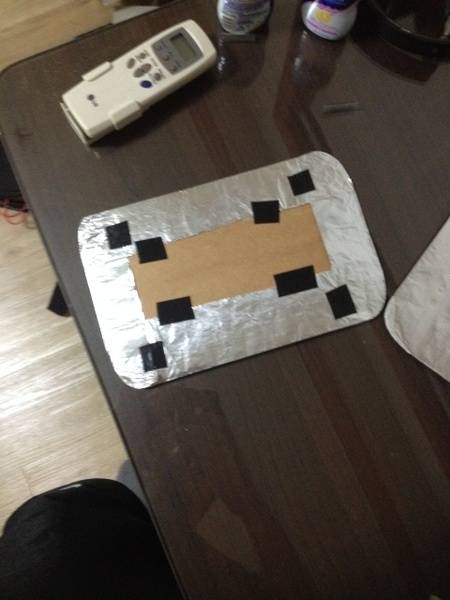
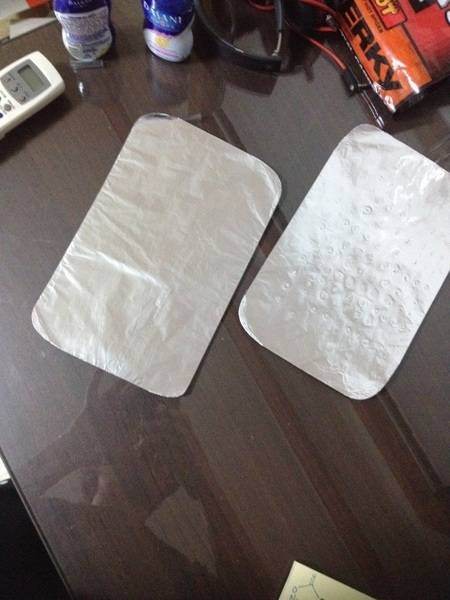
I made two conductive plates out of aluminum foil wrapped around cardboard pieces
LnbWOHI.jpg
6ZKTg33.jpg
i don't have a micrometer with me to measure to the thickness of my paper, so i just googled the average thickness of paper; also just googled the relative permittivity of paper..$$C=\epsilon_r \frac{A}{d}$$

$$\epsilon_r= 3.85$$
$$A=0.21m x 0.146m$$
$$d=0.103mm=0.000103m$$

$$C=3.85\frac{(0.21)(0.146)}{0.000103}=1146.029F$$

what the heck?...

i must've messed up somewhere! because...
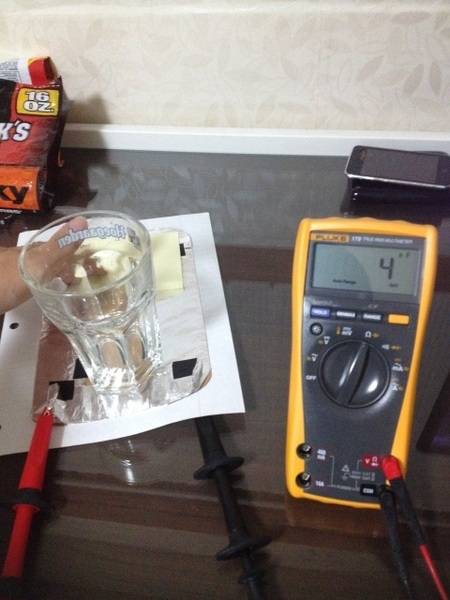
XLHQ40e.jpg


(4nF)

The yellow post-it pad and the cup was just to press the plates closer.


1.) what's with the ridiculously high value i got for the capacitance?

2.) what's with the ridiculous discrepancy?unrelated Q: when posting 2000x2000 images, is there a way to just resize it here??
 
Last edited:
Engineering news on Phys.org
Congratulations on your experimental flair. εr is dimensionless and always occurs in conjunction with εo. You are missing εo in your formula.
 
NascentOxygen was quicker than me ;)

the value for Eo ist


\varepsilon_0 = \frac{1}{\mu_0 c_0^{2}} = 8{,}854\,187\,817\,62\ldots \cdot 10^{-12}~\frac{\mathrm{As}}{\mathrm{Vm}}
 
Last edited by a moderator:
General remark: F is HUUUUGE.

Things may have changed since I dealt with any electronic parts, but from what I remember mF capacitors were rarely used in electronic devices. Most were from the pF, nF and μF range. Your calculation result - in kF range - is a red flag that something went wrong.
 
Thanks fellas! i still got something in the 10^ -8 but stilll a lot more to what i was expecting.
 
so 10-50 nF or so? that sounds about right. You can't confirm the thickness of your paper afterall. Also, try to a apply a more uniform weight rather than some post-its and a cup. Use something like a short book.
 
10-8 is around 10 nF, you measured 4 nF - that's reasonably close, especially taking into account how far from ideal your capacitor is. Distance is not uniform (which is why MrSparkle suggests more reliable way of keeping the surfaces pressed together) and to some degree unknown. Relative permittivity of paper is variable and humidity dependent. Edge effects will change the result further. 10% here, 10% there and you are off by a factor of two.
 
iScience said:
Thanks fellas! i still got something in the 10^ -8 but stilll a lot more to what i was expecting.
Dielectric losses may be confounding your meter. Try replacing the paper with a thin plastic bag.
 
i'm thinking, if i use water, the separation distance shouldn't matter as much since the polar water molecules are able to easily align themselves along the E-field. But, intuition tells me that distance will still matter a lot.

what do you guys think?
 
  • #10
water? for what?
 
  • #11
as the dielectric, since water itself is a pretty poor conductor
 
  • #12
iScience said:
as the dielectric, since water itself is a pretty poor conductor

it may not be the best conductor, but it isn't as poor as you seem to think, it conducts pretty well
you would just short circuit the plates of your capacitor


Dave
 
  • #13
iScience said:
as the dielectric, since water itself is a pretty poor conductor

only perfectly clean distilled water is a poor conductor. But explain to me how you are going to keep the plates separate using a liquid as the dielectric? your plates aren't stiff and inflexible. Quite the opposite. You've got nothing that is going to prevent the slightest pressure from deforming the plates and making them touch. water is not going to work. what is your goal here?
 
  • #14
davenn said:
it may not be the best conductor, but it isn't as poor as you seem to think, it conducts pretty well

While in operational terms you are right, there is more to it.

Ultra pure water has a specific resistivity around 18MΩ - so it is a poor conductor. It is so pure conductor it is difficult to measure its pH using potentiometric methods, as for that you need a closed circuit and 18MΩ water is a lousy choice for a conductor closing the circuit.

However, what we deal with - even when using DI or RO or distilled water - is not so pure. Actually even ultra pure water poured into a beaker and allowed to contact with atmosphere will get contaminated immediately (at first mostly by carbon dioxide) and its resistivity will go down. It will also leach ions from virtually everything but a few selected materials.

So for practical purposes it is a conductor, but a real pure water is not.
 
  • #15
Distilled ( or better DI ) water in contact with AL- will become ionized water = very conductive. Try mineral oil. Although the plastic bag - or plastic wrap may also work. The small amount of air between the plates and dielectic material will also have some effect.
 
  • #16
Windadct said:
Distilled ( or better DI ) water in contact with AL- will become ionized water = very conductive.

Beware - "ionized water" is ambiguous. You most likely mean "contaminated with ions".

And you just repeat what was already said.
 

Similar threads

Replies
7
Views
2K
Replies
6
Views
2K
  • · Replies 12 ·
Replies
12
Views
4K
  • · Replies 4 ·
Replies
4
Views
6K
  • · Replies 5 ·
Replies
5
Views
4K
  • · Replies 1 ·
Replies
1
Views
2K
Replies
4
Views
3K
  • · Replies 1 ·
Replies
1
Views
5K
  • · Replies 22 ·
Replies
22
Views
6K
Replies
12
Views
7K