Calculating Force Generated by Gas Powered Launcher

Click For Summary
SUMMARY

The discussion centers on calculating the force generated by a gas-powered launcher, specifically when a valve opens to release compressed air. The pressure in the tank is 140 Psi, which converts to 863,913 Pa after accounting for atmospheric pressure. The cross-sectional area of the valve is calculated as 0.00049 square meters. Using the formula for force, the resulting force exerted at the valve's exit is approximately 423.317 Newtons, confirming the theoretical approach to calculating force in this context.

PREREQUISITES
  • Understanding of basic physics principles, particularly pressure and force calculations.
  • Knowledge of gas laws, specifically adiabatic expansion.
  • Familiarity with unit conversions, especially between Psi and Pascal.
  • Basic geometry for calculating cross-sectional areas.
NEXT STEPS
  • Research the principles of adiabatic expansion in gases.
  • Learn about pressure calculations in pneumatic systems.
  • Explore the use of radar guns for measuring projectile velocity.
  • Investigate safety measures when working with high-pressure systems, particularly with PVC materials.
USEFUL FOR

Students in physics, engineers designing pneumatic systems, hobbyists building gas-powered launchers, and anyone interested in the mechanics of pressure and force generation.

Quaboble
Messages
7
Reaction score
0
A student designs a gas powered launcher that consists of a pressure tank, a valve and a barrel. When the valve is turned the gas, in this case air, expands propelling whatever is in the barrel. The pressure tank and barrel have the same dimensions while the valve connecting the two has a diameter of 25 mm. Assume the valve instantly opens. How much force in Newtons is generated when the valve is opened at the exit end of the valve (point X)?
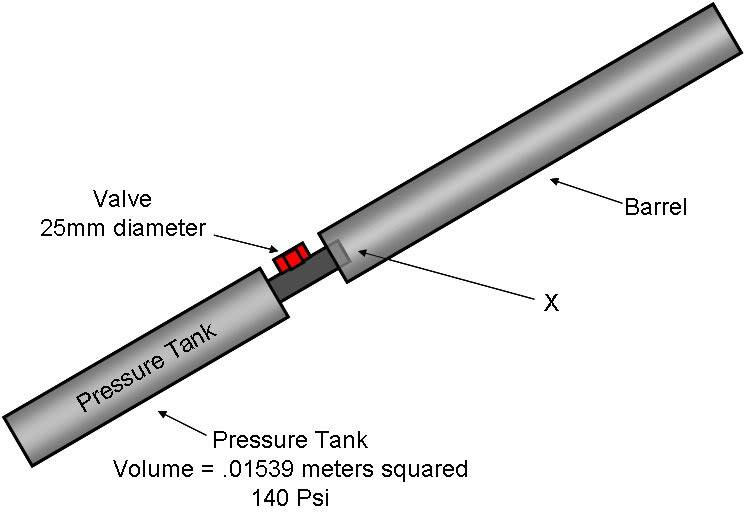
cokelauncherforce.jpg

Please help me, I'm totally lost :( I actually made this question as I have built this launcher and am wondering what its power theoretically is. I was never taught how to do this.
 
Last edited:
Physics news on Phys.org
If you need to know the muzzle velocity of the projectile, why are you asking for force, because that won't be constant? Have you done adiabatic expansion.? Show some attempt, and help will come. Read up your books or notes.
 
Cant really attempt it... I've only had 1 complete term of basic physics, and this isn't even a question assigned to me by school. How will muzzle velocity of the projectile help me?. I am just curious to know if it is possible to calculate the force expelled by the expanding air.
 
Last edited:
At the moment the valve is opened suddenly, it is possible to calculate how much force the compressed air exerts on an object that is pressed against the outlet of the valve. It is the product of the pressure in the tank minus atmospheric pressure multiplied by the cross-sectional area of the end of the valve , in any self consistent system of units.
 
Thanks! So it should work like this:

pressure: 140 Psi - 14.7 Psi = 125.3 Psi (converting to pascal = 863,913 Pa)
cross sectional area of valve: .0125 ^2 x Pi = .00049 meters squared

then: 0.00049 meters x 863,913 Pa = 423.317 Newtons

Does that sound about right?
 
I haven't checked the numbers, but the concept is correct.
 
Alright thanks a bunch for the help man!
 
Usually it's not the valve area, but the cross-sectional area of the barrel that mostly determines the force. You'd have to check the flow through the valve to see if that's limiting, but it's possibly not. Keep in mind that the supply tank will lose pressure as the potato (pumpkin, whatever) goes up the barrel. And, as noted earlier, this is adiabatic; I've seen ice fly out of these things.

And, I got to ask you, man. What material are you putting 140 psi in? Should I introduce you to ole 3 fingers McGurk who exploded a tire at 100 psi? Because air is compressible, pressure is somewhat dangerous.

By the way, most people do the muzzle velocity by "borrowing" the baseball radar gun from the coach's office. Once, we even got the local police to come out and do it.
 
Last edited:
Hmmm... well the ammunition is coca cola bottles and cans (both have a near perfect fit for 70 mm piping). The rounds are put directly against the valve which protrudes a bit into the actual barrel so the gas hits the projectile before it expands into the barrel. The pressure tank is made out of PVC piping and i have taken it to 140 Psi already. Hmm well I live in Europe (though i used to like in the USA) so baseball is rare and i doubt my school even has a radar gun. European schools really miss out on the sports when compared to American schools :P
 

Similar threads

  • · Replies 12 ·
Replies
12
Views
4K
  • · Replies 43 ·
2
Replies
43
Views
5K
Replies
15
Views
11K
  • · Replies 14 ·
Replies
14
Views
9K
  • · Replies 3 ·
Replies
3
Views
3K
  • · Replies 2 ·
Replies
2
Views
1K
  • · Replies 1 ·
Replies
1
Views
2K
  • · Replies 28 ·
Replies
28
Views
4K
Replies
11
Views
3K
  • · Replies 2 ·
Replies
2
Views
2K