What is the Controversy Behind the Discovery of Rapid Climate Swings?

Click For Summary

Discussion Overview

The discussion centers on the controversy surrounding the discovery of rapid climate swings, particularly those inferred from ice core research in Greenland. Participants explore the implications of these findings on the understanding of climate change, the reliability of proxies used in climate science, and the interpretations of historical climate data.

Discussion Character

  • Debate/contested
  • Exploratory
  • Technical explanation

Main Points Raised

  • Some participants reference Spencer Weart's work on ice core research, noting that rapid climate swings were identified, which challenged previous beliefs about the timescales of climate change.
  • Concerns are raised about the interpretation of isotope data, with some suggesting that the observed temperature swings may not be solely indicative of temperature changes but could also relate to aridity.
  • A publication by U. Clark et al. (2009) is cited, which suggests that ice sheets began retreating before the temperature increases indicated by isotope data, raising questions about the timing and interpretation of these climate proxies.
  • Other participants challenge the validity of the claims made regarding the doubts about proxies, arguing that the referenced papers do not support the drastic conclusions drawn about proxy reliability.
  • One participant emphasizes the need for a more coherent presentation of arguments and references, suggesting that linking to other threads does not adequately address the concerns raised.
  • There is a mention of a "Mystery Interval" in climate history, where contradictory evidence regarding deglaciation and temperature conditions is discussed, but no direct inference of problems with proxies is found in the cited literature.

Areas of Agreement / Disagreement

Participants express disagreement regarding the interpretation of the data and the reliability of climate proxies. Some assert that doubts about proxies are valid, while others contend that the references do not support such claims, indicating that the discussion remains unresolved.

Contextual Notes

Limitations in the discussion include the potential for missing assumptions in the interpretation of climate data, the complexity of proxy relationships, and the unresolved nature of the claims regarding the timing of climate events.

Andre
Messages
4,294
Reaction score
73
In The discovery of global warming Spencer Weart elaborates extensively about the discovey of large climate swings, inferred from the ice core research in Greenland.

You can read the book online there, but also http://www.aip.org/history/climate/. A few quotes from the chapter http://www.aip.org/history/climate/rapid.htm,

...A Danish group headed by Willi Dansgaard drilled a long core of ice at Camp Century, Greenland in cooperation with Americans led by Chester Langway, Jr. The proportions of different oxygen isotopes in the layers of ice gave a fairly direct record of temperature. But mixed in with the expected gradual cycles, the group was surprised to notice what they called "spectacular" shorter-term shifts — including, once again, an oscillation around 12,000 years ago. Some of the shifts seemed to have taken as little as a century or two..

..Swings of temperature that scientists in the 1950s believed to take tens of thousands of years, in the 1970s to take thousands of years, and in the 1980s to take hundreds of years, were now found to take only decades. Ice core analysis by Dansgaard's group, confirmed by the Americans' parallel hole, showed rapid oscillations of temperature repeatedly at irregular intervals throughout the last glacial period. Greenland had sometimes warmed a shocking 7°C within a span of less than 50 years. ..

A similar plot can be found in the price winning book http://press.princeton.edu/titles/6916.html of Richard Alley.

The isotope jumps in question look like these:
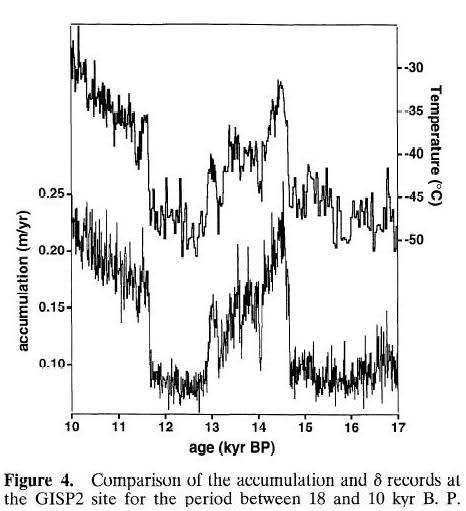
2r7xdsw.jpg

http://www.ipsl.jussieu.fr/GLACIO/hoffmann/Texts/jouzelJGR1997.pdf , ) showing clear strong temperature jumps, especially at around 15,000 years ago, known as the Bolling Allerod interstadial.

However some doubts remainded, although one had to very audaciously ignore the strong expressions of undesirabilty of sharing those doubts with others, but nevertheless that happened in threads like these:

https://www.physicsforums.com/showthread.php?t=125669
https://www.physicsforums.com/showthread.php?t=333159

accumulating into the idea that these isotope jumps were not about temperature but aridity:

https://www.physicsforums.com/showthread.php?t=333747

Now all of a sudden we see this published:

U. Clark, et al. (2009) The Last Glacial Maximum, in Science Vol 325, 710-714, doi:10.1126/science.1172873
[/url]

which states:

...Based on the youngest possible age for ice-sheet maxima derived from our uncertainty assessment (7), most of the LIS, the northwest Cordilleran Ice Sheet (CIS), the Barents-Kara Ice Sheet (BKIS), the British-Irish Ice Sheet(BIIS), and the Scandinavian Ice Sheet (SIS) had begun to retreat from their maxima between 19 and 20 ka (10) (Fig. 3B). Although the onset of Greenland Ice Sheet (GIS) retreat from the LLGM is poorly constrained by existing 14C and TCN ages (fig. S3B), marine records of GIS runoff suggest that GIS retreat may have commenced ~20 ka (11). This evidence for widespread ice-margin retreat occurring between 19 and 20 ka indicates that the 19-ka meltwater pulse, which represents a rapid 10-m rise in sea level from the LGM lowstand sometime between 19 and 20 ka (Fig. 3C) (8, 12), originated from these Northern Hemisphere ice sheets (13)...

So, with this publication, it seems now official those doubts, the ice sheets retreating a considerable time before the isotope temperature increased. So no warming of a shocking 7°C within a span of less than 50 years.

Somebody has a lot of explaining to do. One of the messages seems to be: the interpretation of "proxies" is much trickier than it looks, justifying a sincere doubt about the value of other "proxies", one of the corner stones of global warming.
 
Last edited by a moderator:
Earth sciences news on Phys.org
Huh?

None of the papers that you've referenced share the same doubts or draw similar conclusions.
 
Andre said:
No?

No. Xnn is right, and you don't answer that just by linking to other threads. The issue here is that none of your references supplied here actually share your specific and rather drastic doubts on proxies or draw similar conclusions, as far as I can see.

You've answered that just by linking to a different thread, but it appears to have similar problems. Wouldn't it better to take the time to write something comprehensible and self-contained for this thread, with a reference (if one exists) that actually makes inferences similar to those you are proposing?

Here, for example, is a properly presented citation taken from [post=1877279]msg #4[/post] of thread "Paleoclimate Proxy problems", which I obtained by following your link, which was itself a reference to this post. I tried to find the reference which seemed most likely to meet Xnn's request. I include also the same extract which you gave; the first paragraph of the article.

  • GH Denton, WS Broecker, RB Alley, 2006; http://www.pages.unibe.ch/cgi-bin/WebObjects/products.woa/wa/product?id=271 , Past Global Changes (Pages) Volume 14 No 2 August 2006, pp14-17
The time period between the beginning of Heinrich event #1 (H-1) and the onset of the Bølling/Allerød rivals the Younger Dryas in importance to our understanding of how the planet responds to abrupt mode switches. This interval also constitutes the onset of the most recent termination, arguably the most fundamental climate shift of the last 100-kyr glacial cycle. As some of the responses during this time appear to be mutually contradictory, we term it the “Mystery Interval”.[/color]​

But looking at the paper yet again shows that an inference of problems with proxies is entirely absent! Here are more extracts which help explain what this paper considers as a "seeming contradiction" and what inferences the authors make as a plausible resolution. The major apparent contradiction identified in the paper is described as follows:
One seeming contradiction may afford an important clue; namely, extensive deglaciation of the European Alps occurred during a time of maximum cold in the adjacent Atlantic Ocean and Mediterranean Sea, along with some indications of continued cold conditions, at least during winter, on the continent itself.[/color]​
This paper goes on to present in some detail a scenario inferred by the authors, involving a shutdown of meridional overturning circulation in the Atlantic after melting of a large H-1 iceberg armada reduced salinity; maintaining cold conditions in Western Europe and Greenland even as there are rising temperatures elsewhere.
Assuming that our read of the evidence is correct, we can think of only one explanation for this contradiction; namely, that the cold oceanic and terrestrial conditions reflect extensive winter sea ice cover in the northern Atlantic and that the retreat of temperate mountain glaciers reflects warming summer conditions brought on by rising atmospheric CO2 [...]
...
The relative timing of northern and southern events shown in Figure 1 suggests that the shutdown of meridional overturning in the North Atlantic during the Mystery Interval may have been the major factor in driving the last termination, which in panel A of Figure 1 is marked by the rise of Antarctic temperature and of atmospheric CO2. A consequence of this shutdown of northern overturning appears to have been an overall reorganization of ocean circulation, probably through the operation of a bipolar thermohaline seesaw (Broecker, 1988), that led to shrinkage of the sea-ice fringe around Antarctica. As a result, Antarctica warmed while atmospheric CO2 slowly increased, perhaps due to more efficient degassing from the Southern Ocean (Stephens and Keeling, 2000). These events were curtailed when northern overturning resumed during the Bølling/Allerød. They were then renewed during the Younger Dryas, which in many ways was a shorter repetition of the Mystery Interval.[/color]​

There's no inference here of problems with proxies -- which (correct me if I am wrong) appears to be Andre's own personal major inference. Andre concludes the opening post of this thread as follows:
Andre said:
Somebody has a lot of explaining to do. One of the messages seems to be: the interpretation of "proxies" is much trickier than it looks, justifying a sincere doubt about the value of other "proxies", one of the corner stones of global warming.

The real "message" on interpretation of proxies is one that working scientists already have well in hand. The various references in this field frequently consider issues of calibration and matching of proxy records, and there are legitimate uncertainties that are already considered in paleoclimate research. None of Andre's references seem to share his conclusion of a particular problem with proxies over and above these well understood calibration issues, or share his view that there is any reasonsable basis for doubt in their value.

I don't doubt your sincerity, Andre; but your conclusions seem highly idiosyncratic and out of touch with working science on paleoclimate proxies.

There's nothing here at all to back up the thread title "Requiem for a climate change". The real issues are all about digging into details of changes in climate in the past, using the information available from multiple cross checked proxies.

As a minor aside, I suggest we are best to forget about the "global warming" of the present in this discussion. Let's stick to paleoclimate. The major cornerstone of the current global warming is instrument records in the present, not proxies, and well understood physics of how the composition of the atmosphere affects the Earth's energy balance.

Cheers -- sylas
 
Last edited by a moderator:
Unfortunately I have other priorities to react in depth however already one element here for consideration.

denton et al 2006 said:
early high sea surface temperature observations in the North Atlantic of for instance Waelbroeck, et al (1998), Lagerklint & Wright (1999) Bard et al (2000), Dolven et al (2002) prior to the onset of Heinrich event-1 and the Bølling, would tend to limit the extend of the sea ice prior to that period considerably

I copy from an old post I wrote somewhere:

early high sea surface temperature observations in the North Atlantic of for instance Waelbroeck, et al (1998), Lagerklint & Wright (1999) Bard et al (2000), Dolven et al (2002) prior to the onset of Heinrich event-1 and the Bølling, would tend to limit the extend of the sea ice prior to that period considerably

Refs

Bard E., Hamelin B., Fairbanks R. G., and Zindler A., Calibration of the 14C timescale over
the past 30,000 years using mass spectrometric U-Th ages from Barbados corals, Nature 345, 405-410 (1990)

Dolven J.K. Cortese G, Bjørklund K.R. 2002 A High-resolution Radiolarian-derived
Paleotemperature Record for the Late Pleistocene-Holocene in the Norwegian Sea,
Paleoceanography, Vol 17, No. 4 1072 pp 24-1

Lagerklint M, J.D. Wright 1999 Late glacial warming prior to Heinrich event 1: The influence of ice rafting and large ice sheets on the timing of initial warming. Geology; December 1999; v. 27; no. 12; p. 1099–1102;

Waelbroeck, C. et al. Improving past sea surface temperature estimates based on planktonic fossil faunas. Paleoceanography 13, 272–283 (1998).
 

Similar threads

  • · Replies 73 ·
3
Replies
73
Views
17K
  • · Replies 5 ·
Replies
5
Views
5K
  • · Replies 10 ·
Replies
10
Views
8K
Replies
7
Views
11K
  • · Replies 8 ·
Replies
8
Views
8K
  • · Replies 7 ·
Replies
7
Views
6K
  • · Replies 11 ·
Replies
11
Views
7K
Replies
4
Views
10K
  • · Replies 9 ·
Replies
9
Views
29K
  • · Replies 4 ·
Replies
4
Views
13K