Physics w/ Calculus, Ch. 1 question: Vector Addition

Click For Summary

Homework Help Overview

The discussion revolves around a vector addition problem in the context of physics with calculus, specifically focusing on the geometric interpretation of vector components and the application of the Law of Sines and Law of Cosines. The original poster seeks clarity on deriving the expression Csin(φ) without resorting to standard vector addition methods.

Discussion Character

  • Exploratory, Conceptual clarification, Mathematical reasoning

Approaches and Questions Raised

  • Participants explore the geometric relationships between the vectors and their components, questioning how to derive Csin(φ) using trigonometric identities and laws rather than traditional vector addition. Some express confusion about the original poster's understanding of the problem and seek clarification on the specific difficulties faced.

Discussion Status

The discussion is active, with participants providing insights into the geometric and trigonometric foundations of the problem. There is recognition of the potential misunderstanding by the original poster regarding the instructions in the provided screenshots. Multiple interpretations of the problem are being explored, particularly concerning the equivalence of different methods for finding the resultant vector.

Contextual Notes

Participants note that the exercise involves converting between polar and Cartesian coordinates and that the original poster may have misinterpreted the problem's requirements based on the provided materials.

LearninDaMath
Messages
295
Reaction score
0
This seems to be a very perplexing problem to which there is much difficulty of making sense of. So instead of trying to rewrite the problem in pieces, I've decided to provide the entire image leading up to the question so that you are seeing what I'm seeing. Hopefully, if I can describe where I'm having difficulty well enough, perhaps someone could provide some insight.


vectorhelp1.png


vectorhelp2.png


vectorgeometrya.png


vectorgeometryb.png


The problem, for the moment, is PART D.

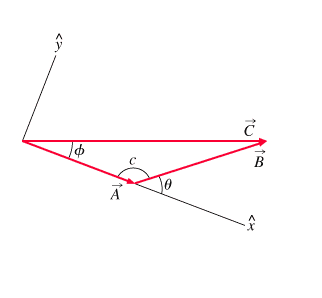
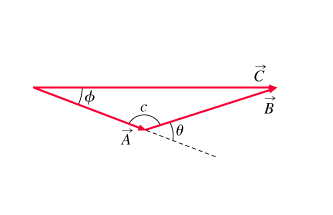
The question: How do you get Csin\phi geometrically? That is, how do you get that answer by, "I think," using either or both of the first two equations (law of cosine and sin) instead of using the usual vector addition method?
 
Last edited:
Physics news on Phys.org
Looking at the bottom picture, if I'm given C and phi then you have your answer. Are you confused how to get both C and phi, but then a quick look at your work-set looks like you are shown how to get both C and phi?

I'm confused with your confusion, %^) others might be as well. Could you state your problem in another way?
 
LearninDaMath said:
The problem, for the moment, is PART D.

The question: How do you get Csin\phi geometrically? That is, how do you get that answer by, "I think," using either or both of the first two equations (law of cosine and sin) instead of using the usual vector addition method?
I'm not sure if I understand your question. The y-component of any vector is its magnitude, multiplied by the sine of the angle it makes with the +x axis. But surely you knew that already?
 
yep - geometrically, the trig relation follows from the definition of the sine.

You can get it from the law of sines as follows:

look at the big right-angled triangle with hypotenuse C and opposite side C_y the known angles are \phi, 90-\phi and 90 degrees.
By the sine-rule, therefore:

\frac{C_y}{\sin\phi} = \frac{C}{\sin(90)}
 
Last edited:
I think I finally understand the question that's being asked. The screen shots in the opening post of this thread helped a great deal.

We have a vector equation:
\vec{A}+\vec{B}=\vec{C}\,,​
where the known quantities are the magnitudes of the vectors \vec{A} and \vec{B} and the angle, θ, between their directions.

The exercise in the screen shots, presumably from "Mastering Physics" is taking you through steps which can show the equivalence of two methods for finding and describing the resultant vector, \displaystyle\vec{C}\,.
One method -- the 'Geometry Method' -- mainly uses the Law of Cosines and the Law of Sines along with plane geometry to find the magnitude of \displaystyle\vec{C} along with its direction relative to the direction of \displaystyle\vec{A}\,.

The other method -- the Component Method -- uses elementary trigonometry to find the components of \displaystyle\vec{A} and \displaystyle\vec{B} then adding them to describe \displaystyle\vec{C} via its components.​

That the two methods give the same magnitude for \displaystyle\vec{C} is dealt with in Parts B & C.

We see in Part D that they begin with geometry giving the result \displaystyle C_y=\left|\vec{C}\right|\sin(\phi)\,. Obviously the component method gives \displaystyle C_y=\left|\vec{B}\right|\sin(\theta) \,. (See Item 4 on the first panel of the screen shots.) As I see it, the rest of the exercise is to show that these expressions for Cy are equivalent. This can be done using the Law of Sines for the triangle formed by the three vectors, \vec{A}\,,\ \vec{B}\,,\ \text{and }\vec{C}\,.
 
This is what I was thinking from this thread, and others - OP has misunderstood what the papers in the screenshots are telling him to do. That's why we've been floundering around.

Had OP started out with this thread (i.e. had he asked about the problem he actually had instead of trying to talk around it) it would have been apparent sooner.

You can also run the proofs through elementary trig, or by noticing that c=\pi - \theta too.

What the exercise in the green box is effectively asking for is the conversion between polar and cartesian coordinates.
(That the polar and cartesian representations of C given are the same.)
 

Similar threads

  • · Replies 4 ·
Replies
4
Views
2K
Replies
5
Views
3K
Replies
6
Views
3K
Replies
11
Views
6K
  • · Replies 1 ·
Replies
1
Views
4K
  • · Replies 9 ·
Replies
9
Views
31K
  • · Replies 1 ·
Replies
1
Views
4K
  • · Replies 14 ·
Replies
14
Views
3K
  • · Replies 5 ·
Replies
5
Views
2K
  • · Replies 11 ·
Replies
11
Views
4K