Vectors using the component method

Click For Summary
SUMMARY

The discussion focuses on using the component method to add vectors, specifically calculating the resultant vector in unit-vector notation. The length of the vector is given as 2.55 m with an angle θ of 31.5°. The user has successfully calculated the x-component using the formula 3*cos(31.5), resulting in 2.56 for the i component but requires assistance in determining the y-component for the j direction. The correct approach involves using the sine function to find the y-component.

PREREQUISITES
  • Understanding of vector addition and components
  • Familiarity with trigonometric functions, specifically sine and cosine
  • Knowledge of unit-vector notation
  • Basic geometry involving angles and lengths
NEXT STEPS
  • Learn how to calculate vector components using sine and cosine functions
  • Study unit-vector notation and its applications in physics
  • Explore examples of vector addition in two dimensions
  • Practice problems involving the component method for vector addition
USEFUL FOR

Students studying physics or mathematics, educators teaching vector concepts, and anyone interested in mastering vector addition techniques.

farhana21
Messages
7
Reaction score
0
Use the component method to add the vectors and shown in the figure. The length of is 2.55 m and the angle θ = 31.5°. Express the resultant + in unit-vector notation.

The answer should be in the form of ...i + ...j

so far i have done

3*cos(31.5) = 2.56 so this is for ...i but I am unsure of how to find vector j for the y axis.

Please could someone advise me. All help and guidance given is much appreciated
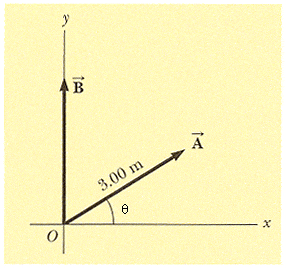
vector.gif
 
Physics news on Phys.org

Similar threads

Replies
8
Views
1K
  • · Replies 12 ·
Replies
12
Views
12K
Replies
3
Views
1K
  • · Replies 3 ·
Replies
3
Views
2K
  • · Replies 21 ·
Replies
21
Views
3K
Replies
13
Views
2K
Replies
13
Views
2K
  • · Replies 9 ·
Replies
9
Views
2K
  • · Replies 7 ·
Replies
7
Views
2K
Replies
11
Views
3K