A simple question about the flow of the electricity

  • Thread starter Thread starter DorelXD
  • Start date Start date
  • Tags Tags
    Electricity Flow
Click For Summary

Homework Help Overview

The discussion revolves around understanding electric circuits, specifically the behavior of charges as they move through resistors and the concept of energy transfer within the circuit. Participants are exploring fundamental principles of electricity, including resistance, energy loss, and current flow.

Discussion Character

  • Exploratory, Conceptual clarification, Assumption checking

Approaches and Questions Raised

  • Participants are questioning why charges do not lose all their energy at the first resistor they encounter and are exploring the relationship between resistance and energy loss. There are inquiries about the flow of charge in a circuit and whether charges can accumulate at any point. Some participants are also drawing analogies to gravitational potential energy to understand electrical potential energy.

Discussion Status

The discussion is active, with participants providing insights and models to clarify concepts. Some guidance has been offered regarding the nature of resistance and energy distribution, but multiple interpretations and questions remain unresolved, particularly concerning the movement of charges and energy transfer in the circuit.

Contextual Notes

Participants are grappling with foundational concepts in electricity, including the behavior of charges in circuits, the implications of resistance, and the conservation of energy. There is an acknowledgment of the complexity of these concepts, which may be compounded by the constraints of homework guidelines.

DorelXD
Messages
126
Reaction score
0
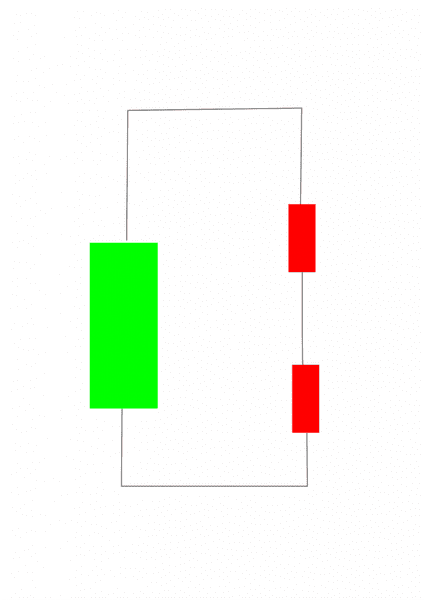
Hey guys! I'm trying to get a bettter undesrstanding of how the electric circuits work. But I do have a rather simple question. So, in the internal circuit we give energy to the charge. Let's say that I have an electricity source and two resitors, like this:
drawing_zps26dc98ff.png


So when passing through circuit elements the charge gives up energy, so that the sum of the amount of energy it gives to each resistor is equal to the initial energy. But why? Why doesn't the charge give all the energy to the first resistor it encounters ?

And why is there no potential difference between the two red resistors? I don't get that :( . I know it's a simple concept but I can't understand why the charge loses energy only when it passes through resistors ?
 
Last edited:
Physics news on Phys.org
Because it doesn't have to. Think of "resistance" as friction as the current passes through the resistor. There will be a certain amount of friction for the length of the resistor which causes the charge to lose energy (force times distance). The amount of energy lost depends upon the friction and distance but is not, in general, all of the energy of the current.
 
  • Like
Likes   Reactions: 1 person
HallsofIvy said:
Because it doesn't have to. Think of "resistance" as friction as the current passes through the resistor. There will be a certain amount of friction for the length of the resistor which causes the charge to lose energy (force times distance). The amount of energy lost depends upon the friction and distance but is not, in general, all of the energy of the current.

Ok, I think I get it. But, from what I read, and using the model you gave me, when the charge comes out of the second red resistor it should lose al its energy, right ? So if the charge loses all the energy, then how can it go back to the source ?
 
DorelXD said:
Ok, I think I get it. But, from what I read, and using the model you gave me, when the charge comes out of the second red resistor it should lose al its energy, right ? So if the charge loses all the energy, then how can it go back to the source ?

Why should the charge lose all of its energy after leaving the second resistor? The amount of energy lost is still proportional to the amount of resistance.
 
DorelXD said:
Ok, I think I get it. But, from what I read, and using the model you gave me, when the charge comes out of the second red resistor it should lose al its energy, right ? So if the charge loses all the energy, then how can it go back to the source ?

Which resistor is the first resistor? Is it possible the energy in the circuit flows from green to red down both sides of the circuit at the same time?
 
So the movement of the electrons has nothing to do with the energy they store ?
 
DorelXD said:
So the movement of the electrons has nothing to do with the energy they store ?

Nothing is not the right word to describe the relationship in general but in a simple circuit like yours you might want to think about the electrical source and what it provides to produce current flow.
 
Ok, I think I get it. But, from what I read, and using the model you gave me, when the charge comes out of the second red resistor it should lose al its energy, right ? So if the charge loses all the energy, then how can it go back to the source ?

The wire is assumed to have zero resistance.

If that's not correct and it has some resistance then the distribution of energy around the circuit will be different.

Perhaps it helps to understand that resistors are just little rods of some material that isn't an ideal conductor. So two resistors in series are equivalent to one longer rod or any number of shorter rods.

So your question..

Why doesn't the charge give all the energy to the first resistor it encounters ?

is like asking..

Why doesn't the charge give all the energy to the first few mm or μm of one of the resistors.
 
I rephrase my question. I drew a wire, and I also chose to represent two cross-section through it.

junction3_zps7c20b426.png


In other, word, how do I know that in the same interval of time the same amount of charge passes through the AA' and BB' ? It is quite intuitive, but I would like a justification. I can't find a simple argument, and it's driving me nuts. I can't gasp some simple concepts about electricity.
 
Last edited:
  • #10
DorelXD said:
In other, word, how do I know that in the same interval of time the same amount of charge passes through the AA' and BB' ? It is quite intuitive, but I would like a justification. I can't find a simple argument, and it's driving me nuts. I can't gasp some simple concepts about electricity.
If it were to happen that in a single continuous circuit fewer charges were passing one point than another, then the only explanations could be that charge was vanishing somehow, or it was accumulating or bunching up at some point intermediate. There is no mechanism shown here that could allow either scenario.

http://imageshack.us/scaled/landing/109/holly1756.gif
 
Last edited by a moderator:
  • #11
DorelXD said:
I rephrase my question. I drew a wire, and I also chose to represent two cross-section through it.

junction3_zps7c20b426.png


In other, word, how do I know that in the same interval of time the same amount of charge passes through the AA' and BB' ? It is quite intuitive, but I would like a justification. I can't find a simple argument, and it's driving me nuts. I can't gasp some simple concepts about electricity.

Charge cannot bunch up anywhere in a circuit. Not even in a capacitor. This fact is based on one of Maxwell's equations, which says that the total voltage drops around any circuit is zero. If current bunching took place then that statement would no longer be true. Kirchhoff recognized this and formulated his KCL and KVL laws.
 
  • #12
But what if the current bunched in some place ? Why isn't that possible ?
 
  • #13
DorelXD said:
But what if the current bunched in some place ? Why isn't that possible ?
Like charges repel each other. They try to push each other apart, and the closer they are the stronger they push apart so it follows they actively work against bunching up.

There is a difference between current and charge, but I'm sure you realize this.
http://imageshack.us/scaled/landing/109/holly1756.gif
 
Last edited by a moderator:
  • #14
Like charges repel each other. They try to push each other apart, and the closer they are the stronger they push apart so it follows they actively work against bunching up.

Ohhhh, right. :) :) :) :) :) :) :)

There is a difference between current and charge, but I'm sure you realize this.

Well, current is charge that flows.

Now, please, help me to understand the KVL law. I tried to make an analogy with the gravitational field.

I would like to post my questions gradually. Here's my first.

analogy_zpsb7f03e16.png


Let the point A be at the groudn level. So, here I go: I move the object from A to B and it gains potential energy. Since the gravitational force is conservative the path doesn't matter. By moving the object back to A again it loses al the potential energy.

Now in a circuit with only a battery: I move the charge from - to + and it gains electrical potential energy. So, if I move it back to - it should get there with no potential energy, right ? So, for me it seems that the potential energy the charge gets is converted to kinetic energy, so that the charge can move back to where it came from. I don't see how we could use some of the energy of the charge to do something else with it. That is, I can't see how putting a resistor in the circuit will use the energy in another way, so that we do something useful with it.

What am I doing wrong? Is it because the charge doesn't actually convert the potential energy to kinetic energy ? That is, the movement of the charge isn't based on the potential energy it gained when it exited the internal circuity, but on the collisions with other charges ? But how's that possible? The potential energy should change while the charge is moving because it changes the position relative to the battery :( :( :( :( :( . I'm confused...
 
  • #15
DorelXD said:
What am I doing wrong? Is it because the charge doesn't actually convert the potential energy to kinetic energy ? That is, the movement of the charge isn't based on the potential energy it gained when it exited the internal circuity, but on the collisions with other charges ? But how's that possible? The potential energy should change while the charge is moving because it changes the position relative to the battery :( :( :( :( :( . I'm confused...

http://hyperphysics.phy-astr.gsu.edu/hbase/electric/elevol.html#c1
 
  • #17
That is not a good analogy. A higher voltage battery doesn't cause a given quantity of charge to flow in the external conductor at a greater speed; it causes more charges to flow and with an unchanged speed (if you want to put it that way).

The model you are thinking of would be thermionic emission in a vacuum tube, where electrons are liberated from the cathode and fly through a vacuum to the anode terminal of the high voltage battery. The higher the voltage, the faster the electrons are accelerated and the more KE each gains. This energy can be liberated in spectacular fashion when the electron crashes into the metal anode.

But the unimpeded flight of a charged particle through the emptiness of a vacuum is totally different to the "bucket brigade" transfer of electricity that goes on in the sea of free electrons in a metallic conductor. The electron that enters the piece of wire at one end of the battery is not the same electron that disappears back into the other end of the battery.
 
  • Like
Likes   Reactions: 1 person
  • #18
DorelXD said:
But what if the current bunched in some place ? Why isn't that possible ?

Well, you'd have to ask Mr. Maxwell, except he's dead.
Plus, it would violate conservation of energy.
 
  • Like
Likes   Reactions: 1 person
  • #19
DorelXD said:
Ohhhh, right. :) :) :) :) :) :) :)


Well, current is charge that flows.

Now, please, help me to understand the KVL law. I tried to make an analogy with the gravitational field.

I would like to post my questions gradually. Here's my first.

analogy_zpsb7f03e16.png


Let the point A be at the groudn level. So, here I go: I move the object from A to B and it gains potential energy. Since the gravitational force is conservative the path doesn't matter. By moving the object back to A again it loses al the potential energy.

Now in a circuit with only a battery: I move the charge from - to + and it gains electrical potential energy. So, if I move it back to - it should get there with no potential energy, right ? So, for me it seems that the potential energy the charge gets is converted to kinetic energy, so that the charge can move back to where it came from. I don't see how we could use some of the energy of the charge to do something else with it. That is, I can't see how putting a resistor in the circuit will use the energy in another way, so that we do something useful with it.

What am I doing wrong? Is it because the charge doesn't actually convert the potential energy to kinetic energy ? That is, the movement of the charge isn't based on the potential energy it gained when it exited the internal circuity, but on the collisions with other charges ? But how's that possible? The potential energy should change while the charge is moving because it changes the position relative to the battery :( :( :( :( :( . I'm confused...

When a mass moves from the top to the bottom the potential energy at the top changes to kinetic energy at the bottom: mgh → 1/2 mv^2.

In the case of charge q the potential energy 'at the top' changes to heat energy 'at the bottom': qE → Q
Q is the heat added
E is the battery emf.
 
  • #20
Wow, I begin to understand :) . How exactly is the conservation of energy principle violated, could you please explain in more detail ? I'm dumb and I don't understand.
 
  • #21
DorelXD said:
Wow, I begin to understand :) . How exactly is the conservation of energy principle violated, could you please explain in more detail ? I'm dumb and I don't understand.

As I said, if charge bunched up at a node then the total voltage drops around a circuit would not be zero, but that would violate the conservation of energy since the electrostatic field is conservative.
 
  • #22
rude man said:
As I said, if charge bunched up at a node then the total voltage drops around a circuit would not be zero, but that would violate the conservation of energy since the electrostatic field is conservative.
It wouldn't violate conservation of energy. In fact, bunching can occur, but the positive and negative bunches cancel out, as in a capacitor. Total charge in the circuit (including the power source) is obviously conserved, as it is a closed system. Total charge within the power source tends to be conserved because of the way the power is generated.
Even without a capacitor as such, circuits have a small amount of capacitance, and inductance. If a resistance suddenly increases some charge bunching will occur, but since the capacitance is usually low even a small bunching will generate a large voltage, tending to spread the charge out again.

DorelXD, from the OP, it seems to me that your initial misconception was that the energy was a property of the charge, and the charge somehow carried the energy around with it, spending it along the way. Rather, it is charge x voltage. The resistors being the same, there'll be the same voltage drop across each.
The wires will also have some voltage drop, since they will have a little resistance, but it's much smaller.
 
  • #23
haruspex said:
It wouldn't violate conservation of energy.

The OP's circuit consists of a battery and two resistors. There can be no bunching at any node therein.

Introducing parasitics in a first EE or physics course leads only to confusion by the OP.
 
  • #24
DorelXD, from the OP, it seems to me that your initial misconception was that the energy was a property of the charge, and the charge somehow carried the energy around with it, spending it along the way. Rather, it is charge x voltage. The resistors being the same, there'll be the same voltage drop across each.
The wires will also have some voltage drop, since they will have a little resistance, but it's much smaller.

Thank you all for your time! It begins to make sense, but I'm still struggling a little.
 
  • #25
So let's put it that way: let's say I travel to the top of the building. Say that I'm a lazy person , and for reaching the top I take the elevator. But when I go back, I take the stairs. When I first reached the top my potential energy raised. When I climbed down the stairs my potential energy went back to 0. Is that what's happening inside a circuit ? I still can't picture it clearly in my mind..
 
  • #26
DorelXD said:
So let's put it that way: let's say I travel to the top of the building. Say that I'm a lazy person , and for reaching the top I take the elevator. But when I go back, I take the stairs. When I first reached the top my potential energy raised. When I climbed down the stairs my potential energy went back to 0. Is that what's happening inside a circuit ? I still can't picture it clearly in my mind..
Yes, that's a reasonable model for potential. In fact, if you think of height x gravitational acceleration as being the potential and your mass as charge then multiplying the two gives the potential energy.
 
  • #27
So, I'm trying to explain this to myself.

Ok, this is clear. So: I'm traveling up by elevator: I'm gaining gravitational potential energy. I'm climbing down the stairs: my potential energy is lost. But, let's suppose that by climbing down the stairs I don't get where I left from ; that is I don't arrive exactly at the doors of the elevator. To come back to where I left from, I must use some kinetic energy, correct ?

Well, let's look at the charge. It travels through the battery and it gains potential energy, right? Then, when it exits the battery it starts its journey through the connecting wires. Question:

From the end of the battery to the beginning of the restior, what type of energy does the charge use ? Does it convert it's potential energy to kinetic energy ?

Or is this an incorrect thinking? I'm thiking that the charge packs the energy and transports it to the resistor. Or in fact, the energy is transmited by collisions, I don't know how to put it, like a wave? I know that the electrons move very slowly, and for that reason, my judgement seems a bit odd.

Could someone clarify this, please?
 
  • #28
DorelXD said:
So, I'm trying to explain this to myself.

Ok, this is clear. So: I'm traveling up by elevator: I'm gaining gravitational potential energy. I'm climbing down the stairs: my potential energy is lost. But, let's suppose that by climbing down the stairs I don't get where I left from ; that is I don't arrive exactly at the doors of the elevator. To come back to where I left from, I must use some kinetic energy, correct ?

Well, let's look at the charge. It travels through the battery and it gains potential energy, right? Then, when it exits the battery it starts its journey through the connecting wires. Question:

From the end of the battery to the beginning of the restior, what type of energy does the charge use ? Does it convert it's potential energy to kinetic energy ?

Or is this an incorrect thinking? I'm thiking that the charge packs the energy and transports it to the resistor. Or in fact, the energy is transmited by collisions, I don't know how to put it, like a wave? I know that the electrons move very slowly, and for that reason, my judgement seems a bit odd.

Could someone clarify this, please?
The analogue of KE would be a magnetic field generated by inductance, maybe, but there is none here.
Your mistake is in thinking of the connecting wires as having no resistance. They're just more resistors, but with much smaller values.
 
  • #29
There is potential difference between the terminals of the battery. A resistor is connected to the terminals with wires, but the resistor is also a long wire. So there is a conductive path between the terminals of the battery, you can imagine it as a single wire. There is potential difference between the ends of the wire. At the negative terminal, the electrons feel a repulsive force so they move away from the terminal. At the positive terminal, the electrons of the metal are attracted. There is an electric field in the whole wire, which accelerates the electrons toward the positive terminal. The electrons gain some extra velocity parallel to the wire. You know that the electrons of the metal perform random motion. During their random motion, the electrons collide with the atoms of the metal, and loose their extra velocity gained from the electric field. As the result they will "drift" inside the wire with a constant velocity, proportional to the electric field intensity. That drift velocity is much smaller than the velocity of their random motion, and the KE associated with it can be ignored with respect to their average thermal KE. The extra energy the electrons gained from the field is added to the vibrating atoms, increasing their vibration amplitude, which means that the temperature of the metal increases. The electric energy of the battery is converted to heat inside the wires and the resistor. We say that the electric energy is dissipated when current flows through a resistor. The dissipated power is P=UI, U is the potential difference across the resitor and I is the current flowing through it.
When you climb down on stairs, your potential energy decreases, but your kinetic energy does not increase in average as you descend. Making one step, some of your PE is converted to KE, but arriving to the next step, you loose that extra velocity, by "colliding" with the stair. The change of PE converts to the elastic energy of your muscles, to chemical energy, and to heat, at the end.

ehild
 
  • #30
I believe I understand now. My picture of electric flow is much clearer. But still, how comes that the intensity of the current is constant? While passing through resitors, why doesn't the current "slow down" ? How are we sure that the flow is indeed a constant ?

Don't get me wrong! I understand that what comes in must definitely come out. But how comes that it goes out, at the same rate? Well, if two people enter a room through a door the two people will definitley come out sooner or later. Let's say that the first grabs a cup of coffee and the exits, and the second exits after he takes a nap. The electrons are very very dense, I get this. Is their tendency of repulsion that keeps them from gathering ?
 
Last edited:

Similar threads

Replies
20
Views
2K
Replies
4
Views
2K
Replies
14
Views
2K
  • · Replies 2 ·
Replies
2
Views
1K
  • · Replies 12 ·
Replies
12
Views
1K
Replies
2
Views
1K
Replies
3
Views
2K
Replies
2
Views
3K
  • · Replies 5 ·
Replies
5
Views
2K
  • · Replies 44 ·
2
Replies
44
Views
5K