Understanding the Role of Degrees of Freedom in 1-Dimensional Random Walks

Click For Summary
SUMMARY

The discussion centers on the concept of degrees of freedom in 1-dimensional random walks, specifically addressing the significance of the term "n-1" in the context of particle movement. Participants clarify that after n steps, the position of a particle is determined by its position after (n-1) steps plus a distance δ. The confusion arises from the relationship between the n-1 term and degrees of freedom, which is ultimately resolved through understanding the iterative nature of the random walk. The conversation also touches on the manipulation of equations involving δ and the implications of subtracting averages in the context of particle movement.

PREREQUISITES
  • Understanding of 1-dimensional random walks
  • Familiarity with the concept of degrees of freedom in physics
  • Basic knowledge of statistical averages and their calculations
  • Proficiency in interpreting mathematical notation and equations
NEXT STEPS
  • Study the principles of random walks in statistical mechanics
  • Explore the mathematical derivation of degrees of freedom in physical systems
  • Learn about the implications of averaging in stochastic processes
  • Investigate the role of δ in random walk equations and its effects on particle movement
USEFUL FOR

Students and professionals in physics, particularly those studying statistical mechanics, as well as mathematicians interested in stochastic processes and random walks.

SansaStark
Messages
15
Reaction score
0
Hello!
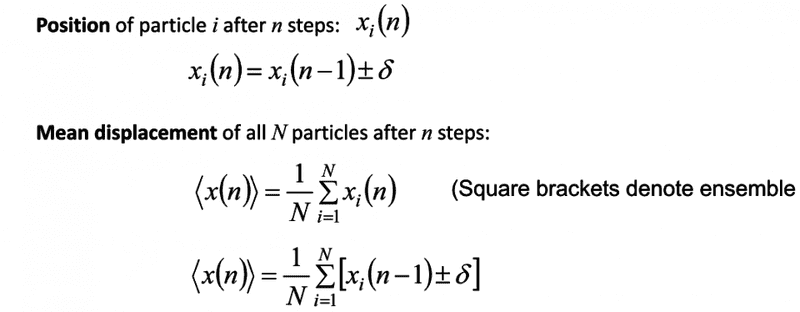
I'm struggling with a probably easy physics question concerning random walks. Here I have the slide regarding this:
Delta is the distance that a particle moves.
upload_2016-1-2_16-32-9.png


Can someone explain where the n-1 initially comes from? Does it have to do wtih the concept of the degrees of freedom?
Than you already! Regards, Vera
 
Mathematics news on Phys.org
Not sure if I understand the question. So your first equation states that after ##n## steps the particle is at the position it was after the previous step (which is the ##(n-1)##th step) plus some ##\delta##. If you put in ##n=1## you get that the position after the first step is the initial position plus some ##\delta##: ##x_1(1) - x_i(0) \pm \delta##. Every next step a new ##\delta## is added, so of course the position after ##n## steps depends on the position after ##(n-1)## steps. Why do you think this has to do anything with degrees of freedom?
 
  • Like
Likes SansaStark
After ##n-1## steps, particle i is at position ##x_i(n-1)##.
One step after that, at step ##n##, particle i has moved by ##\pm \delta##: therefore ##x_i(n)=x_i(n-1)\pm \delta##.
 
  • Like
Likes SansaStark
The notations ##x_n^{(i)}## and ##<x_n^{(i)} | 1≤i≤N >## might have been less confusing. Or more.
 
Oh okay, thank you. After some thinking ad not giving that much emphasis of on this n-1 (which so muchly looks like the n-1 from the df concept) I finally realized what both of you mean ;) I was really confused about why suddenly this n-1 would appear. But its probably quite reasonable. oO Thanks a lot!
 
@fresh42: More (for I have no clue what the vertical bar means AND SO ON) ;)
 
Another question:
Equation 1.) is followed by equation 2.). In equation 2.) the delta is treated separately as encircled in red colour. Is this just a process of pulling the expression after the sigma sign in equ. 1 apart?
But then, why is the second expression (in the circle) SUBTRACTED from the first part of equ. 2.)? I know it doesn't really matter as delta is 0... but just assume that the encircled expression without the minus in the beginning would equal a positive number. Then the outcome would be different compared to when the expression was negative. I know there's a mistake in thinking but I I just can figure out what's behind this. ^^

1.)
upload_2016-1-2_18-17-55.png
2.)
upload_2016-1-2_18-10-26.png
Just how I'd approach this: The first part of equ. 2.) is the average of all preceding steps (n-1) and the second part is the average of all distances after one step. Then, if I subtract all deltas and assume their average was negative (which just means this whole particle is moving in the opposite direction compared to a positive delta) this would result in a position (x) actually in the opposite direction of the negative delta average for it is subtracted from the first average...

Is that right or complete bullsh**? ;) Thanks!
 

Attachments

  • upload_2016-1-2_18-17-37.png
    upload_2016-1-2_18-17-37.png
    2.2 KB · Views: 632
Last edited:

Similar threads

  • · Replies 7 ·
Replies
7
Views
2K
  • · Replies 3 ·
Replies
3
Views
685
Replies
1
Views
5K
  • · Replies 18 ·
Replies
18
Views
3K
  • · Replies 4 ·
Replies
4
Views
7K
  • · Replies 8 ·
Replies
8
Views
2K
  • · Replies 8 ·
Replies
8
Views
2K
  • · Replies 1 ·
Replies
1
Views
2K
  • · Replies 22 ·
Replies
22
Views
6K
  • · Replies 12 ·
Replies
12
Views
8K