2 charged conductors connected by a wire

Click For Summary
SUMMARY

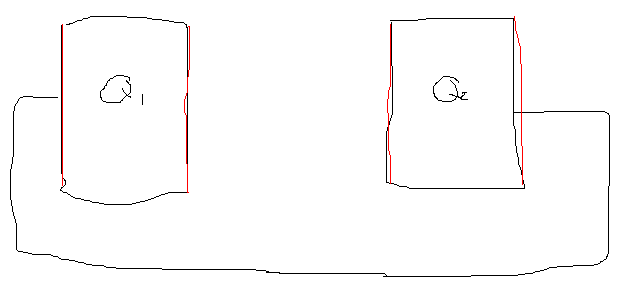
The discussion centers on the charge distribution of two charged conductors, Q1 and Q2, connected by an ideal wire, forming an ideal parallel plate capacitor. The total charge remains Q1 + Q2, but the charge distribution on the four surfaces depends on local geometry, particularly the radius of curvature. Gauss's law is employed to determine surface charge densities, revealing that the outward-facing surfaces (s1 and s4) should not hold charge, while the inward-facing surfaces (s2 and s3) must also be equipotential, leading to a complex interplay of charge conservation and distribution.

PREREQUISITES
  • Understanding of Gauss's Law in electrostatics
  • Familiarity with the concept of equipotential surfaces
  • Knowledge of surface charge density and its implications
  • Basic principles of parallel plate capacitors
NEXT STEPS
  • Study the application of Gauss's Law to various geometries
  • Explore the concept of equipotential surfaces in electrostatics
  • Investigate charge distribution in capacitors using simulation software
  • Learn about Maxwell's Equations and their role in electrostatics
USEFUL FOR

Electrophysics students, electrical engineers, and anyone interested in understanding charge distribution in electrostatic systems.

feynman1
Messages
435
Reaction score
29
2 separate big conductors initially charged Q1 and Q2. Then connect them with an ideal wire (no resistance). The charges Q1 and Q2 will go to the 4 surfaces (marked red). All the 4 surfaces have an area A. Suppose the 2 conductors form an ideal parallel plate capacitor. How to determine the charges on the 4 red surfaces?
1611927898366.png
 
Physics news on Phys.org
Since the entire assembly is an equipotential, the charge distribution will depend on the local geometry. The surface charge density will be higher where the radius of curvature, such as around corners, is smaller. Of course the total charge on the contraption will be Q1+Q2.
 
  • Like
Likes   Reactions: sophiecentaur and hutchphd
kuruman said:
Since the entire assembly is an equipotential, the charge distribution will depend on the local geometry. The surface charge density will be higher where the radius of curvature, such as around corners, is smaller. Of course the total charge on the contraption will be Q1+Q2.
Suppose the 2 conductors form an ideal parallel plate capacitor (infinitely large plates) and only the 4 red surfaces are considered.
 
feynman1 said:
Suppose the 2 conductors form an ideal parallel plate capacitor (infinitely large plates) and only the 4 red surfaces are considered.
Then you can use Gauss's law with appropriately chosen Gaussian "pillboxes" to find the surface charge distributions on all 4 flat faces.
 
kuruman said:
Then you can use Gauss's law with appropriately chosen Gaussian "pillboxes" to find the surface charge distributions on all 4 flat faces.
The 2 outward facing surfaces shouldn't hold charges as charges should flow through the wire. The inward facing surfaces shouldn't either otherwise the 2 conductors won't be equipotential. So where do the charges go?
 
feynman1 said:
The 2 outward facing surfaces shouldn't hold charges as charges should flow through the wire. The inward facing surfaces shouldn't either otherwise the 2 conductors won't be equipotential. So where do the charges go?
Sorry, when you said
feynman1 said:
only the 4 red surfaces are considered.
I thought that you were wondering what happens when the connecting wire is not there. My reply was based on the situation where you charge the conductors separately and you bring them close to each other with no wire.

Anyone who reads what you wrote in post #5 will see that you assert that there is no charge on the surfaces, you want to neglect any charge that might be on the connecting wire and then you wonder, "where do the charges go?" Maybe your assumption and reasoning why the plates can hold no charge are faulty? The total charge must be somewhere and it can only be on the plates and the wire.
 
kuruman said:
Sorry, when you said

I thought that you were wondering what happens when the connecting wire is not there. My reply was based on the situation where you charge the conductors separately and you bring them close to each other with no wire.

Anyone who reads what you wrote in post #5 will see that you assert that there is no charge on the surfaces, you want to neglect any charge that might be on the connecting wire and then you wonder, "where do the charges go?" Maybe your assumption and reasoning why the plates can hold no charge are faulty? The total charge must be somewhere and it can only be on the plates and the wire.
Right, let's consider the charge distribution when connected with the ideal wire. Where do the charges go? The wire can't hold any charge as the wire has no resistance. The plates can't hold charges either as they are equipotential. Anything wrong?
 
feynman1 said:
Anything wrong?
Yes, violation of charge conservation. Also the correct spelling of the word is "resista[/color]nce".

I have said all I have to say about this.
 
kuruman said:
Yes, violation of charge conservation. Also the correct spelling of the word is "resistance".

I have said all I have to say about this.
So how should charges be distributed?
 
  • #10
According to Maxwell's Equations. You need to specify the problem. I too am finished.
 
  • #11
These problems make a lot of assumptions, otherwise it's almost impossible to solve them.
Let's say the wire holds no charge and the metal chunks are large enough to neglect any charge beside those on the flat surfaces.
The system's (chunk1 plus chunk2) total initial charge is Q1+Q2 and the final is...?
We also know that, in an electrostatic situation the electric field inside a metal piece is...?

Let's begin with these two questions?
 
  • #12
In your first post, are you showing the thicknesses of the plates? Pretty thick if so, but that's OK. I just need to know. So the plate area is perpendicular to the page?

OK, I'll jump the gun and answer. If the plates are large in area and/or close together it doesn't matter anyway.

@Gordianus has given you good hints BTW

Let the surface charge densities be s1, s2, s3 and s4, left to right. (The inner surfaces are s2 and s3.)

Since the plates are at the same potential (due to the wire) is there an electric field in the gap? Which says what about the charge on the inner surfaces?

You of course also have (assuming unit area)
s1 + s2 = ? and
s3 + s4 = ?

You need 1 more equation. To get it I will give you a hint: put a test charge in say the left plate. What must be the net force on it? The force must come from all four surfaces.

Then you'd have 4 equations in 4 unknowns so you can solve for all the s's irrespective of the magnitude and polarity of Q1 and Q2.
 
Last edited:
  • #13
feynman1 said:
2 separate big conductors initially charged Q1 and Q2. Then connect them with an ideal wire (no resistance). The charges Q1 and Q2 will go to the 4 surfaces (marked red). All the 4 surfaces have an area A. Suppose the 2 conductors form an ideal parallel plate capacitor. How to determine the charges on the 4 red surfaces?

We can consider two cases separately.

In the first case, the charges of q1 and q2 are equal, but one is positive and the other is negative. When connecting with wires, all charges will be neutralized, so there will be no excess charges on the surface of any conductor.

In the second case, the amount of charge has not been completely neutralized, and the distribution of excess charge on the surface of the conductor will be determined according to the geometry and spatial distribution of the conductor. Of course, simulation software is necessary to get accurate answers in complex situations.

However, based on the diagram you provided, I believe that the eight corners of the two cubes and the four right-angle turning positions of the wires will accumulate more charge. 🤔
 
  • #14
alan123hk said:
We can consider two cases separately.

In the first case, the charges of q1 and q2 are equal, but one is positive and the other is negative. When connecting with wires, all charges will be neutralized, so there will be no excess charges on the surface of any conductor.

In the second case, the amount of charge has not been completely neutralized, and the distribution of excess charge on the surface of the conductor will be determined according to the geometry and spatial distribution of the conductor. Of course, simulation software is necessary to get accurate answers in complex situations.

However, based on the diagram you provided, I believe that the eight corners of the two cubes and the four right-angle turning positions of the wires will accumulate more charge. 🤔
Let's not consider corners. Let's consider these 2 as infinitely large parallel plates.
 
  • #15
Please stick to the original thread. I don't want to post PM.
feynman1 said:
Many thanks for replying in the thread! I'm ok with your analysis. The wire can't hold any charge as the wire has no resistance, which implies s1=s4=0?
Why do you say that? s1 and s4 are the outside two surfaces. What's that got to do with the wire?
The plates can't hold charges either as they are equipotential, so s2=s3=0.
Say what? If neither the plates nor the wire can hold charge, what happened to Q1 and Q2?
Then s1=s2=s3=s4=0. Anything wrong?
Plenty, I'm afraid. Do you even understand what I mean by the plate sides s1, s2, s3 and s4? They have nothing to do with the wire.
Assume the wire has zero charge
 
  • #16
rude man said:
Please stick to the original thread. I don't want to post PM.
Why do you say that? s1 and s4 are the outside two surfaces. What's that got to do with the wire? Say what? If neither the plates nor the wire can hold charge, what happened to Q1 and Q2?Plenty, I'm afraid. Do you even understand what I mean by the plate sides s1, s2, s3 and s4? They have nothing to do with the wire.
Assume the wire has zero charge
The 2 conductors are equipotential, so s2=s3=0.
Are you suggesting s1=s4=(Q1+Q2)/2? The s1 and s4 charges are connected with the ideal wire so don't they flow through the wire?
 
  • #17
feynman1 said:
The 2 conductors are equipotential, so s2=s3=0.
Are you suggesting s1=s4=(Q1+Q2)/2? The s1 and s4 charges are connected with the ideal wire so don't they flow through the wire?
I answered a few questions in your PM so you'll need to refer to that, but basically I prefer to stick to a thread rather than divert into private messages.
 
  • #18
feynman1 said:
The 2 conductors are equipotential, so s2=s3=0.
No, you can have a finite amount of s2 and s3 so long as they are of the same magnitude AND polarity.
feynman1 said:
The 2 conductors are equipotential, so s2=s3=0.
Are you suggesting s1=s4=(Q1+Q2)/2? The s1 and s4 charges are connected with the ideal wire so don't they flow through the wire?

Are you suggesting s1=s4=(Q1+Q2)/2? The s1 and s4 charges are connected with the ideal wire so don't they flow through the wire?
[/QUOTE]
Sometimes it's easier to just write the equations you know are correct and solve them. In electrostatics it's easy to get fooled by misapprehension.
 
  • #19
rude man said:
In your first post, are you showing the thicknesses of the plates? Pretty thick if so, but that's OK. I just need to know. So the plate area is perpendicular to the page?
The plate area is perpendicular to the page. The thicknesses are much smaller than the plate areas.
 
  • #20
rude man said:
You of course also have (assuming unit area)
s1 + s2 = ? and
s3 + s4 = ?
s1+s2, s3+s4 each shouldn't be conserved, but s1+s2+s3+s4 is conserved.
 
  • #21
rude man said:
No, you can have a finite amount of s2 and s3 so long as they are of the same magnitude AND polarity.
Then gauss's law is violated, if s2 and s3 have the same sign.
 

Similar threads

  • · Replies 15 ·
Replies
15
Views
1K
  • · Replies 1 ·
Replies
1
Views
1K
  • · Replies 2 ·
Replies
2
Views
1K
  • · Replies 3 ·
Replies
3
Views
2K
  • · Replies 1 ·
Replies
1
Views
1K
  • · Replies 8 ·
Replies
8
Views
2K
Replies
48
Views
5K
  • · Replies 13 ·
Replies
13
Views
2K
  • · Replies 10 ·
Replies
10
Views
1K
  • · Replies 4 ·
Replies
4
Views
2K