Homework Help Overview
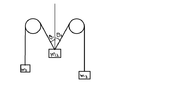
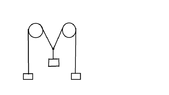
The discussion revolves around a system involving two pulleys and three masses, focusing on the tension in the strings connecting the masses. The original poster questions whether the tension remains constant throughout the string in this configuration, given the presence of multiple masses and pulleys.
Discussion Character
- Exploratory, Assumption checking, Conceptual clarification
Approaches and Questions Raised
- Participants explore the concept of tension in a multi-mass pulley system, questioning whether the tension is the same at all points in the string. Some suggest that the presence of a middle mass may lead to different tension values.
Discussion Status
The discussion is active, with participants providing insights into the conditions of the system, such as equilibrium and the forces acting on the masses. There is acknowledgment that the tensions may not be equal, and some participants have offered guidance on analyzing the forces involved.
Contextual Notes
Participants are considering the implications of different mass values and the setup of the system, including the need for free body diagrams and the effects of adding additional strings to the configuration. The discussion is framed within the context of homework help, emphasizing the need for clarity on given conditions and required outcomes.