2D Momentum Problem with little info for Object

  • Thread starter Thread starter aeromat
  • Start date Start date
  • Tags Tags
    2d Momentum
Click For Summary

Homework Help Overview

The problem involves a collision between two billiard balls, where one ball is moving and the other is stationary. The original poster provides the mass and initial velocity of the moving ball, as well as its post-collision speed and angle. The goal is to determine the speed and direction of the stationary ball after the collision, using the conservation of momentum principles.

Discussion Character

  • Exploratory, Assumption checking, Mathematical reasoning

Approaches and Questions Raised

  • Participants discuss the application of conservation of momentum in both x and y components to solve for the unknowns related to ball B. There are questions regarding how to proceed without knowing the mass of ball B and how to derive the angle and velocity from the equations presented.

Discussion Status

Some participants have provided guidance on using the momentum equations to isolate the variables for ball B. There is an exploration of relationships between the components of momentum, and multiple interpretations of the problem are being discussed without reaching a consensus.

Contextual Notes

The original poster expresses uncertainty about how to solve for the velocity of ball B due to a lack of information regarding its mass. There is also mention of not yet understanding the concepts of elastic and inelastic collisions, which may affect the approach to the problem.

aeromat
Messages
113
Reaction score
0
2D Momentum Problem with little info for Object

Homework Statement


A 0.150kg billiard ball [A] is rolling toward a stationary billiard ball at 10.0m/s. After the collision, ball [A] rolls off at 7.7m/s at an angle of 40.0 degrees clockwise from its original direction. What is the speed and direction of ball B after the collision?


Homework Equations


Conservation of Momentum
(Assuming I don't know the conservation of kinetic energy yet, or stuff about elastic/inelastic collisions)
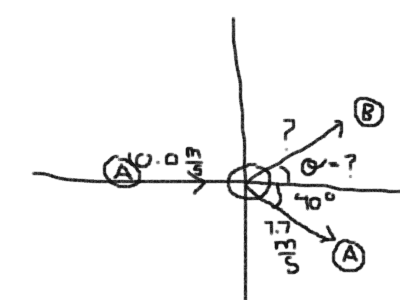

The Attempt at a Solution


PhysicsProblem.png


Ok, basically I got any INFO I would need regarding [A], but yet I have no idea how to approach

X-component[MAVA + 0 = MAV'A + MBV'B]
Y-component[0 = MAV'A + MBV'B]

X [(0.150kg)(10.0m/s) + 0 = (0.150kg)(7.7cos[40]m/s) + MBV'B]
Y [0 = (0.150kg)(-7.7sin[40]m/s) + MBV'B)]

I don't have a clue as to how I will solve for the velocity, when I am lacking any info on mass..
 
Physics news on Phys.org


Conservation of momentum is all that's needed. Remember: momentum is a vector quantity.

The equations you show can be solved for the x and y components of the momentum of ball B.


(mb)(vb)sin(theta) = (0.150)(7.7)sin(40)

(mb)(vb)cos(theta) = (0.150)(10) - (0.150)(7.7)cos(40)

Divide the first equation by the second and you should get tan(theta) = some number so you can solve for theta.


The deflection angle and velocity of B is all you need to deduce the mass of A, given it is stationary. Deducing velocity and incident angle of A is simple once you have the mass.


a 0.2kg block is sliding along a smooth horizontal surface at 8m/s. a bullet is fired at right angles to its motion and remains embeded in the block. if the impact changed direction of the block's motion by 30 degrees whatis the bullet's speed just before it struck the block?
 

Similar threads

Replies
10
Views
3K
Replies
10
Views
3K
Replies
14
Views
3K
  • · Replies 1 ·
Replies
1
Views
3K
  • · Replies 19 ·
Replies
19
Views
3K
  • · Replies 3 ·
Replies
3
Views
4K
  • · Replies 1 ·
Replies
1
Views
7K
  • · Replies 3 ·
Replies
3
Views
2K
  • · Replies 11 ·
Replies
11
Views
3K
  • · Replies 2 ·
Replies
2
Views
3K