What are the coordinates of points equidistant from (1,0) and (5,4)?

  • Context: MHB 
  • Thread starter Thread starter karush
  • Start date Start date
  • Tags Tags
    Circles
Click For Summary
SUMMARY

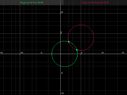
The coordinates of points equidistant from (1,0) and (5,4) with a distance of $\sqrt{10}$ are (2,3) and (4,1). The problem was solved by setting up two equations of circles using the general form $(x-h)^2+(y-k)^2=r^2$. The equations were $(x-1)^2+(y-0)^2=10$ and $(x-5)^2+(y-4)^2=10$. By equating and solving these equations, the intersection points were determined accurately.

PREREQUISITES
  • Understanding of the general equation of a circle: $(x-h)^2+(y-k)^2=r^2$
  • Knowledge of algebraic manipulation and solving quadratic equations
  • Familiarity with coordinate geometry concepts
  • Basic graphing skills to visualize circle intersections
NEXT STEPS
  • Study the properties of circles in coordinate geometry
  • Learn how to derive and solve systems of equations involving circles
  • Explore the use of graphing tools for visualizing mathematical problems
  • Investigate the application of distance formulas in geometry
USEFUL FOR

Students and educators in mathematics, particularly those focusing on geometry, algebra, and coordinate systems. This discussion is also beneficial for anyone looking to enhance their problem-solving skills in mathematical contexts.

karush
Gold Member
MHB
Messages
3,240
Reaction score
5
Find the coordinates of all points
whose distance form (1,0) is $\sqrt{10}$
and whose distance is from (5.4) is $\sqrt{10}$

ok assume first we convert the info to (2) general eq of a circle
$(x-h)^2+(y-k)^2=r^2$
so we have
$(x-1)^2+(y-0)^2=10$ and $(x-4)^2+(y-4)^2=10$edit:took out tikz
 
Last edited:
Mathematics news on Phys.org
karush said:
ok assume first we convert the info to (2) general eq of a circle
$(x−h)^2+(y−k)^2=r^2$
so we have
$(x−1)^2+(y−0)^2=10$ and $(x−{\color{red}5})^2+(y−4)^2=10$

fixed
 
Find the coordinates of all points
whose distance form (1,0) is $\sqrt{10}$
and whose distance is from (5.4) is $\sqrt{10}$

$(x-h)^2+(y-k)^2=r^2$
so we have
$(x-1)^2+(y-0)^2=10$ and $(x-5)^2+(y-4)^2=10$
these eq are equal to each other so expand and combine like terms
$(x-1)^2+(y-0)^2=(x-5)^2+(y-4)^2$
$x^2-2x+1+y^2=x^2-10x+25+y^2-8y+16$
$-2x+1=-10x-8y+41$
$8y=-8x+40$
$y=-x+5$
so far?
W|A says but ?
x = 2, y = 3
x = 4, y = 1

W|A

edit: took out tikz
 
Last edited:
$y = 5-x \implies (x-1)^2 + (5-x)^2 = 10$

solve for the two values of x, then the two corresponding values of y
 
Last edited by a moderator:
$(x-1)^2 + (5-x)^2 = 10$
$x^2-2x+1+25-10x+x^2=10$
$2x^2-12x+16=0$
$x^2-6x+8=0$
$(x-2)(x-4)=0$
$x=2\quad x=4$
$y=5-2=3$
$y=5-4=1$
hence pts of intersection are (2,3),(4,1)
tikz isn't correct

edot: fixed tikz cirlcles

\begin{tikzpicture}[xscale=.3,yscale=.3]
\draw [thin] (0,-5) -- (0,10);
\draw [thin] (-5,0) -- (10,0);
\draw[thick] (1,0) circle (3.162277);
\draw[thick] (5,4) circle (3.162277);
\draw[thin][fill] (2,3) circle (.2);
\draw[thin][fill] (4,1) circle (.2);
\end{tikzpicture}
 
Last edited:
84FD3136-5DAA-4C9A-8E3C-5C7A4CA5B176.png

yep … what did you do wrong?
 
the radius had to be $\sqrt{10}$ not 10
but now need to put ticks and text for intersection pts (2,3)(4,1)nice graph but I like more control of ticks
 
Last edited:

Similar threads

Replies
8
Views
2K
  • · Replies 7 ·
Replies
7
Views
3K
  • · Replies 2 ·
Replies
2
Views
2K
  • · Replies 4 ·
Replies
4
Views
1K
  • · Replies 8 ·
Replies
8
Views
2K
  • · Replies 1 ·
Replies
1
Views
8K
  • · Replies 1 ·
Replies
1
Views
2K
  • · Replies 7 ·
Replies
7
Views
3K
  • · Replies 2 ·
Replies
2
Views
1K
  • · Replies 3 ·
Replies
3
Views
3K