Mccleaves
- 1
- 0
3 excess electrons...calculate the radius...coaxial cable...
An oil droplet with 3 excess electrons is held stationary in a field of 4.24x10⁴N/C.
What is the radius of the oil drop?( The density of the oil is 824 kg/m3,e=1.60x10-19C)
F=qE=mg
m=(density)(volume)
well i assumed that the droplet was a sphere and so the volume would be (4/3 [tex]\pi[/tex]r3. So i set F=qe=mg because the droplet is stationary so the net force is zero. And the mass = density x volume so i just plugged every thing in and solved for r ...i got 8.43 x 10⁻⁷...can some one verify this ..i am not really confident lol
The cross section of a long coaxial cable is shown, with radii as given. The linear charge density on the inner conductor is-10nC/m and the linear charge density on the outer is -40nC/m. The inner and outer cylindrical surfaces are respectively denoted A,B,C and,D ad shown. The linear charge densities on surfaces C and D, in nC/m, are closest to:
A) +10 and -40
B) -10 and -30
C) 0 and -40
D) +10 and -50
E) -30 and -10
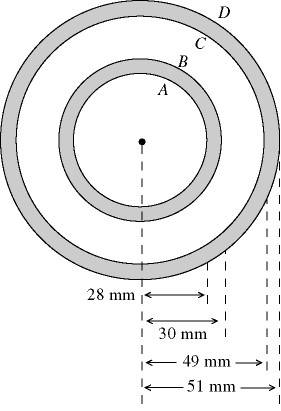
I'm not exactly sure what to do...
The only thing i could think of was that the system is a conductor so the inside charges must be equal to zero and so i thought that what ever the inside charges added up to then the outside charge would be the same magnitude as the sum of the inside charges but opposite in sign. I don;t even know if that is conceptually correct ...please help ...i don;t think i understand the underlying concept of this question...let alone actually solving it haha.
Homework Statement
An oil droplet with 3 excess electrons is held stationary in a field of 4.24x10⁴N/C.
What is the radius of the oil drop?( The density of the oil is 824 kg/m3,e=1.60x10-19C)
Homework Equations
F=qE=mg
m=(density)(volume)
The Attempt at a Solution
well i assumed that the droplet was a sphere and so the volume would be (4/3 [tex]\pi[/tex]r3. So i set F=qe=mg because the droplet is stationary so the net force is zero. And the mass = density x volume so i just plugged every thing in and solved for r ...i got 8.43 x 10⁻⁷...can some one verify this ..i am not really confident lol
Homework Statement
The cross section of a long coaxial cable is shown, with radii as given. The linear charge density on the inner conductor is-10nC/m and the linear charge density on the outer is -40nC/m. The inner and outer cylindrical surfaces are respectively denoted A,B,C and,D ad shown. The linear charge densities on surfaces C and D, in nC/m, are closest to:
A) +10 and -40
B) -10 and -30
C) 0 and -40
D) +10 and -50
E) -30 and -10
Homework Equations
I'm not exactly sure what to do...
The Attempt at a Solution
The only thing i could think of was that the system is a conductor so the inside charges must be equal to zero and so i thought that what ever the inside charges added up to then the outside charge would be the same magnitude as the sum of the inside charges but opposite in sign. I don;t even know if that is conceptually correct ...please help ...i don;t think i understand the underlying concept of this question...let alone actually solving it haha.
Last edited: