3D Heat equation with elementary Dirichlet BC

Click For Summary
SUMMARY

The discussion centers on solving the 3D heat equation with elementary Dirichlet boundary conditions in a semi-infinite domain. The problem involves a constant thermal diffusivity and an initial temperature of zero, with a small square area instantaneously heated to a temperature of u0 while the rest remains at zero. The user, Florian, seeks an analytical solution, noting that existing methods like Green's functions are effective under Neumann conditions but not under Dirichlet conditions. He references A.V. Liukov's Analytical Heat Diffusion Theory (1968) and suggests that properties of the Dirac delta function may be relevant for addressing the boundary conditions.

PREREQUISITES
  • Understanding of the 3D heat equation and its applications.
  • Familiarity with Dirichlet and Neumann boundary conditions.
  • Knowledge of Green's functions in heat conduction problems.
  • Basic principles of Laplace transforms in solving differential equations.
NEXT STEPS
  • Research analytical methods for solving the 3D heat equation with Dirichlet boundary conditions.
  • Study the application of Green's functions specifically for Dirichlet conditions.
  • Explore the use of the Dirac delta function in heat diffusion problems.
  • Investigate alternative mathematical techniques for heat conduction, such as Fourier series expansions.
USEFUL FOR

Mathematicians, physicists, and engineers working on heat conduction problems, particularly those dealing with boundary value problems in partial differential equations.

Flo31
Messages
1
Reaction score
0
TL;DR
3D Heat equation with dirichlet condition in semi infinite domain
Hi,

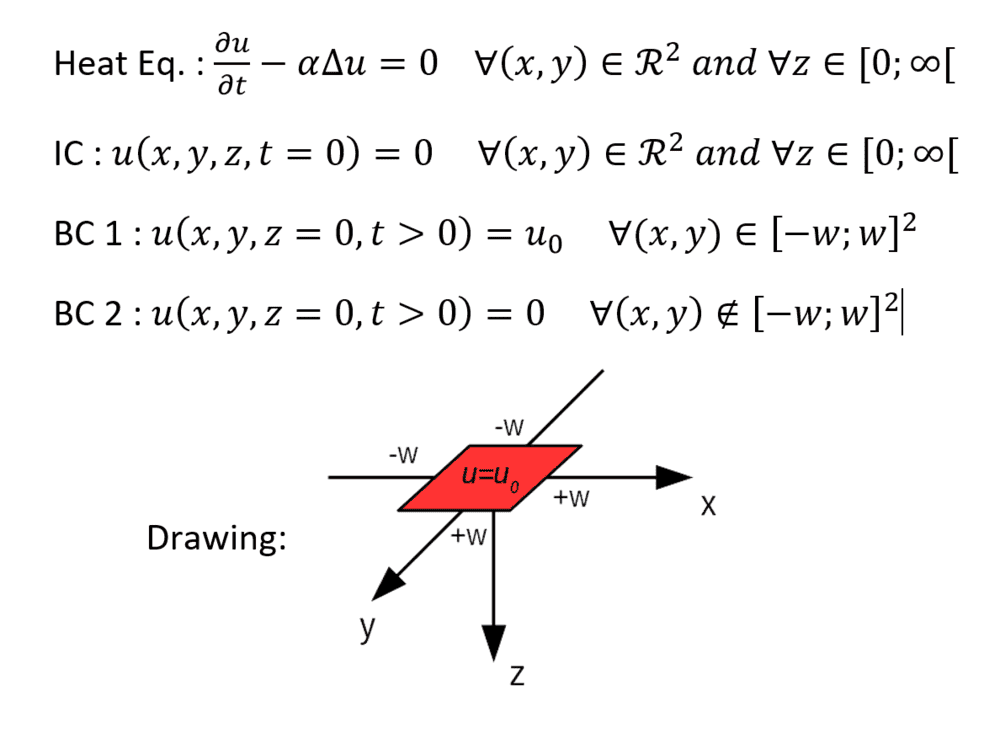
I am looking for the solution of the following heat conduction problem (see figure below):
  • the geometry is the semi-infinite domain such that (x,y)∈R2 and z∈[0,∞[ ;
  • the thermal diffusivity is constant;
  • the domain is initially at a temperature of 0;
  • At t>0, a small square of the surface ((x,y)∈R2) is instantaneously brought at a temperature of u0. The rest of the boundary is maintained at a temperature of 0.
The solution to such problem is fairly easy to get with Green's functions when Neumann boundary conditions are imposed(i.e. imposed heat flux on the surface z=0). I would be surprised that no analytical solution to the same problem with Dirichlet conditions does not exist, although I don't manage to find it. How such boundary can be treated?

I looked into the solutions given by A.V. Liukov Analytical Heat Diffusion Theory (1968), but nothing looks similar to this. The issue, here is the combination of having Dirichlet BC and that the value of temperature on z=0 depends on x and y. Using the properties of door function may help (similarly to the dirac distribution for describing a point source in Green's problem), but I am still not sure how to tackle the problem.
PhysicsForum.PNG
Please let me know your opinion on this problem.
Thanks,
Florian
 
Physics news on Phys.org
Why isn't taking Laplace transforms viable here?
 

Similar threads

  • · Replies 2 ·
Replies
2
Views
2K
  • · Replies 2 ·
Replies
2
Views
3K
  • · Replies 4 ·
Replies
4
Views
4K
  • · Replies 6 ·
Replies
6
Views
3K
  • · Replies 22 ·
Replies
22
Views
4K
  • · Replies 3 ·
Replies
3
Views
3K
  • · Replies 7 ·
Replies
7
Views
3K
  • · Replies 6 ·
Replies
6
Views
3K
  • · Replies 8 ·
Replies
8
Views
3K
  • · Replies 13 ·
Replies
13
Views
3K