3D Schrödinger Equation for a magnetic vector potential in cylinder coordinates

Click For Summary

Discussion Overview

The discussion revolves around the wavefunction of an electron traveling through a magnetic vector potential in a cylindrical coordinate system. Participants explore the implications of the Schrödinger equation under these conditions, focusing on the mathematical formulation and potential solutions.

Discussion Character

  • Technical explanation
  • Mathematical reasoning
  • Debate/contested

Main Points Raised

  • One participant describes their attempt to solve the Schrödinger equation with a specific magnetic vector potential and expresses uncertainty about the resulting differential equations.
  • Another participant questions the clarity of the equations presented, particularly regarding constants and the correctness of the notation used.
  • A suggestion is made to perform a Gauge Transformation to simplify the problem, leading to a new form of the wavefunction.
  • Concerns are raised about the continuity of the vector potential at a specific boundary, prompting discussions about integrating to find solutions.
  • Several participants propose different forms for the scalar function \Lambda and discuss the challenges in reconstructing the initial vector potential from these forms.
  • One participant provides a potential solution for \Lambda but notes that it does not match the behavior of the original vector potential, indicating a possible issue with the solution.
  • Another participant points out inconsistencies in the equations, suggesting that the initial assumptions may not lead to valid solutions.
  • A later reply references historical solutions to similar problems, introducing the idea of associated Laguerre polynomials as part of the discussion.

Areas of Agreement / Disagreement

Participants express differing views on the correctness of the equations and proposed solutions, indicating that multiple competing models and interpretations remain unresolved.

Contextual Notes

Participants highlight the need for clarity regarding constants and boundary conditions, as well as the dependence of solutions on the specific forms of the vector potential and scalar function. There are unresolved mathematical steps and assumptions that affect the discussion.

crazy-phd
Messages
8
Reaction score
0
Hi there,
during my work on my PhD thesis as an experimental physicist I ended up with a very theoretical problem:
What does the wavefunction of an electron traveling through a magnetic vector potential look like?

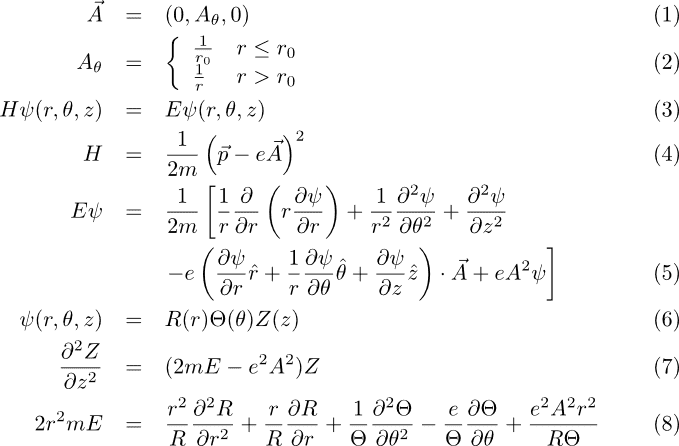
I chose a cylindrical coordinate system with a magnetic vector potential A (see eq (1) and (2)) for which I want to solve the Schrödinger equation (3). As there shall be no other potentials present the Hamilton operator looks like equation (4).

Using the considerations for the vector potential my differential equation looks like equation (5). In a first attempt I tried the usual separation of variables (equation (6)) which leads to two differential equations (7) and (8), in which R & Z and R & \Theta are coupled.

schrodinger-vector-potential.png


Has anybody an idea on how to solve this "beast"?

Thank you
 
Physics news on Phys.org
I don't think that you have written an equation down that we can solve, you haven't said what is constant and what isn't. For example is E a constant?

If I get your notation, I think that (8) is wrong.
 
Hi Mat,
as usual m,e and E are constants (mass, charge and kinetic energy of an electron).
I did not bother to insert for A², but that would be equal to 1/r² or 1/r²_0 (r_0 is an arbitrary constant].

If you have any other regards why equation (8) should be wrong, please let me know.

CU Andi
 
Does your last term in (5) equal your last term in (8)? If that is the case and you are dividing through by \psi then the last term in (8) should just be eA^{2} (I think)
 
It's me again.
After checking back to some books I decided to perform a Gauge Transformation of the form
\vec{A}' = \vec{A}+\mathrm{grad}\Lambda=0
such that the solution to the initial Schrödinger equation becomes
\psi = \psi'*\mathrm{e}^{\frac{ie}{\hbar c}\Lambda},
where \psi' is the solution of the Schrödinger equation in the absence of a magnetic vector potential, i is the complex number.

In order to got to my desired solution I have to solve a much simpler differential equation
\vec{A} = \vec{\nabla}\Lambda.
Due to symmetries of my problem - as mention in the previous post - the vector A looks in a more difficult form like this in cylindrical coordinates:
\vec{A}=\left(A_r,\,A_\theta,\,A_z\right),\; A_r=\left\{\begin{array}{cc}\propto r & r<r_0\\ \propto\frac{1}{r} & r>r_0\end{array}\right.,\,A_\theta=\theta+\frac{1}{2}\pi,\,A_z=0

Thanks to "trial and error" I can consider a good approximation for \Lambda for the last case r>r_0 to be the following
\Lambda(r,\,\theta,\,z)\propto\pi\theta+\theta^2

My remaining problem now is the first case. What does \Lambda look for r<r_0?
Can anybody suggest an analytical or numeric solution??

Thank you
 
Last edited:
A has to be continuous at r=r_{0}[/itex}? Then just integrate. You should have one boundary condition and one matching condition for the two constants.
 
That's exactly what I thought when I started out with this adventure: "just" integrate.

Yes, it would be helpful for \Lambda to be continuous at r=r_0

But one has to keep in mind, that I'm talking about a 3 dimensional vector potential \vec{A} and a scalar function \Lambda of 3 variables. So I end up with a set of differential equations:
\begin{eqnarray}<br /> \frac{\partial\Lambda(r,\,\theta,\,z)}{\partial r} &amp;=&amp; A_r = \left\{\begin{array}{cc}k_1r &amp; r&lt;r_0\\ k_2\frac{1}{r} &amp; r&gt;r_0\end{array}\right.,\; k_i: \mathrm{constants}\\<br /> \frac{1}{r}\frac{\partial\Lambda(r,\,\theta,\,z)}{\partial\theta} &amp;=&amp; A_\theta=\theta+\frac{\pi}{2}\\<br /> \frac{\partial\Lambda(r,\,\theta,\,z)}{\partial z} &amp;=&amp; A_z = 0<br /> \end{eqnarray}<br />

As mentioned previously the case r&gt;r_0 is almost trivial. The problem is one has to find a scalar function \Lambda(r,\,\theta) that solves the first two equations. None of the expressions I tried as a solution for \Lambda(r,\,\theta) did reconstruct the initial \vec{A}.

I tried several forms of "separation of variables", but none resulted in a solution.
This is why I am asking for help in this forum...
 
Last edited:
From the third equation you know that \Lambda =\Lambda (r,\theta ), from the second equation you find that:
<br /> \Lambda =\frac{1}{2}r\theta^{2}+f(r)<br />
Where f(r) is an arbitrary function of r. and if you plug this into the first equation you find that:
<br /> \frac{1}{2}\theta^{2}+f&#039;(r)=\left\{<br /> \begin{array}{cc}<br /> k_{1}r &amp; r&lt;r_{0} \\<br /> \frac{k_{2}}{r} &amp; r&gt;r_{0}<br /> \end{array}\right.<br />
Can you integrate that?
 
Your equations can be solved without big problems:
<br /> \Lambda(r,\,\theta,\,z) = \frac{1}{2}r\theta^2+\left\{\begin{array}{cc}<br /> \frac{2k_1\mathrm{ln}(r)}{\theta(\theta+\pi)} &amp; r&gt;r_0\\<br /> \frac{k_2r^2}{\theta(\theta+\pi)} &amp; r&lt;r_0<br /> \end{array}\right.<br />
The gradient of this expression does not show a similar behavior like the initial vector potential, which suggests that this is no true solution to the equation.

forum-original-vector-field.png

This is a cut plane through the original vector potential.

forum-ansatz-lambda.png

This is \Lambda in the z=0 plane.

forum-ansatz-vector-field-2.png

This is the gradient of \Lambda, which shows clearly a different behavior.

Using another approach
<br /> \Lambda(r,\,\theta,\,z)=\left\{\begin{array}{cc}<br /> \frac{1}{2}\theta^2+\pi\theta &amp; r&gt;r_0\\<br /> ? &amp; r&lt;r_0<br /> \end{array}\right.<br />

This results in a similar behavior for r&gt;r_0. In the following figure \vec{\nabla}\Lambda is plotted for the entire range of r.
forum-ansatz-vector-field-1.png
 
  • #10
Looking that the solution you gave, I don't think you've got the correct solution as you have a singularity at \theta =0,-\pi and when you set r=r_{0} you don't get the same solution.

Also looking at your initial equations, A_{\theta} appears to be constant for r&lt;r_{0} and yet in your later equations it isn't. I don't think that you've solved the equations correctly.
 
  • #11
You cannot get rid of the vector potential with your gauge transformation because A has non-vanishing rotation. The problem has been solved in 1928 by Fock. Solutions of the radial part are associated Laguerre polynomials. See S. Mikhailov, Physica B 299 (2001), 6-31
 

Similar threads

Replies
3
Views
3K
  • · Replies 17 ·
Replies
17
Views
3K
  • · Replies 2 ·
Replies
2
Views
3K
  • · Replies 2 ·
Replies
2
Views
2K
  • · Replies 2 ·
Replies
2
Views
2K
  • · Replies 6 ·
Replies
6
Views
2K
  • · Replies 1 ·
Replies
1
Views
4K
  • · Replies 1 ·
Replies
1
Views
3K
  • · Replies 6 ·
Replies
6
Views
3K
  • · Replies 32 ·
2
Replies
32
Views
4K