What is 4-Vector Potential Transformation under Gauge Fixing?

Click For Summary
SUMMARY

The discussion focuses on the concept of 4-vector potential transformation under gauge fixing, emphasizing that a gauge transformation modifies the 4-vector potential without altering the electric (E) and magnetic (B) fields. It highlights that the B field is derived from the curl of the 3-vector part of the vector potential A, and thus, adding a 3-vector with zero curl to A does not affect B. Gauge fixing is defined as the process of imposing specific conditions on A to simplify calculations, while maintaining the gauge-invariant nature of the equations involved.

PREREQUISITES
  • Understanding of 4-vector potential in electromagnetism
  • Familiarity with gauge transformations
  • Knowledge of curl operations in vector calculus
  • Basic principles of gauge invariance
NEXT STEPS
  • Research common gauge fixing conditions in electromagnetism
  • Study the implications of gauge invariance on physical equations
  • Explore the mathematical properties of curl in vector fields
  • Learn about applications of gauge theory in quantum field theory
USEFUL FOR

This discussion is beneficial for physicists, electrical engineers, and students studying electromagnetism or gauge theory, particularly those interested in the mathematical foundations of field theory.

Kulkarni Sourabh
Messages
2
Reaction score
1
Homework Statement
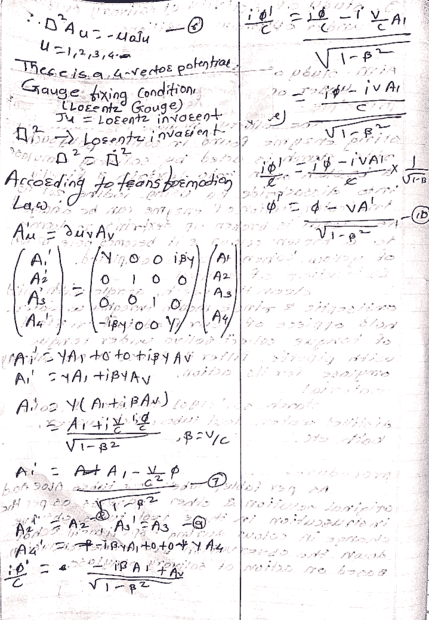
4- vector potential transformation under Gauge fixing.
Relevant Equations
.
What is 4- vector potential transformation under Gauge fixing ?
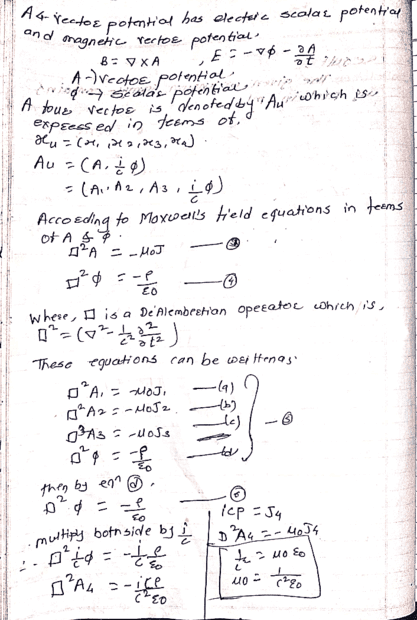
Screenshot_2023_0220_150437.png
Screenshot_2023_0220_150520.png
 
Physics news on Phys.org
A gauge transform is a change in the 4-vector potential that leaves the ##E## and ##B## fields unchanged. So, for example, consider the 3-vector part of ##A##. Since the ##B## field is the curl of the 3-vector part of ##A##, then changing ##A## by adding a 3-vector with zero curl does not change ##B##.

Gauge fixing means to select particular conditions on ##A## to simplify the calculations you are currently doing. You do this by adding the corresponding things to ##A## such that the required condition is true. There are a number of commonly used gauge fixing conditions.

They are useful because we usually express the original version of the equations in a gauge-invariant (or covariant) form. That means we write all the equations in such a way that they are still true regardless of the gauge conditions we apply. That means if we were to do the calculation in another gauge we would necessarily get the same answer. Assuming, of course, we didn't make a mistake.
 
Last edited by a moderator:

Similar threads

  • · Replies 1 ·
Replies
1
Views
1K
  • · Replies 5 ·
Replies
5
Views
2K
  • · Replies 1 ·
Replies
1
Views
2K
Replies
3
Views
2K
Replies
19
Views
3K
  • · Replies 4 ·
Replies
4
Views
2K
  • · Replies 2 ·
Replies
2
Views
3K
  • · Replies 5 ·
Replies
5
Views
2K
  • · Replies 4 ·
Replies
4
Views
3K
  • · Replies 1 ·
Replies
1
Views
3K