8-Bit Ripple Carry Multiplier using 4-Bit Adders

  • Thread starter Thread starter tmlee2
  • Start date Start date
  • Tags Tags
    Ripple
Click For Summary

Discussion Overview

The discussion revolves around designing an 8-bit multiplier using 4-bit adders, specifically addressing issues encountered with a ripple carry multiplier schematic. Participants explore various approaches and solutions to correct the design and improve functionality.

Discussion Character

  • Technical explanation
  • Debate/contested
  • Experimental/applied

Main Points Raised

  • One participant describes their initial design of an 8-bit multiplier using 16 4-bit adders and requests help to identify mistakes in the schematic.
  • Another participant suggests a method to connect the lower and upper bits of the inputs to two 4-bit adders, proposing a way to make them function as a single 8-bit adder.
  • A participant points out that the specific 4-bit adder IC being used does not have an enable pin, which complicates the proposed solution.
  • One participant mentions the use of flip-flop circuits as adders and recommends checking the datasheet for the specific chip to understand its functionality better.
  • A link to an article on half-adders and full-adders is shared, which may provide additional insights into the circuit design.
  • A participant later finds a solution that involves using 2-input AND gates to drive each stage while still utilizing the 4-bit adder ICs.

Areas of Agreement / Disagreement

Participants express differing views on the best approach to design the multiplier, with no consensus reached on a single solution. Some methods are proposed, but challenges remain regarding the specific components being used.

Contextual Notes

Participants note limitations related to the specific ICs being used, such as the absence of an enable pin, which affects the proposed solutions. There is also mention of the need for additional components like AND gates to implement certain designs.

Who May Find This Useful

Individuals interested in digital circuit design, specifically those working with multipliers and adders in hardware implementations.

tmlee2
Messages
3
Reaction score
0
Hey Everyone,

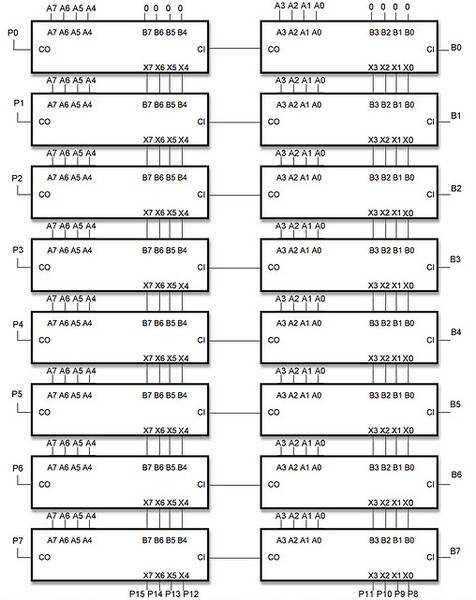
I want to design an 8-bit Multiplier, using 4-bit Adders. I created a Ripple Carry Multiplier using 16 4-bit adders, but after debugging realized it doesn't work. I got this schematic off of a 4-bit multiplier i saw online, but can't find the link to it anymore.

Here is the schematic I created:
8546963078_894888afed_z.jpg


SUMMARY HOW IT WORKS:

Mantissa 1 (A7-A0) go into A7-A0 of each ADDER stage.
Mantissa 2 (B7-B0) go into the CI of each ADDER stage.
0’s go into the first stage of B7-B0, to initialize it.
The output of each stage (X7-X0) go into the input of next stage (B7-B0).
The results (P7-P0) are on the CO of each stage, and the outputs of the last stage (X7-X0) are P15-P8.

If someone could please help me correct it or see any mistakes or know of any another way to create an 8-bit multiplier using 4-bit adders. Thank you for your time and help!
 
Engineering news on Phys.org
Its in the adressing take the lower 4 bits connect to the one 4 bit adder. Take the upper 4 bits to the second adder. Have the same signal activate both Chip enable pins. you will have to connect the output of a3to a1 of the second 4bit adder. This will essentially make 2 4bit adders act as one 8bit adder. a
A0to A3 connect output a3 to A0 input of second adder. On the
second adder address as A4 to A7

edit forgot to mention each output of the adder needs to connect to the input of the next bit.
Ao output to A1 input a1 ouptut to a2 input repeat till A7
 
Last edited:
Thank you for your feedback, but the IC's I am using (74HC283) do not have an enable pin, so that solution won't work, I should have listed that before.

EDIT: Do you know any 4-bit adder ICs with an enable on it? That would be very helpful.
 
Last edited:
The method I described was utilizing a flip flop circuit as an adder. The chip you described works differently. Its been sometime for me on the circuit I described I would recommend you post the datasheet for the chip you have. I am on my phone atm so would be tricky for me to do so.
However the datasheet may provide the answer you need at least it will help us with your circuit.
 
I have found a solution to my problem, I can do what you described above but need 2-input AND gates to drive each stage and still use my 4-bit Adder ICs. Thank you for your help!
 
No problem glad you found the solution
 

Similar threads

  • · Replies 2 ·
Replies
2
Views
27K
  • · Replies 3 ·
Replies
3
Views
1K
  • · Replies 16 ·
Replies
16
Views
3K
  • · Replies 1 ·
Replies
1
Views
6K
  • · Replies 6 ·
Replies
6
Views
19K
Replies
7
Views
35K
  • · Replies 12 ·
Replies
12
Views
11K
  • · Replies 2 ·
Replies
2
Views
3K
  • · Replies 2 ·
Replies
2
Views
3K
  • · Replies 10 ·
Replies
10
Views
11K