(A+B)(A+C)=A+BC circuit doest not work (protoboard)

  • Context: Engineering 
  • Thread starter Thread starter Noob of the Maths
  • Start date Start date
  • Tags Tags
    Circuit Work
Click For Summary
SUMMARY

The forum discussion centers on troubleshooting a protoboard circuit implementing the logic expression (A+B)(A+C)=A+BC. Users report that the LED remains constantly on and does not respond to button presses. Key insights include the necessity of grounding unused inputs in CMOS logic, ensuring correct Vcc connections (5V for 74LS logic family), and the importance of using appropriate pull-up or pull-down resistor values. Additionally, it is recommended to monitor gate voltages with a digital voltmeter (DVM) and consider using an inverter or transistor to improve output driving capability.

PREREQUISITES
  • Understanding of digital logic circuits and Boolean algebra
  • Familiarity with protoboard assembly techniques
  • Knowledge of CMOS logic families, specifically 74LS
  • Experience with using digital voltmeters (DVM) for circuit diagnostics
NEXT STEPS
  • Research grounding techniques for unused inputs in CMOS logic circuits
  • Learn about the specifications and characteristics of the 74LS logic family
  • Study the use of pull-up and pull-down resistors in digital circuits
  • Explore the implementation of inverters and transistors to enhance circuit output
USEFUL FOR

Electronics students, hobbyists working on digital logic projects, and engineers troubleshooting protoboard circuits.

Noob of the Maths
Messages
52
Reaction score
6
Homework Statement
Reproduce the boolean expresion: (A+B)(A+C)=A+BC (in protoboard)
Relevant Equations
Nothing
Hi guys :)!
I have a little problem with my homework protoboard circuit:
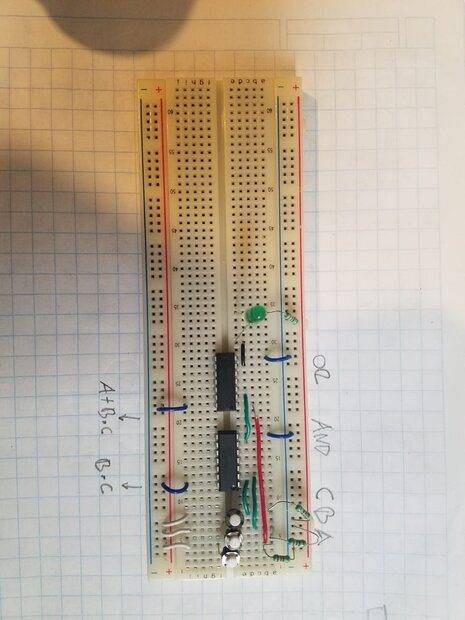
WhatsApp Image 2022-02-22 at 2.20.23 PM.jpeg


First, i try to connect the simplification (A+BC), the LED it doest not turn off and not response when i push the buttons.

All the components its ok, all its works. If the simplification works, the complete expression become easy to continue.

Thanks for read
 
Last edited:
Physics news on Phys.org
Please post your schematic. Also, you should be grounding all unused gate inputs (not outputs though, obviously).
 
berkeman said:
Please post your schematic. Also, you should be grounding all unused gate inputs (not outputs though, obviously).
esquema.png

I make the schematic in proteus and its works fine.
 
If A is high (set) or if both B and C are high, the light should come on.
 
Your schematic doesn't match either one of your equations in your first post, IMO. Also, where are the switches? What logic family are you using? What are the Vcc connections and ground connections? If you are using CMOS logic, the unused inputs of the other gates need to be grounded.
 
Mark44 said:
If A is high (set) or if both B and C are high, the light should come on.
Yes, but in my case the LED is always turn ON and not responding to the buttons to take off ;(
 
berkeman said:
Your schematic doesn't match either one of your equations in your first post, IMO. Also, where are the switches? What logic family are you using? What are the Vcc connections and ground connections? If you are using CMOS logic, the unused inputs of the other gates need to be grounded.
The schematic corresponds to A+BC. I use logic probe like switches in the schematic, Vcc and ground are the blue connections in the first image.
 
What logic family? 74HC? 74VHC? Vcc=5V or 3.3V? The switches are single pole double throw, break before make?
 
berkeman said:
What logic family? 74HC? 74VHC? Vcc=5V or 3.3V? The switches are single pole double throw, break before make?
74LS, Vcc= 5V. The switch are pushbuttons in the protoboard
 
  • #10
Noob of the Maths said:
The switch are pushbuttons in the protoboard
What value of your resistor pullups or pulldowns (depending on which way the switches pull)?

Do you have a DVM where you can monitor the voltage at each gate input and output? That may help you figure out what is going on.

Also, 74LS is not very strong at driving a "high" output. It is better at driving a "low" output, so you may want to add an inverter (or a transistor) at your circuit's output so it can pull the cathode of the LED Low (rather than trying to drive the anode high). Check the datasheet for values of Voh, Vol, Ioh, Iol, etc. It may also help to use a high-efficiency Red LED, which can generally be driven with less current.
 
  • Like
Likes   Reactions: Noob of the Maths

Similar threads

  • · Replies 4 ·
Replies
4
Views
2K
  • · Replies 7 ·
Replies
7
Views
3K
Replies
17
Views
4K
  • · Replies 2 ·
Replies
2
Views
2K
  • · Replies 1 ·
Replies
1
Views
1K
  • · Replies 2 ·
Replies
2
Views
2K
  • · Replies 11 ·
Replies
11
Views
4K
Replies
12
Views
2K
Replies
26
Views
3K
  • · Replies 43 ·
2
Replies
43
Views
17K