A Box is suspended by two strings, what is the tension?

Click For Summary
SUMMARY

The discussion focuses on calculating the tension in two strings, T1 and T2, supporting a block weighing 100 kg, with angles of 30 degrees (Phi) and 60 degrees (Theta) to the horizontal. The key equation derived is T1 = mg / (tan(Theta) cos(Phi) + sin(Theta)), where g is the acceleration due to gravity (10 m/s²). The relationship between the angles is highlighted, noting that if angles are complementary, the sine of one angle equals the cosine of the other, simplifying the calculations for T2. This mathematical approach provides a clear understanding of the forces at play in the system.

PREREQUISITES
  • Understanding of basic physics concepts, particularly forces and tension.
  • Familiarity with trigonometric functions, specifically sine, cosine, and tangent.
  • Knowledge of Newton's laws of motion, especially in static equilibrium.
  • Ability to manipulate algebraic equations to solve for unknowns.
NEXT STEPS
  • Study the derivation of tension equations in static equilibrium scenarios.
  • Learn about the relationship between complementary angles in trigonometry.
  • Explore examples of tension in multiple string systems in physics textbooks.
  • Practice solving similar problems involving angles and forces using free-body diagrams.
USEFUL FOR

This discussion is beneficial for physics students, educators teaching mechanics, and anyone interested in understanding the principles of tension in static systems.

EthanVandals
Messages
55
Reaction score
2
1. The problem statement, all variables, and given/known data
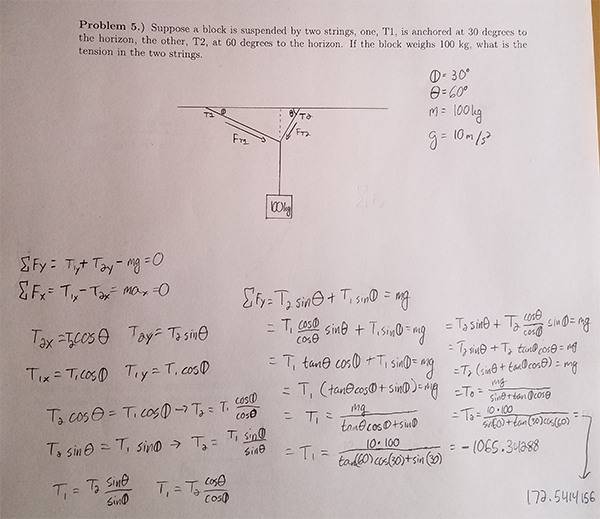
Suppose a block is suspended by two strings, one, T1, is anchored at 30 degrees to the horizon, the other, T2, at 60 degrees to the horizon. If the block weighs 100 kg, what is the tension in the two strings?
Assume that:
The 30-degree angle is Phi.
The 60-degree angle is Theta.
M = 100 kg
g = 10 m/s^s

Homework Equations


(I had to create them myself, so they will be shown in the attempt section.)

The Attempt at a Solution


This image details my attempt. I am fairly certain that I got the correct answers, but I would really appreciate confirmation as well as an explanation for why certain things may be sin or cos. Most of the formulas are ones the professor just gave to us in class, and instead of expecting us to know how to create them, he just wants us to memorize them, which I struggle with unless I know the basis behind it.
7Sx1bqD.jpg
 
Physics news on Phys.org
The key equation that you have is:

##T_1 = \frac{mg}{\tan(\theta) \cos(\phi) + \sin(\theta)}##

Which is very good!

In fact, if you then calculate a similar expression for ##T_2## you will see the symmetry of the solution.
 
To add to PeroK's answer, a useful thing to memorize is that if angles θ and φ are complementary, i.e. θ + φ = 90o, the sine of one is the cosine of the other. If you use this fact to express T1 in terms of one of the angles, say θ, your expression will simplify to a great extent. Do the same for T2 and you should recognize the expression relating the two tensions to the weight as something old and familiar.
 

Similar threads

Replies
21
Views
957
Replies
2
Views
1K
  • · Replies 22 ·
Replies
22
Views
1K
  • · Replies 19 ·
Replies
19
Views
5K
  • · Replies 47 ·
2
Replies
47
Views
3K
Replies
5
Views
2K
  • · Replies 19 ·
Replies
19
Views
4K
  • · Replies 11 ·
Replies
11
Views
3K
  • · Replies 4 ·
Replies
4
Views
4K
  • · Replies 7 ·
Replies
7
Views
7K