A confusion about conductance of weak electrolytes

  • Context: Chemistry 
  • Thread starter Thread starter nafisanazlee
  • Start date Start date
  • Tags Tags
    Conductance Weak
Click For Summary
SUMMARY

The discussion centers on the conductance of weak electrolytes, specifically addressing the confusion between two approaches to calculating conductivity at infinite dilution. One participant references a textbook that states α = 1 (100%) at infinite dilution, while another expresses doubt due to the lack of consideration for a 6% concentration in the textbook's solution. Ultimately, the consensus is that the handwritten solution aligns with the textbook's approach, confirming its correctness.

PREREQUISITES
  • Understanding of weak electrolytes and their dissociation
  • Knowledge of conductivity and its relation to concentration
  • Familiarity with the concept of infinite dilution in chemistry
  • Ability to interpret and compare different problem-solving approaches
NEXT STEPS
  • Research the principles of weak electrolyte conductance
  • Study the concept of infinite dilution and its implications in electrolyte solutions
  • Explore various methods for calculating conductivity in solutions
  • Examine case studies involving discrepancies in textbook solutions and student approaches
USEFUL FOR

Chemistry students, educators, and professionals involved in analytical chemistry or physical chemistry, particularly those focusing on electrolyte behavior and conductivity measurements.

nafisanazlee
Messages
20
Reaction score
2
Homework Statement
The equivalent conductance of weak monobasic acid at infinite dilution is 388.5 ohm^-¹ cm² equiv-¹ at 25 %C. Find the specific conductance of 0.1 molar solutions. the degree of dissociation of which is 6%.
Relevant Equations
Λe/Λe∞ = α
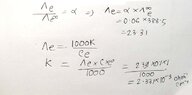
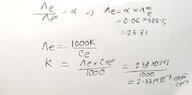
My attempt is the handwritten one. But my reference book solved it in a different way, they left a note saying at infinite dilution α = 1(100%). (the attached picture) Which one is the correct approach?
 

Attachments

  • IMG_20231129_035339.jpg
    IMG_20231129_035339.jpg
    14.3 KB · Views: 114
Last edited:
Physics news on Phys.org
Can't see a handwritten attempt, or a note to that effect in the attached picture. Please clarify the two approaches.
 
Book doesn't use information about 6%, which makes me doubt the solution, even without checking details.
 
  • Like
Likes   Reactions: nafisanazlee
mjc123 said:
Can't see a handwritten attempt, or a note to that effect in the attached picture. Please clarify the two approaches.
I am sorry, didn't notice that it didn't got uploaded. Here it is.
 

Attachments

  • CamScanner 11-29-2023 03.49.jpg
    CamScanner 11-29-2023 03.49.jpg
    29 KB · Views: 122
Borek said:
Book doesn't use information about 6%, which makes me doubt the solution, even without checking details.
Borek said:
Book doesn't use information about 6%, which makes me doubt the solution, even without checking details.
This is my solution, I'm sorry that it didn't got posted earlier.
 

Attachments

  • CamScanner 11-29-2023 03.49.jpg
    CamScanner 11-29-2023 03.49.jpg
    29 KB · Views: 114
I think your result is correct.
 
et_al said:
I think your result is correct.
Thanks so much.
 

Similar threads

  • · Replies 2 ·
Replies
2
Views
1K
  • · Replies 2 ·
Replies
2
Views
866
  • · Replies 8 ·
Replies
8
Views
2K
Replies
2
Views
6K
Replies
1
Views
4K
  • · Replies 1 ·
Replies
1
Views
2K
  • · Replies 4 ·
Replies
4
Views
2K
  • · Replies 1 ·
Replies
1
Views
17K
  • · Replies 9 ·
Replies
9
Views
2K
  • · Replies 1 ·
Replies
1
Views
2K