A derivation of the Vdc in a fullwave rectifier with smoothing?

Click For Summary
SUMMARY

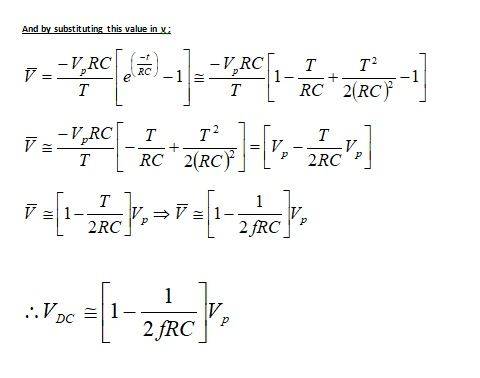
The discussion focuses on deriving the DC voltage (Vdc) in a full-wave rectifier with a smoothing capacitor. The final equation presented is Vdc~(1-(1/2fRC))Vp, which aligns with established literature. The assumption that Vdc represents the average value of the discharging function, while neglecting the charging part, is validated as a reasonable approximation. Factors such as diode resistances, transformer winding resistances, and leakage inductances are acknowledged as influencing the charge time, although they are minimal compared to discharge time.

PREREQUISITES
  • Understanding of full-wave rectifier circuits
  • Knowledge of smoothing capacitors in power electronics
  • Familiarity with Taylor series approximations
  • Basic principles of diode operation and resistance
NEXT STEPS
  • Study the impact of transformer winding resistance on rectifier performance
  • Explore the effects of leakage inductance in rectifier circuits
  • Learn about advanced smoothing techniques for power supplies
  • Investigate the role of diode forward voltage drops in rectification
USEFUL FOR

Electrical engineers, students studying power electronics, and anyone involved in designing or analyzing rectifier circuits will benefit from this discussion.

patric44
Messages
308
Reaction score
40
Homework Statement
i had an assignment of deriving the Vdc in a fullwave rectifier with smoothing capacitor
Relevant Equations
Vdc = V average of the discharging part
i was trying to derive the Vdc in a fullwave rectifier with smoothing capacitor , i guess i had it right as my final equation matches the book equation :

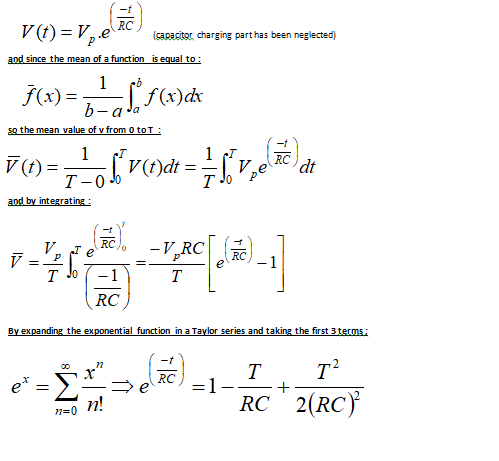
Vdc~(1-(1/2fRC))Vp , but i am not really sure that my attempt was completely right as i assumed that Vdc is the average value of the discharging function neglecting the charging part , and i had to take the first 3 terms of the Taylor approximation to get the answer ,
i just want some one to verify my attempt :
capacitor.png

cap33.jpg
 
Physics news on Phys.org
Any help , i will really appreciate it
 
Last edited:
i just want to know if assuming that the vdc is the average of the discharging function is a good approximation
or not .
r9MqF.gif
 

Attachments

  • 1582313870333.png
    1582313870333.png
    2.6 KB · Views: 164
Yes it is. The diode resistances are very much smaller than the load resistance so the charge-up time is very small compared to the discharge time.

But the charge time is not zero, and depends not only on diode forward voltage drops but also transformer winding resistances. and leakage inductances.
 

Similar threads

Replies
1
Views
3K
  • · Replies 10 ·
Replies
10
Views
4K
  • · Replies 5 ·
Replies
5
Views
3K
  • · Replies 15 ·
Replies
15
Views
3K
  • · Replies 14 ·
Replies
14
Views
3K
  • · Replies 6 ·
Replies
6
Views
4K
  • · Replies 3 ·
Replies
3
Views
5K
  • · Replies 5 ·
Replies
5
Views
2K
Replies
9
Views
4K
  • · Replies 3 ·
Replies
3
Views
3K