A few questions about airflow and filters...

Click For Summary

Discussion Overview

The discussion revolves around airflow dynamics in relation to filters and motors, particularly in contexts such as PC fans, vacuum motors, and automotive air intake systems. Participants explore the effects of filter surface area, resistance, and airflow characteristics in various applications, including the Corsi–Rosenthal Box and workshop vacuums.

Discussion Character

  • Exploratory
  • Technical explanation
  • Debate/contested

Main Points Raised

  • Some participants propose that adding more filters increases the available surface area for airflow, potentially reducing resistance, but the exact relationship between surface area and resistance is uncertain.
  • There is a discussion about the performance of the Corsi–Rosenthal Box, where increasing the number of filters did not yield a proportional increase in airflow, leading to questions about measurement accuracy.
  • Some participants suggest that more expensive workshop vacuums have larger HEPA filters and wider hoses, which may contribute to better airflow due to reduced resistance, but the relationship is complex and depends on various factors.
  • One participant mentions that the resistance through filters may behave differently under laminar versus turbulent flow conditions, affecting the overall airflow dynamics.
  • There is a consideration of how narrowing a hose at the end affects airflow, with some suggesting that wider hoses could lead to greater airflow despite a narrowing at the attachment point.
  • The use of wind speed meters is discussed as a method to measure airflow, with some participants noting that average velocity measurements can be influenced by the size of the measurement area.

Areas of Agreement / Disagreement

Participants generally agree that increasing filter surface area can reduce resistance, but there is no consensus on the exact nature of this relationship or how it applies in different scenarios. Multiple competing views remain regarding the effects of filter design, hose diameter, and airflow measurement techniques.

Contextual Notes

Participants highlight that the analysis of airflow and resistance is dependent on various factors, including the state of the filters (clean vs. clogged), the type of flow (laminar vs. turbulent), and the specific design of the system being analyzed. These variables complicate the predictions of airflow behavior.

Who May Find This Useful

This discussion may be useful for individuals interested in fluid dynamics, HVAC systems, vacuum technology, and those looking to optimize airflow in various mechanical systems.

SentinelAeon
Messages
31
Reaction score
3
Just a few quick questions regarding airflow, mostly in connection with motors creating the airflow, like pc fans, vacuum motor, air going into a car engine through air filter, etc.

1) Adding more filters increases the availably surface through which the air can flow, therefor reducing the resistance. Am i correct in that ? How would one get the appropriate reduction of the resistance by doubling the filter surface ? I know exact number depends on many aspects but just to get a broad idea, is the resistance halved or is the resistance reduced by a lot smaller amount ?

filters.png

2) To add to the previous question, the reason i am asking is because some data i saw regarding Corsi–Rosenthal Boxes. There was a comparison between just using 1 filter and fan attached directly to it and a Corsi–Rosenthal Box - here you have 4 usable filters. But when they compared the air speed flowing through the fan, it was only improved for about 20%, which doesn't sound much considering we increased the filter surface by 4. Could it be that they made an error and actualy measured the airflow going through the filter and since the surface is 4 times bigger that would mean a lot more cfm of air moved at the same air speed ?

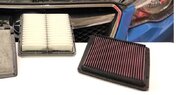
3) Is this the reason why expensive workshop vacuums usualy have a bigger hepa filter (more surface) than cheap ones and why sports air filters usualy have more dense structure than cheap ones (more curves - more actual filter material), in the image below the cheap white has 15 curves while the more expensive one has 28 curves - a lot more actual filter material (path for air to go through) on the expensive filter.
car filters.jpg

4) Another thing i saw was that many of the more expensive workshop vacuums use wider hoses. That would mean that because they are wider, there is less resistance for air to travel through. And while the actual speed of air might be slower, due to a lot wider hose, the volume of air that travels through it per minute will be higher. Am i correct ?

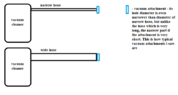
5) What if we used a wider hose for less air resistance but at the end of that hose, there was a narrowing - an example of that could be a vacuum attachment. Does that mean that even though the hole in the attachment is the same for both cases (see image below), the fact that the hose itself is wider means the resistance would be smaller and airflow greater ?
vacuum.png

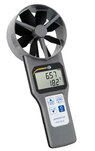
6) Would a wind speed meter be appropriate to compare such scenarios, more air speed means less resistance ? Could i also get aproximation of volume of air moved per minute by taking into account air speed and diameter of the exiting tube ?
Capture.JPG
 
Last edited:
Engineering news on Phys.org
SentinelAeon said:
1) Adding more filters increases the availably surface through which the air can flow, therefor reducing the resistance. Am i correct in that ?
Towards the end of the service interval, the pressure drop through a filter, partly blocked by collected particles, is more critical than the pressure drop through the clean material of a new filter.

A greater area, of parallel flow through filter material, increases the quantity of particulates that can be trapped, before the filter will need to be replaced.

Any analysis must assume the filter is at the end of the service period, in the worst case environment.
 
  • Like
Likes   Reactions: SentinelAeon
Baluncore said:
Towards the end of the service interval, the pressure drop through a filter, partly blocked by collected particles, is more critical than the pressure drop through the clean material of a new filter.

A greater area, of parallel flow through filter material, increases the quantity of particulates that can be trapped, before the filter will need to be replaced.

Any analysis must assume the filter is at the end of the service period, in the worst case environment.
we are ignoring particles. I am only interested in how filter affects airflow. So, does more surface reduces the resistance ?
 
SentinelAeon said:
So, does more surface reduces the resistance ?
... I'd say it's more about the increased cross section of having multiple openings rather than the surface area of the filters. But yeah, I think paralleling filters would allow more flow through for a given pressure differential.
 
  • Like
Likes   Reactions: berkeman
SentinelAeon said:
1) Adding more filters increases the availably surface through which the air can flow, therefor reducing the resistance. Am i correct in that ?
Yes. If the flow through the filter is laminar, the resistance will be half at the same flow. If the flow is turbulent, the resistance will be less than half. Search terms to learn about the difference: laminar flow and turbulent flow.
SentinelAeon said:
There was a comparison between just using 1 filter and fan attached directly to it and a Corsi–Rosenthal Box - here you have 4 usable filters. But when they compared the air speed flowing through the fan, it was only improved for about 20%
Any system with air flow through it has a system curve (search the term). The resulting flow is the point where the system curve intersects the fan curve (search that term). Changing the resistance of one part of the system may or may not have a large effect on the total flow.
SentinelAeon said:
Is this the reason why expensive workshop vacuums usualy have a bigger hepa filter (more surface) than cheap ones
Hepa filters have more resistance than less effective filters. Also, larger filters hold more particulates. And this is a case where you get what you pay for.
SentinelAeon said:
4) Another thing i saw was that many of the more expensive workshop vacuums use wider hoses.
You pay more to get more "suck", or a combination of more air flow and more vacuum. The larger hoses move more material, and larger chunks. The combination of more air flow and more vacuum requires a more powerful motor and larger blower. Again, you get what you pay for.
SentinelAeon said:
Does that mean that even though the hole in the attachment is the same for both cases (see image below), the fact that the hose itself is wider means the resistance would be smaller and airflow greater ?
Probably. The exact answer depends on the size of the hole in the attachment, the diameter of the hose, the length of the hose, and some minor variables.
SentinelAeon said:
6) Would a wind speed meter be appropriate to compare such scenarios, more air speed means less resistance ? Could i also get aproximation of volume of air moved per minute by taking into account air speed and diameter of the exiting tube ?
Yes. This is a good way to measure air flow. Just be aware that the wind speed meter is measuring average velocity over the area of the turbine, and you are measuring a small diameter air flow. If you want compare the total air flow for different hoses and attachments, a good technique is to cut two holes in a sealed box. Insert the hose into one hole, seal around it with duct tape or something, and lay the wind speed meter over the other hole. The wind meter hole might be the same diameter as the wind meter turbine, or it could be larger. If the hole is larger, move the meter around to get an average velocity. Velocity times hole area equals flow.

Measuring air flow are good experiments for a curious person. You can also measure the fan curve by adding a water manometer (search that term) made from a piece of hardware store vinyl tubing and a ruler.
 
Basically everything you described is correct. The airflow increase is tough to predict because:

1. The resistance is probably linear vs airflow for filters, but usually it is quadratic vs obstructions.

2. The fan has an operating curve that you'd have to check to see how it's airflow varies with pressure. It may be flat or steep.
 

Similar threads

Replies
5
Views
3K
Replies
6
Views
6K
  • · Replies 3 ·
Replies
3
Views
3K
  • · Replies 15 ·
Replies
15
Views
4K
Replies
1
Views
2K
  • · Replies 13 ·
Replies
13
Views
6K
  • · Replies 3 ·
Replies
3
Views
6K
  • · Replies 1 ·
Replies
1
Views
3K
  • · Replies 3 ·
Replies
3
Views
2K
  • · Replies 21 ·
Replies
21
Views
3K