A Function for multiple 2D Gaussians

Click For Summary

Discussion Overview

The discussion revolves around the formulation of a function that sums multiple 2D Gaussian functions, specifically in the context of visualizing them as a surface graph. Participants explore the notation and representation of these functions, as well as concerns about clarity and correctness in mathematical expressions.

Discussion Character

  • Technical explanation
  • Conceptual clarification
  • Debate/contested

Main Points Raised

  • One participant seeks to create a function that represents multiple 2D Gaussians, questioning if their formulation is correct for visualizing these as a surface.
  • Several participants agree that the function can be visualized as a landscape with multiple hills, referring to the Gaussian peaks.
  • Concerns are raised about the notation used, particularly the placement of the index and the use of the symbol for the function.
  • There is a suggestion to use a single symbol for the Gaussian function to avoid confusion, with some proposing to use ##g## instead of ##f##.
  • Participants discuss the appropriateness of using ##n## to represent the count of Gaussian functions (hills) and whether a more formal notation exists.
  • Clarifications are made regarding the function's dependence on variables x and y, with suggestions to index the Gaussian functions for clarity.

Areas of Agreement / Disagreement

Participants generally agree on the concept of summing multiple 2D Gaussians and the visualization aspect, but there is ongoing discussion regarding the notation and clarity of the function representation. No consensus is reached on the best notation to use.

Contextual Notes

Limitations in the discussion include potential ambiguity in notation and the need for clearer definitions of the function variables. The discussion does not resolve these issues.

Who May Find This Useful

Readers interested in mathematical modeling, particularly in the context of Gaussian functions and surface plotting, may find this discussion relevant.

ThunderLight
Messages
27
Reaction score
2
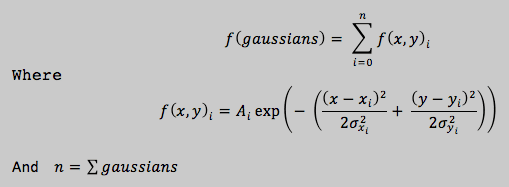
I'm trying to put together a function that sums multiple 2D Gaussian functions in one graph (i.e.; multiple Gaussian pyramids).

So far from my research, I formed the following function definition:
Screen Shot 2017-03-09 at 9.42.13 PM.png


I'm not sure if my research led me to the correct way of forming the function. Is this how Gaussians can be represented to give me a graph of multiple Gaussians in one surface?
 
Mathematics news on Phys.org
Yes. Kind of a landscape pocked with lots of hills.
 
  • Like
Likes   Reactions: ThunderLight
BvU said:
Yes. Kind of a landscape pocked with lots of hills.

Yes, that's what I'm looking for. But I'm worried about the notation, and placement of the i
Is it also correct for me to say ΣGaussians to represent how many hills, n? - Or there's a more formal notation for that?
 
Yes, I would say ##n## is the count of the hills. You confuse the issue somewhat by using the symbol ##f## twice.
 
  • Like
Likes   Reactions: ThunderLight
BvU said:
Yes, I would say ##n## is the count of the hills. You confuse the issue somewhat by using the symbol ##f## twice.

Would it be more proper/clearer to use only the first ##f## and go on directly to saying ##=... ## instead of redefining what ##f## function is?Thank you for your answer and affirmation.
 
Last edited:
Either that, or you use a symbol g for a single gaussian:
upload_2017-3-9_13-57-54.png


I take it you want to pass ##f## to a surface plot program or something.
 
  • Like
Likes   Reactions: ThunderLight
I would put the index i next to the function name: ##g_i(x,y)##

"f(gaussians)" doesn't make sense. f is a function of x and y: f(x,y).
 
  • Like
Likes   Reactions: ThunderLight
BvU said:
Either that, or you use a symbol g for a single gaussian:
View attachment 114288

I take it you want to pass ##f## to a surface plot program or something.

Great, thank you for your tip.
 
mfb said:
I would put the index i next to the function name: ##g_i(x,y)##

"f(gaussians)" doesn't make sense. f is a function of x and y: f(x,y).

I just realized that, thank you for pointing this out. You're right.
Thank you very much
 

Similar threads

  • · Replies 1 ·
Replies
1
Views
2K
  • · Replies 8 ·
Replies
8
Views
3K
Replies
2
Views
1K
  • · Replies 5 ·
Replies
5
Views
2K
  • · Replies 4 ·
Replies
4
Views
6K
  • · Replies 3 ·
Replies
3
Views
3K
  • · Replies 0 ·
Replies
0
Views
1K
  • · Replies 2 ·
Replies
2
Views
3K
  • · Replies 13 ·
Replies
13
Views
3K
Replies
7
Views
2K