Undergrad A Function for multiple 2D Gaussians

Click For Summary
SUMMARY

This discussion focuses on creating a function to sum multiple 2D Gaussian functions, referred to as Gaussian pyramids. The participants confirm that the notation ΣGaussians accurately represents the count of Gaussian hills, denoted as n. They emphasize the importance of clear notation, suggesting the use of g_i(x,y) for individual Gaussian functions instead of redefining f multiple times. The conversation concludes with a consensus on the correct representation for surface plotting.

PREREQUISITES
  • Understanding of 2D Gaussian functions
  • Familiarity with mathematical notation and functions
  • Knowledge of surface plotting techniques
  • Experience with programming languages that handle mathematical functions (e.g., Python, MATLAB)
NEXT STEPS
  • Research how to implement multiple 2D Gaussian functions in Python using NumPy
  • Learn about surface plotting libraries such as Matplotlib or Plotly
  • Explore mathematical notation standards for functions in academic papers
  • Study optimization techniques for visualizing complex mathematical surfaces
USEFUL FOR

Mathematicians, data scientists, and software developers interested in visualizing complex functions, particularly those working with Gaussian distributions and surface plots.

ThunderLight
Messages
27
Reaction score
2
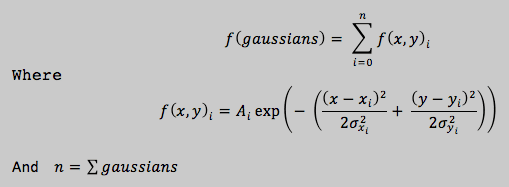
I'm trying to put together a function that sums multiple 2D Gaussian functions in one graph (i.e.; multiple Gaussian pyramids).

So far from my research, I formed the following function definition:
Screen Shot 2017-03-09 at 9.42.13 PM.png


I'm not sure if my research led me to the correct way of forming the function. Is this how Gaussians can be represented to give me a graph of multiple Gaussians in one surface?
 
Mathematics news on Phys.org
Yes. Kind of a landscape pocked with lots of hills.
 
  • Like
Likes ThunderLight
BvU said:
Yes. Kind of a landscape pocked with lots of hills.

Yes, that's what I'm looking for. But I'm worried about the notation, and placement of the i
Is it also correct for me to say ΣGaussians to represent how many hills, n? - Or there's a more formal notation for that?
 
Yes, I would say ##n## is the count of the hills. You confuse the issue somewhat by using the symbol ##f## twice.
 
  • Like
Likes ThunderLight
BvU said:
Yes, I would say ##n## is the count of the hills. You confuse the issue somewhat by using the symbol ##f## twice.

Would it be more proper/clearer to use only the first ##f## and go on directly to saying ##=... ## instead of redefining what ##f## function is?Thank you for your answer and affirmation.
 
Last edited:
Either that, or you use a symbol g for a single gaussian:
upload_2017-3-9_13-57-54.png


I take it you want to pass ##f## to a surface plot program or something.
 
  • Like
Likes ThunderLight
I would put the index i next to the function name: ##g_i(x,y)##

"f(gaussians)" doesn't make sense. f is a function of x and y: f(x,y).
 
  • Like
Likes ThunderLight
BvU said:
Either that, or you use a symbol g for a single gaussian:
View attachment 114288

I take it you want to pass ##f## to a surface plot program or something.

Great, thank you for your tip.
 
mfb said:
I would put the index i next to the function name: ##g_i(x,y)##

"f(gaussians)" doesn't make sense. f is a function of x and y: f(x,y).

I just realized that, thank you for pointing this out. You're right.
Thank you very much
 

Similar threads

  • · Replies 1 ·
Replies
1
Views
2K
  • · Replies 7 ·
Replies
7
Views
2K
Replies
2
Views
1K
  • · Replies 5 ·
Replies
5
Views
2K
  • · Replies 2 ·
Replies
2
Views
3K
  • · Replies 4 ·
Replies
4
Views
6K
Replies
16
Views
3K
  • · Replies 2 ·
Replies
2
Views
2K
  • · Replies 0 ·
Replies
0
Views
8K
  • · Replies 1 ·
Replies
1
Views
1K