A general formula for the sum of the series 1/k?

Click For Summary
SUMMARY

The forum discussion centers on finding a general expression for the sum of the series 1/k, specifically the harmonic numbers defined as H_n = ∑(1/k) from k=1 to n. The approximation for large n is ln(b/a), where b and a are the upper and lower limits. The exact sum can be computed using the relationship H_b - H_(a-1), where H_n can also be expressed through integrals and binomial expansions. The discussion concludes with a detailed derivation of the integral form of H_n, confirming its equivalence to the summation.

PREREQUISITES
  • Understanding of harmonic numbers and their properties
  • Familiarity with integral calculus and basic integration techniques
  • Knowledge of binomial theorem and combinatorial notation
  • Ability to manipulate summations and series
NEXT STEPS
  • Study the properties and applications of harmonic numbers in number theory
  • Learn about integral calculus techniques, particularly integration by substitution
  • Explore the binomial theorem and its implications in combinatorial mathematics
  • Investigate the relationship between series and integrals in mathematical analysis
USEFUL FOR

Mathematicians, students of calculus, and anyone interested in series summation and harmonic numbers will benefit from this discussion.

s0ft
Messages
83
Reaction score
0
Is there any general expression for the sum to nth term of the series 1/k?

I know that for sufficiently large indices, a good approximation can be ln(b/a) where b and a are the upper and lower limits respectively.
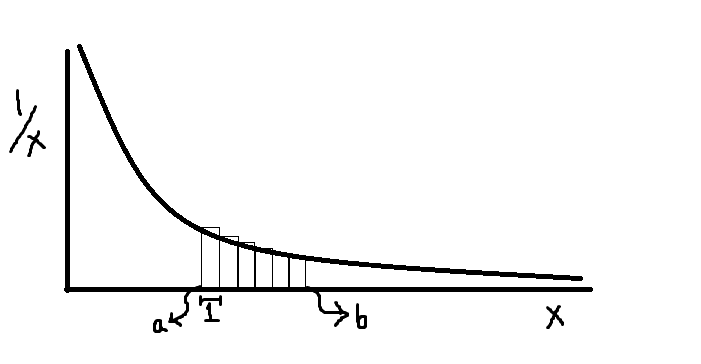
I've tried to do something very simple for the exact sum by constructing unit length rectangles between the curve of the function 1/x and the x axis. This shows clearly that as the values of x gets larger and larger, the integral, being the portion of the rectangle below the curve, gets closer and closer to the actual sum, the total area of the rectangles.
59vgjn.png

But I don't seem to be able to get any further than this. I did try to account for the extra (above-curve) portions of the rectangles by treating them approximately as triangles(what better option did I have?) and using the 0.5*b*h formula for their area but later realizing that the heights are changing, I thought it wouldn't be so easy.
So, anyone willing to give it a try?
 
Physics news on Phys.org
I couldn't understand wikipedia pwsnafu. Care to explain?
 
s0ft said:
I couldn't understand wikipedia pwsnafu. Care to explain?

Sure. The harmonic numbers are defined ##H_n = \sum_{k=1}^n \frac{1}{k}##. Now obviously when you calculate your sum, you'll get a rational number. Fun little fact, the numerators you get (in order) is called the Wolstenholme numbers, and the denominators are called...I don't think they have a name. Hmm.

Anyway, you want to calculate ##\sum_{k=a}^b \frac{1}{k}## when that is ##\sum_{k=1}^b \frac{1}{k} - \sum_{k=1}^{a-1} \frac{1}{k} = H_{b}-H_{a-1}##. So that's the answer, you just look them up on the internet and we are done.

But that's not really a satisfactory answer. Now Wikipedia shows two other forms:
##H_n = \int_0^1 \frac{1-x^n}{1-x} dx = \sum_{k=1}^{n}(-1)^k \frac{1}{k} {n \choose k}##.
The first equality is easy: we know
##\frac{1-x^n}{1-x} = \frac{(1-x)(1+x+x^2+\ldots+x^{n-1})}{1-x} = 1+x+x^2+\ldots+x^{n-1}##.
Integrating term by term we get
##x+\frac{x^2}{2}+\frac{x^3}{3} + \ldots + \frac{x^n}{n}##. The terms of the integral is just x=1 and x=0, so we obtain ##H_n##.

Follow?
 
I got lost from the integral for Hn.
Even if I take it as a given, I don't get how it equals the summation part.
 
s0ft said:
I got lost from the integral for Hn.
Even if I take it as a given, I don't get how it equals the summation part.

But you do follow what I wrote right?

So moving onto the summation. We want to solve ##\int_0^1 \frac{1-x^n}{1-x}dx##.
We do the substitution ##u = 1-x##. We get
##\int_0^1 \frac{1-(1-u)^n}{u} du##
if this is not immediately obvious verify it.

Now we expand. You know from the binomial theorem that
##(1-u)^n = 1 - u + {n \choose 2} u^2 - \ldots (-1)^n u^n##
So
##1-(1-u)^n = u - {n \choose 2} u^2 + \ldots (-1)^{n-1} u^n##
And
##\frac{1-(1-u)^n}{u} = 1 - {n \choose 2} u + \ldots (-1)^{n-1} u^{n-1}##

So we calculate
##\int_0^1 1 - {n \choose 2} u + \ldots (-1)^{n-1} u^{n-1} \, du##
is equal to ##u - {n \choose 2} \frac{u^2}{2} + \ldots (-1)^{n-1} \frac{u^n}{n} |_0^1##
and we are left with
##1 - {n \choose 2} \frac{1}{2} + \ldots (-1)^{n-1} \frac{1}{n}##
and that's exactly the sum formula.

Edit: 500th post. Yay!
 
Thank you very much!
 

Similar threads

  • · Replies 8 ·
Replies
8
Views
2K
  • · Replies 24 ·
Replies
24
Views
4K
  • · Replies 2 ·
Replies
2
Views
2K
  • · Replies 7 ·
Replies
7
Views
2K
  • · Replies 10 ·
Replies
10
Views
2K
  • · Replies 14 ·
Replies
14
Views
2K
  • · Replies 3 ·
Replies
3
Views
3K
  • · Replies 3 ·
Replies
3
Views
3K
  • · Replies 1 ·
Replies
1
Views
3K
  • · Replies 20 ·
Replies
20
Views
3K