pkc111 said:
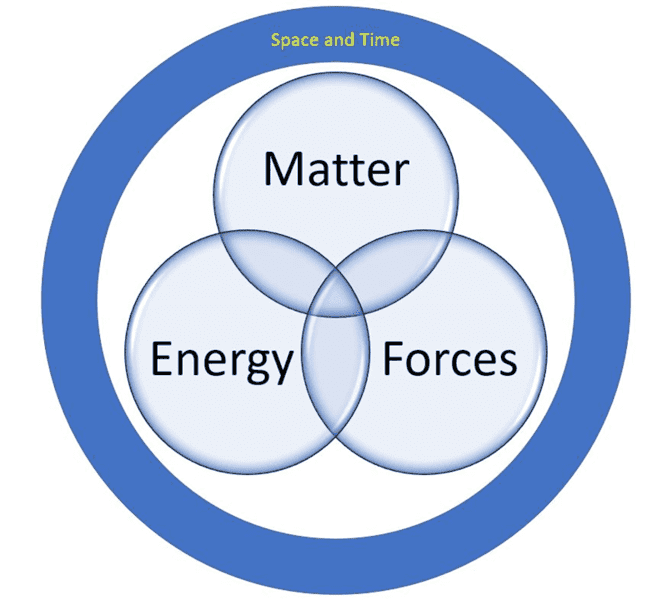
I want to present my senior classes with a model of the fundamentals of the physical world to serve as a mind map for us when we reach each topic.
IMHO what I think is the mind map for physics is Noether's Theorem:
It explains what energy, momentum and angular momentum is and why they are conserved. It is very profound.
Another thing they need to understand is what the concept of force really is. Take Newtons first law - it follows from the second and the second is just a definition. The content is in the third law - which is easily shown to be equivalent to the conservation of momentum - but as shown above that follows from Noether. Just what is classical mechanics telling us. Have the class investigate and discuss this.
The answer you as the teacher should know is the real basis of mechanics is what is assumed in Noethers theorem - the Principle of Least Action which follows from Feynman's path integral approach to QM. Newtions laws are not laws in the usual sense - but rather a prescription that says - get thee to the forces - but they need to discuss and understand, under your guidance, why this is. Your students can read about it here:
https://www.amazon.com/dp/0691024170/?tag=pfamazon01-20
This will teach your students the actual modern view of what physics tells us about the world.
Have they done calculus and have some previous knowledge of physics? If so I would recommend the following for what you want to do:
https://www.amazon.com/dp/0521876222/?tag=pfamazon01-20
It's really first or even second year university, but its the only book I know that presents at the lowest mathematical level possible the correct basis of modern physics - it has Noether and all that. Supplement it with the first few chapters of the Feynman Lectures, plus of course the QED book by the same great teacher I mentioned, and you will have a course that will prepare your seniors with a deep understanding of physics - excluding EM. But they will understand concepts that will prepare them for things like why do fields have energy etc.
If they do not know calculus then I think there will be a lot of work for you in preparing a course and notes.
Good luck. If I was a teacher it is what I would do. Its unconventional and hard in that you have to do t yourself - no standard text for it - but your students will get what I think is the core of modern physics.
Thanks
Bill