A multivariate function of Toruses - tangent vectors

Join the discussion
Registration is free. Start your own thread to ask a follow-up.
5 replies · 2K views · last reply
docnet
Messages
796
Reaction score
487
Homework Statement
this map multiplies all lengths of tangent vectors by the same factor. what is the factor?
Relevant Equations
p^2+q^2=1
r^2+s^2=1

w^2+x^2=1
y^2+z^2=1

w=pr+qs
x=qr-ps
y=pr-qs
z=qr+ps
Thank you to all those who helped me solve my last question. This week, I've been assigned an interesting problem about toruses. I think I've solved most of this problem on my own, but I'd like to hear a few suggestions for part c.
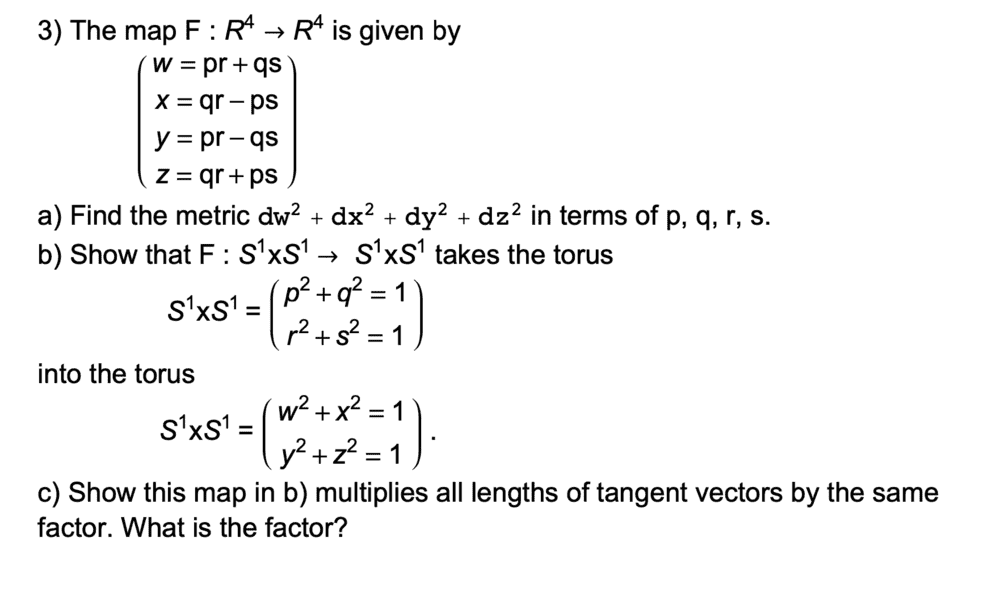
Homework problem 3 on a map F from R4 to R4 defined by w = pr + qs, x = qr - ps, y = pr - qs, z = qr + ps, with parts a) to c) on the metric, the torus mapping and tangent vector scaling.


I think this map multiplies tangent vectors by a factor of sqrt(2). We can think of tangent vectors as velocity while traveling along a curve on the surface. From simply plotting points, we know if travel around the pq plane or the rs plane once, we travel around both the wx and yz planes. We also know the two planes are orthogonal to each other because it's the definition of the torus under this equation. Under this map, the velocity gains an additional orthogonal component of equal magnitude, and from Pythagorean theorem the net magnitude is sqrt(1+1) = sqrt(2).

Is my intuition correct?

I've calculated the metric in part a and solved part b. but, I don't think these parts will help with c. thanks
 
Physics news on Phys.org
The metric tells you how to compute the length of tangent vectors. Maybe it can help?
 
  • Like
Likes   Reactions: docnet
If you set [itex](p,q,r,s) = (\cos \theta, \sin \theta, \cos \phi, \sin \phi)[/itex] you will find that in appropriate charts the map sends [itex](\theta, \phi)[/itex] to [itex](\zeta, \eta) = (\theta - \phi, \theta + \phi)[/itex]. Thus a tangent vector [itex]X = \alpha \frac{\partial}{\partial \theta} + \beta\frac{\partial}{\partial \phi}[/itex] is mapped to [tex]Y = (\alpha + \beta)\frac{\partial}{\partial \zeta} + (\alpha - \beta)\frac{\partial}{\partial \eta}.[/tex] You can assume that all of the basis vectors are orthogonal with unit norm.
 
  • Informative
Likes   Reactions: docnet
Office_Shredder said:
The metric tells you how to compute the length of tangent vectors. Maybe it can help?

Thank you. I ended up using the metric and found the answer to be 2.
pasmith said:
If you set (p,q,r,s)=(cos⁡θ,sin⁡θ,cos⁡ϕ,sin⁡ϕ) you will find that in appropriate charts the map sends (θ,ϕ) to (ζ,η)=(θ−ϕ,θ+ϕ). Thus a tangent vector X=α∂∂θ+β∂∂ϕ is mapped to Y=(α+β)∂∂ζ+(α−β)∂∂η. You can assume that all of the basis vectors are orthogonal with unit norm.

Sorry I'm having trouble visualizing these tangent vectors. How does one understand tangent vectors in polar coordinates?

Thanks,
 
Attachments
Last edited:
I realized my solutions are wrong. How do I delete my previous post?
 
Here are the complete solutions to the problem. Feel free to let me know if you see an error :)
Handwritten notes on lined paper solving a problem on the map F: R^4 to R^4, given by w, x, y, z in terms of p, q, r, s, expanding dw^2 + dx^2 + dy^2 + dz^2 term by term with some terms crossed out.
Handwritten derivation on lined paper: the squared norm of a tangent vector expanded in p, q, r, s and their differentials, then a torus parametrization with conditions p^2+q^2=1 and r^2+s^2=1, and a final note on the map's image covering the torus twice.
Handwritten derivation on lined paper: tangent vector length calculation, definitions of p, q, r, s, w, x, y, z in terms of sine and cosine, differentials dw, dx, dy, dz, and a final result of 2 dθ².
Handwritten derivation on lined paper computing dθ and dφ terms of a metric by expanding squared sine and cosine expressions, ending with 2dφ² and a comparison of metrics ds² = 2dθ² + 2dφ² against dθ² + dφ².