Undergrad A new exomoon candidate: Kepler-1625b I

  • Thread starter Thread starter mfb
  • Start date Start date
Click For Summary
The discussion centers on the potential exomoon candidate Kepler-1625b I, with weak evidence suggesting the presence of smaller moons in the Kepler transit data. Kepler-1625b is noted for its unusual features across three observed transits, and the Hubble telescope is set to observe its next transit in October. If confirmed as a moon, it would be Neptune-sized orbiting a planet approximately 10 Jupiter masses. The conversation highlights the challenges in detecting exomoons due to their relatively small mass compared to their parent planets, with comparisons drawn to Jupiter's numerous moons. The rarity of a moon with Neptune's mass raises questions about the dynamics and stability of such orbits in exoplanet systems.
Messages
37,398
Reaction score
14,233
HEK VI: On the Dearth of Galilean Analogs in Kepler and the Exomoon Candidate Kepler-1625b I

The authors looked for signals of potential moons in the Kepler transit data. There is some weak evidence that a group of smaller moons exists, but the measurements are not accurate enough to pin that down on a star-by-star level. One particular planet, however, Kepler-1625b, has very curious features in all three observed transits. The Hubble telescope will observe the next transit in October this year.

If it is a moon, then the parent planet probably has 10 Jupiter masses while being a bit smaller than Jupiter, and the moon has Neptune size.
The star is probably quite old already and leaving the main sequence.

Wikipedia article

Transits from the paper, bad paint drawings from me. The main dip comes from the planet, a shallower dip of variable time seems to be there, in agreement with expectations from a moon. We look at the system from below in the drawings.
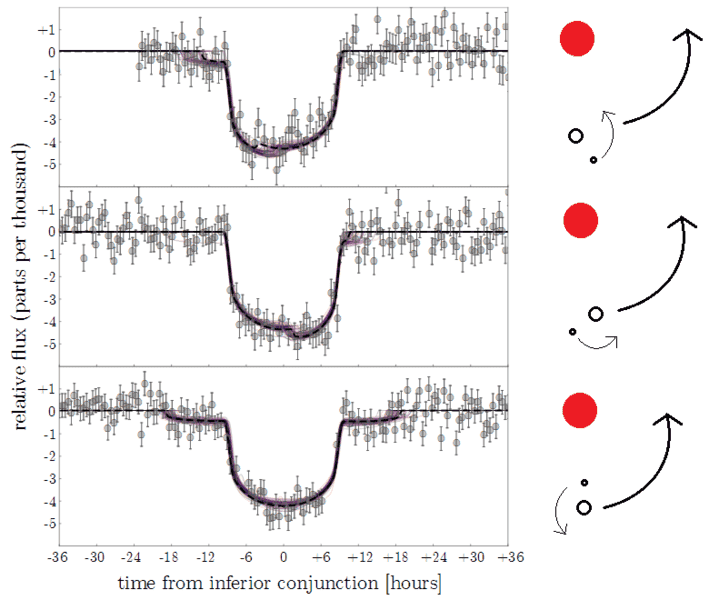
exomoon_maybe.png
 
Last edited:
  • Like
Likes Lord Crc, Buzz Bloom, amarante and 3 others
Astronomy news on Phys.org
mfb said:
If it is a moon, then the parent planet probably has 10 Jupiter masses while being a bit smaller than Jupiter, and the moon has Neptune size.

That's a big moon...
 
It does make one wonder out of the 3,500+ exoplanets that have been confirmed, how much of their estimated mass includes one or more moons. Jupiter currently has 67 moons that we've detected, so it would seem extremely likely that exoplanets of comparable mass would also have numerous moons. The only reason we are not detecting these exomoons, until now, is most likely due to their mass. All of Jupiter's moons combined are only a tiny fraction of Jupiter's mass. So it is understandable why we have not detected exomoons before now. A moon with the mass of Neptune has to be a fairly rare occurrence. Just achieving a stable orbit would be problematic.
 
Mass estimates will always include moons, while size estimates will sometimes include moons (via their cross section area) and sometimes not, depending on how the transits (or direct images) looked like.

Big moons around big planets don't sound so unreasonable. The system here has an estimated mass ratio of 1:200, that is more than the Earth/Moon mass ratio.
 
mfb said:
Mass estimates will always include moons, while size estimates will sometimes include moons (via their cross section area) and sometimes not, depending on how the transits (or direct images) looked like.

Big moons around big planets don't sound so unreasonable. The system here has an estimated mass ratio of 1:200, that is more than the Earth/Moon mass ratio.
The ratio of this system is closer to 1:815 (3.9 Earth masses orbiting 31,783 Earth masses). The Earth/moon mass ratio is 1:81. So there is approximately 10 times the mass difference between these exoplanet/exomoon pairings and the pairing of the Earth and moon combination. Nevertheless, it is still a very big moon.
 
Where do you get the 3.9 Earth masses from? The mass of the moon is basically unconstrained (transit timing variation could give access to it, but we need more precise transit timing), only the size has a rough estimate. Neptune has 17 times the mass of Earth.

It is a big moon, but it is a big planet as well.
 
mfb said:
Where do you get the 3.9 Earth masses from? The mass of the moon is basically unconstrained (transit timing variation could give access to it, but we need more precise transit timing), only the size has a rough estimate. Neptune has 17 times the mass of Earth.

It is a big moon, but it is a big planet as well.
I must have used Neptune's radius instead of its mass, my mistake. You are correct, Neptune is 17.15 times Earth mass.
 
|Glitch| said:
It does make one wonder out of the 3,500+ exoplanets that have been confirmed, how much of their estimated mass includes one or more moons. Jupiter currently has 67 moons that we've detected, so it would seem extremely likely that exoplanets of comparable mass would also have numerous moons. The only reason we are not detecting these exomoons, until now, is most likely due to their mass. All of Jupiter's moons combined are only a tiny fraction of Jupiter's mass. So it is understandable why we have not detected exomoons before now. A moon with the mass of Neptune has to be a fairly rare occurrence. Just achieving a stable orbit would be problematic.
Do we have any news about the new exoplanets NASA had discover in February? I think they were characterized as potential "life supporters"
 
I didn't see anything completely new from Kepler this year.

Please keep the discussion focused on the exomoon candidate.
 

Similar threads

  • · Replies 29 ·
Replies
29
Views
6K
  • · Replies 16 ·
Replies
16
Views
5K
Replies
2
Views
1K
  • · Replies 1 ·
Replies
1
Views
2K
  • · Replies 12 ·
Replies
12
Views
3K
  • · Replies 2 ·
Replies
2
Views
3K
Replies
17
Views
4K
  • · Replies 1 ·
Replies
1
Views
1K
  • · Replies 2 ·
Replies
2
Views
2K
  • · Replies 6 ·
Replies
6
Views
4K