Science Advisor
- 1,421
- 1,172
First thanks everybody for discussion in previous thread https://www.physicsforums.com/threads/a-man-on-a-cart.870858/ This is a continuation of that topic. I will formulate another problem. I believe that the most suitable tool for this problem is the Lagrangian formalizm. But what do you think about elementary solution and usefulness of this problem in courses of general physics.
A frame consists of four thin homogeneous rods, all the rods are the same and have mass m. The tips of rods connected with each other by weightless ball joints A,B,C,D with no friction. This frame is shaped as square and rests on smooth horizontal table.
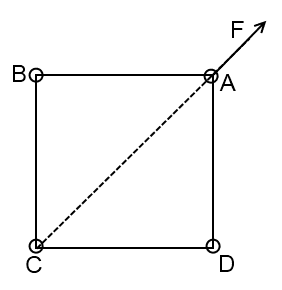
Then one begin to draw the joint A with the force F. The force is directed outside square along the diagonal AC.
Find the acceleration of the joint A right after the force started to act.
If you also estimate this problem is of UK GCE level I will cry
A frame consists of four thin homogeneous rods, all the rods are the same and have mass m. The tips of rods connected with each other by weightless ball joints A,B,C,D with no friction. This frame is shaped as square and rests on smooth horizontal table.
Then one begin to draw the joint A with the force F. The force is directed outside square along the diagonal AC.
Find the acceleration of the joint A right after the force started to act.
If you also estimate this problem is of UK GCE level I will cry