A problem with Newton's mechanics

  • Thread starter Thread starter m0urazz
  • Start date Start date
  • Tags Tags
    Mechanics
Click For Summary

Homework Help Overview

The discussion revolves around a problem in Newton's mechanics, specifically focusing on a system in equilibrium involving tension in ropes and the readings of a scale under various conditions.

Discussion Character

  • Exploratory, Assumption checking, Problem interpretation

Approaches and Questions Raised

  • Participants explore the concept of tension in ropes and how it relates to the readings on a scale. Questions arise regarding the weight of the masses involved and how the arrangement of these masses affects the scale's reading.

Discussion Status

The discussion is active, with participants providing insights into the relationship between tension and scale readings. Some guidance has been offered regarding the balance of forces and the implications of different setups, though multiple interpretations of the problem are being explored.

Contextual Notes

Participants are navigating assumptions about the system's equilibrium and the effects of placing masses at different points relative to the scale. There is a mention of potential confusion regarding the scale's reading when masses are arranged in various configurations.

m0urazz
Messages
7
Reaction score
0
[Mod note: Thread moved from forum Classical Physics so no template shown]

This set is in equilibrium and I can't find out what will the scale write down in Newtons, any help?
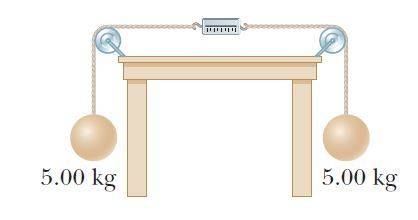
Capture.JPG
 
Physics news on Phys.org
What do you think? To start with, what's the weight of those masses?
 
Everyone weights 49N
 
m0urazz said:
Everyone weights 49N
Good. So what must be the tension in the rope?
 
The tension T is T=49 N
 
scarpma said:
The tension T is T=49 N
Yes. The tension is the same whether there are two counter balanced masses or one mass and one end of the scale tied off to a large static object.

If there was only one mass, the mass would simply fall, pulling the scale with it and there would be effectively no tension.
 
Doc Al said:
Good. So what must be the tension in the rope?
In every rope, there's also a tension which is equal to 49N
 
m0urazz said:
In every rope, there's also a tension which is equal to 49N
Exactly. So what must the scale read?
 
Doc Al said:
Exactly. So what must the scale read?
I know what you mean, but there are two masses, if we simply put them at one end it'd read 98 N, and now by putting one at every end it will read 48 N, I just can't understand why :/
 
  • #10
m0urazz said:
if we simply put them at one end it'd read 98 N,
Careful here. If you put both masses at the the same end of the scale, the scale would go flying.

What you need to understand is that the scale (assuming it's not accelerating) must be in balance. Equal forces pulling it in both directions. And the scale simply reads the tension with which it is being pulled.

Try these. Say two people were playing tug of war with ropes attached to each end of the scale. Say they each pull with a force of 49 N. What will the scale read? Now have one of the ropes tied to a tree. If one person pulls on the other rope with a force of 49 N, what force must the tree be exerting? What will the scale read?
 
  • Like
Likes   Reactions: m0urazz
  • #11
Doc Al said:
If one person pulls on the other rope with a force of 49 N, what force must the tree be exerting? What will the scale read?
The tree will exert 49 N just to balance the force exerted
 
  • #12
m0urazz said:
The tree will exert 49 N just to balance the force exerted
Right. And the tension in the ropes will be 49 N. Which is what the scale will read.
 
  • #13
Oh, that was easy I just couldn't see that, thanks Doc!
 

Similar threads

  • · Replies 2 ·
Replies
2
Views
1K
  • · Replies 22 ·
Replies
22
Views
2K
Replies
2
Views
1K
Replies
1
Views
914
  • · Replies 5 ·
Replies
5
Views
2K
Replies
17
Views
2K
  • · Replies 5 ·
Replies
5
Views
1K
  • · Replies 8 ·
Replies
8
Views
1K
  • · Replies 9 ·
Replies
9
Views
1K
Replies
7
Views
1K