High School A question about Gauss' Theorem

  • Thread starter Thread starter Wrichik Basu
  • Start date Start date
  • Tags Tags
    Gauss Theorem
Click For Summary
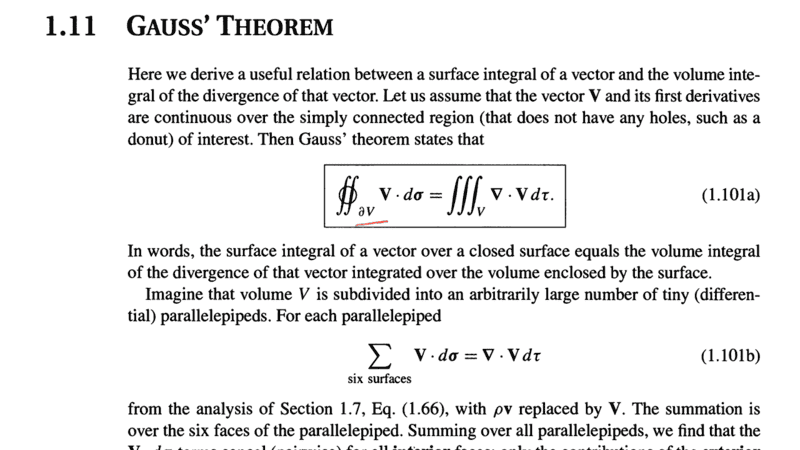
Gauss' Theorem states that the surface integral of a vector over a closed surface equals the volume integral of the divergence of that vector over the enclosed volume. The notation ##\partial V## refers to the boundary of the volume, which is synonymous with the closed surface ##S##. A clarification was made that the integral of the divergence should indeed be taken over the enclosed volume, not the surface itself. The authors of the referenced book "Mathematical Methods for Physicists" are Arfken, Weber, and Harris. Understanding this distinction is crucial for correctly applying Gauss' Theorem in physics and mathematics.
Wrichik Basu
Science Advisor
Insights Author
Gold Member
Messages
2,180
Reaction score
2,721
I was reading the book "Mathematical Methods for Physicists", and in the first chapter, under Gauss's Theorem, the statement given was:

The surface integral of a vector over a closed surface equals the volume integral of the divergence of the vector over the entire closed surface.

But the in the mathematical form, ##\partial V## was used instead of ##S## to denote the surface integral.
20180427_130410.png


I could understand that ##\partial V## is the same as ##S##. Can anyone explain how?
 

Attachments

  • 20180427_130410.png
    20180427_130410.png
    35.8 KB · Views: 7,857
Mathematics news on Phys.org
Wrichik Basu said:
I was reading the book "Mathematical Methods for Physicists"
Always quote the author(s) as well as the book title when you quote something. There are many books with this title and similar and without the authors we cannot know which.

Wrichik Basu said:
The surface integral of a vector over a closed surface equals the volume integral of the divergence of the vector over the entire closed surface.
This is not correct. The integral of the divergence should be over the enclosed volume, not the surface.

For any volume ##V##, ##\partial V## denotes its boundary.
 
Orodruin said:
Always quote the author(s) as well as the book title when you quote something. There are many books with this title and similar and without the authors we cannot know which.

Authors are Arfken, Weber and Harris.

Orodruin said:
This is not correct. The integral of the divergence should be over the enclosed volume, not the surface
My mistake. In the book, it was written over the entire volume.

Orodruin said:
For any volume V, ∂V denotes its boundary.
Understood, thanks.
 
Good morning I have been refreshing my memory about Leibniz differentiation of integrals and found some useful videos from digital-university.org on YouTube. Although the audio quality is poor and the speaker proceeds a bit slowly, the explanations and processes are clear. However, it seems that one video in the Leibniz rule series is missing. While the videos are still present on YouTube, the referring website no longer exists but is preserved on the internet archive...

Similar threads

  • · Replies 1 ·
Replies
1
Views
2K
Replies
28
Views
2K
Replies
6
Views
2K
  • · Replies 30 ·
2
Replies
30
Views
3K
  • · Replies 2 ·
Replies
2
Views
1K
  • · Replies 3 ·
Replies
3
Views
2K
  • · Replies 3 ·
Replies
3
Views
2K
Replies
1
Views
4K
  • · Replies 1 ·
Replies
1
Views
1K
  • · Replies 5 ·
Replies
5
Views
2K