A Question in a proof on Lebesgue integral under diffeomorphism

Click For Summary
SUMMARY

The discussion centers on proving the finiteness of the integral \(\int_{U_j}|\det D_x G|dx\) as part of the proof for Theorem 2.47 in Folland's "Real Analysis: Modern Techniques and Their Applications," second edition. The application of the measure property "continuity from above" requires that \(m(G(U_1))\) or \(m(G(U_j))\) for at least one \(j>1\) is finite. The user seeks assistance in demonstrating that \(|\det D_x G|\) is integrable on \(U_j\), given that \(U_j\) is an open set with finite measure. The discussion also references an erratum on the author's website regarding the proof's exposition.

PREREQUISITES
  • Understanding of Lebesgue integrals and their properties
  • Familiarity with measure theory concepts, particularly "continuity from above"
  • Knowledge of the Dominated Convergence Theorem
  • Basic concepts of diffeomorphisms and Jacobians
NEXT STEPS
  • Study the application of the Dominated Convergence Theorem in Lebesgue integration
  • Review the properties of Jacobians in the context of diffeomorphisms
  • Examine examples of integrable functions over open sets with finite measure
  • Consult the errata for Folland's book to clarify any discrepancies in the proof
USEFUL FOR

Mathematicians, graduate students in real analysis, and anyone studying measure theory and Lebesgue integrals, particularly in the context of diffeomorphisms.

zzzhhh
Messages
39
Reaction score
1
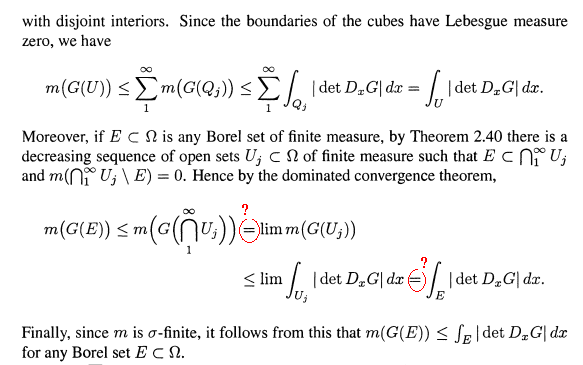
This question comes from proof of Theorem 2.47 in Folland's "real analysis: modern techniques and their applications", second edition. In particular, the question lies in the inequalities in line 7 and 8 in page 76. The first equality is an application of measure property "continuity from above". But for this property to be applicable, m(G(U_1)) (or m(G(U_j)) for at least one of j>1) must be finite. If we can prove that \int_{U_1}|\det D_x G|dx is finite, we can derive this result by the inequality in line 3. Secondly, to use dominated convergence theorem to obtain the last "=", |\det D_x G| must be integrable on U_j, that is, \int_{U_j}|\det D_x G|dx must be finite. But I can not prove this. I tried to show that |\det D_x G| is bounded on U_j, but U_j is only an open set, although it has finite measure. Could you please help me prove that the integral \int_{U_j}|\det D_x G|dx is finite? Thanks!
The following image contains part of this proof, for reference.
21l7gqf.png
 
Physics news on Phys.org
The exposition here is wrong, check the errata 1 of this book from the author's website ...
oops!
 

Similar threads

  • · Replies 1 ·
Replies
1
Views
2K
  • · Replies 1 ·
Replies
1
Views
3K
  • · Replies 20 ·
Replies
20
Views
4K
  • · Replies 7 ·
Replies
7
Views
2K
  • · Replies 7 ·
Replies
7
Views
3K
  • · Replies 3 ·
Replies
3
Views
3K
  • · Replies 2 ·
Replies
2
Views
2K
  • · Replies 21 ·
Replies
21
Views
2K
  • · Replies 6 ·
Replies
6
Views
4K
  • · Replies 1 ·
Replies
1
Views
2K