kostoglotov
- 231
- 6
I don't really feel that I understand what it means for two matrices to be similar.
Of course, I understand the need to understand ideas on their own terms, and that in math analogies are very much frowned upon. In asking if you know of any "reasonable" analogies for what it means for two matrices to be similar, I'm also asking for a broader kind of informal help with the ideas of similar matrices, Jordan Forms and diagonalization.
My cousin (who has not studied LA beyond High School vectors and matrices, solving systems of equations, etc) recently asked me if similar matrices have the same angle between the vectors in the matrix, drawing an obvious analogy to geometry with similar triangles. I replied that similar matrices have the same set of eigenvalues (necessary but not sufficient) and must all share the same Jordan Form...of course, I don't really know what a Jordan Form is - I've seen the method for constructing them and I know that they are as near to a diagonalization as is possible for a given matrix that cannot be diagonalized; and that the diagonal form of a diagonalizable matrix is its Jordan Form.
Which brings me to what I do and don't understand (and suspect) about diagonalization.
A diagonalization is a change of basis to a full eigenvector basis for a matrix/transformation. So if you convert all your vectors of interest into that same eigenbasis, then you can just multiple that vector by the diagonal lambda matrix, which is much more computationally efficient and analytically insightful than doing the transformation in some other basis -- as the former merely involves a simple scaling of the basis vectors to achieve the same transformation.
So I went into MATLAB's eigshow(), and went to compare a matrix to it's diagonal form
\frac{1}{4}\begin{bmatrix}1 & 3\\ 4 & 2\end{bmatrix} \ \text{versus} \ \begin{bmatrix}-0.5 & 0\\ 0 & 1.25\end{bmatrix}
And it definitely seems that both those similar matrices are performing the same transformation, just in a different basis.
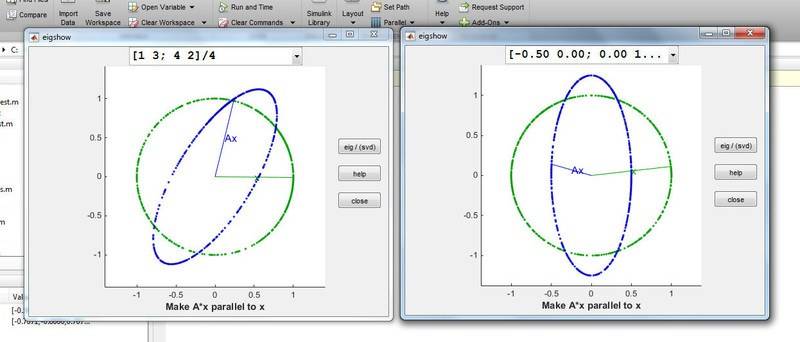
So, a diagonal form is doing the same transformation, but in a different (more manageable) basis...?
Is the Jordan Form of a matrix doing the same transformation just in a different basis?
Is there a connection between Jordan Form and SVD?
Of course, I understand the need to understand ideas on their own terms, and that in math analogies are very much frowned upon. In asking if you know of any "reasonable" analogies for what it means for two matrices to be similar, I'm also asking for a broader kind of informal help with the ideas of similar matrices, Jordan Forms and diagonalization.
My cousin (who has not studied LA beyond High School vectors and matrices, solving systems of equations, etc) recently asked me if similar matrices have the same angle between the vectors in the matrix, drawing an obvious analogy to geometry with similar triangles. I replied that similar matrices have the same set of eigenvalues (necessary but not sufficient) and must all share the same Jordan Form...of course, I don't really know what a Jordan Form is - I've seen the method for constructing them and I know that they are as near to a diagonalization as is possible for a given matrix that cannot be diagonalized; and that the diagonal form of a diagonalizable matrix is its Jordan Form.
Which brings me to what I do and don't understand (and suspect) about diagonalization.
A diagonalization is a change of basis to a full eigenvector basis for a matrix/transformation. So if you convert all your vectors of interest into that same eigenbasis, then you can just multiple that vector by the diagonal lambda matrix, which is much more computationally efficient and analytically insightful than doing the transformation in some other basis -- as the former merely involves a simple scaling of the basis vectors to achieve the same transformation.
So I went into MATLAB's eigshow(), and went to compare a matrix to it's diagonal form
\frac{1}{4}\begin{bmatrix}1 & 3\\ 4 & 2\end{bmatrix} \ \text{versus} \ \begin{bmatrix}-0.5 & 0\\ 0 & 1.25\end{bmatrix}
And it definitely seems that both those similar matrices are performing the same transformation, just in a different basis.
So, a diagonal form is doing the same transformation, but in a different (more manageable) basis...?
Is the Jordan Form of a matrix doing the same transformation just in a different basis?
Is there a connection between Jordan Form and SVD?