DavidAp
- 44
- 0
A rigid "H" falls rotating about one of its legs. What's its angular velocity?
A rigid body is made of three identical thin rods, each with length L = 0.340 m, fastened together in the form of a letter H, as suggested by the figure here. The body is free to rotate about a horizontal axis that runs along the length of one of the legs of the H. The body is allowed to fall from rest from a position in which the plane of the H is horizontal. What is the angular speed of the body when the plane of the H is vertical
Answer: 8.05 rad/s
I knew k = 1/2 Iw^2 so I went on to find k and I about each rod and adding them together to get their total kinetic energy(potential energy)/Inertia. My work is shown below.
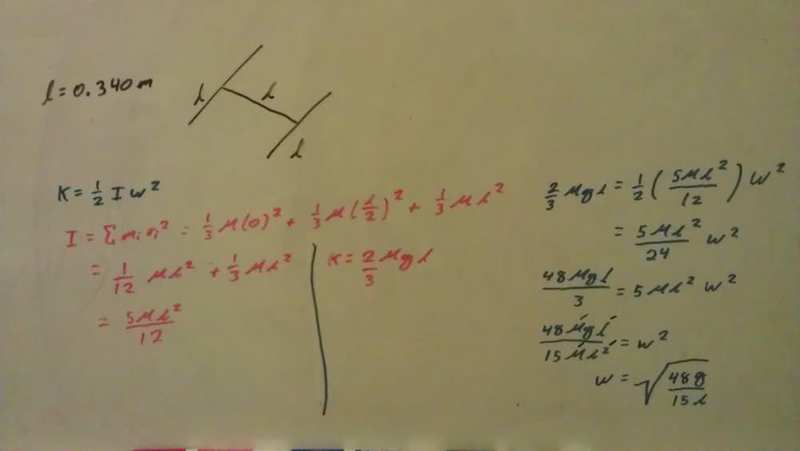
When I plug this in though I get 9.60 "rad"/s. Why, what did I do wrong? After working on this problem for over an hour I (although my work doesn't show it, it took my a long time to get to this stage) I decided to us I = Icm + Mh^2, knowing that h=l, giving me a new inertia of (17M(L^2))/(12) but when plugging in I got 5.208 "rad"/s.
What am I doing wrong? How do you solve this problem?
Thank you for taking the time to review my question.
A rigid body is made of three identical thin rods, each with length L = 0.340 m, fastened together in the form of a letter H, as suggested by the figure here. The body is free to rotate about a horizontal axis that runs along the length of one of the legs of the H. The body is allowed to fall from rest from a position in which the plane of the H is horizontal. What is the angular speed of the body when the plane of the H is vertical
Answer: 8.05 rad/s
I knew k = 1/2 Iw^2 so I went on to find k and I about each rod and adding them together to get their total kinetic energy(potential energy)/Inertia. My work is shown below.
When I plug this in though I get 9.60 "rad"/s. Why, what did I do wrong? After working on this problem for over an hour I (although my work doesn't show it, it took my a long time to get to this stage) I decided to us I = Icm + Mh^2, knowing that h=l, giving me a new inertia of (17M(L^2))/(12) but when plugging in I got 5.208 "rad"/s.
What am I doing wrong? How do you solve this problem?
Thank you for taking the time to review my question.
Last edited: