A set of numbers as a smooth curved changing manifold.

Click For Summary

Discussion Overview

The discussion revolves around the representation of smooth curved manifolds associated with objects in higher-dimensional spaces, particularly focusing on helicoids and their properties in both Euclidean and Minkowski spaces. Participants explore the mathematical constructs needed to describe these manifolds and the implications of attaching vectors and points in space-time.

Discussion Character

  • Exploratory
  • Technical explanation
  • Conceptual clarification
  • Debate/contested

Main Points Raised

  • One participant suggests that a helicoid can be represented by a set of seven numbers, encoding its position, orientation, pitch, and handedness, while questioning the definition of smooth curved manifolds associated with moving points in space-time.
  • Another participant proposes that a helicoid can be specified with six real numbers, detailing the parameters necessary for its definition, and notes the difference in geometry when considering Minkowski space compared to Euclidean space.
  • A participant expresses confusion regarding the request for associating smooth curved manifolds with a moving point and oriented vector, seeking clarification on the intended meaning of "can be associated with."
  • One participant describes a construction involving attaching oriented circles to points in space-time, suggesting that this could represent a smooth curved manifold that changes over time, while noting the complexity of visualizing this concept.
  • A follow-up question is raised about the possibility of obtaining a spinor field over space-time, inquiring about the geometrical object needed for such a transformation, distinct from the previously discussed oriented circles.

Areas of Agreement / Disagreement

Participants express varying levels of understanding and agreement regarding the representation of helicoids and the association of smooth curved manifolds with moving points. There is no consensus on the specific methods or constructs that should be used, and some questions remain unresolved.

Contextual Notes

Participants acknowledge the complexity of defining the problem and the potential need for additional assumptions. The discussion includes references to different geometrical frameworks (Euclidean vs. Minkowski) and the implications of these differences on the properties of the objects being discussed.

Spinnor
Gold Member
Messages
2,231
Reaction score
419
Edit, the vector that rotates below might not rotate at all.

Please forgive any mistaken statements or sloppiness on my part below.

I think that by some measure a helicoid can be considered a smooth curved 2 dimensional surface except for a line of points?
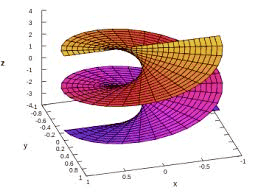
1580927855862.png


Consider not the helicoid above but one that has an arbitrary orientation, rotation, and position in space. A pair of vectors and a line segment perpendicular to one of the vectors can encode all the information of such a helicoid with arbitrary position, orientation, and rotation? That would be 7 numbers? One vector represents the distance from some origin to a point on the axis of the helicoid, the other vector represents three pieces of information, the orientation of the axis of the helicoid, the pitch of the helicoid, and the handedness of the helicoid. The perpendicular line segment represents the rotational orientation of the helicoid.

So we have a smooth surface represented by a set of numbers. What I would like to do is take an object that could be represented by a set of numbers, which is easy to visualize, and associate if possible one or more smooth curved manifolds with that object, ideally this manifold's shape changes with time.

Consider the following simple object in 4D Minkowski space-time, a point which moves through space in a straight line at the speed of light. To our moving point attach a vector that moves along with our point and that rotates in the plane perpendicular to the line that is the path of our point through space. We need a number for the rate at which the vector rotates and we need to specify which way the vector rotates. This is the object that I would like to know what smooth curved manifolds can be associated with it, if any. There may be some small set of points where our curved manifold is not defined.

I may have not defined my problem as precisely as I should and will edit if any errors occur to me but I hope you got the idea.

Thanks for any help or suggestions.
 
Last edited:
Physics news on Phys.org
In 3D space I believe the helicoid can be specified with six real numbers:

A 3D vector ##\vec v## to specify the point on the helicoid's axis that is closest to the origin of the coordinate system. We know that the axis must lie in the plane P through that point that has normal ##\vec v##.

One number ##\theta## in the range ##[0,2\pi)## to indicate the orientation of the positive helicoid axis in the plane P. 'Positive' assumes a right-hand rule. This number covers both axis orientation and handedness (chirality), since helices with this parameter as ##\theta## and ##\theta+\pi## have opposite handedness.

A positive real number ##p## to denote pitch.

A number ##\phi\in [0,2\pi)## to denote the phase of the helicoid at the point ##\vec v##.

Every set of six numbers in those ranges gives a different helicoid. I expect the map from ##\mathbb R^4\times [0,2\pi)^2## to the set of all points on all possible helicoids would be continuous.

The object you describe in Minkowski space is like a a helicoid, except its geometry would be different from a helicoid in Euclidean space because Euclidean space is Riemannian while Minkowski space is not.

I don't know if that helps. I didn't understand the question: "I would like to know what smooth curved manifolds can be associated with it, if any". I didn't know what you meant by 'can be associated with'.
 
  • Like
  • Informative
Likes   Reactions: Klystron and Spinnor
andrewkirk said:
I don't know if that helps. I didn't understand the question: "I would like to know what smooth curved manifolds can be associated with it, if any". I didn't know what you meant by 'can be associated with'.

So given an arbitrary helicoid it can be represented by a set of numbers. So kind of do the inverse. Let a moving point with oriented vector which does or does not rotate, which can be given by a small set of numbers, work backwards with this different set of numbers (or equivalently an object) and find a curved space that represents that object.

I think I came up with a construction that is represented by my moving point plus vector and is curved. To each point of space-time, ST, attach an orientated circle. Cut each circle at the point of attachment of ST. Because the circles are oriented we can distinguish the ends of each circle, call the two ends A and B. We can now picture attaching the ends of each circle, the points A and B, at different points in space-time.

Edit, we must then imagining the ends of all circles as being "reconnected" in a natural way.A 4-vector for each point of space-time can represent the displacement of the ends A and B from each other. This displacement is then a 4-vector field over space-time, call it F, that we can image changing with space and time? Our moving point and vector can then represent how our vector field F might change in some small region of space as a function of time. With some additional assumptions that are needed but unknown to me I think this construction can be thought of as a smooth curved time changing manifold but picturing it is difficult. One simple thing that can be pictured is if the ends of the fibers are attached at different space-time points then one complete orbit around a fiber would take you to a different point of space-time.
 
Spinnor said:
This displacement is then a 4-vector field over space-time, call it F, that we can image changing with space and time?

The above raises the following question, fiber space-time not with our oriented, cut, reattached circles to get a 4_vector field over space-time but fiber space-time with what object (if there is one) preform surgery on if needed to get a spinor field over space-time. What geometrical object does the trick, not an oriented circle but a ...?

Thanks.
 

Similar threads

  • · Replies 9 ·
Replies
9
Views
4K
  • · Replies 8 ·
Replies
8
Views
2K
  • · Replies 5 ·
Replies
5
Views
3K
  • · Replies 1 ·
Replies
1
Views
2K
  • · Replies 21 ·
Replies
21
Views
4K
  • · Replies 4 ·
Replies
4
Views
2K
  • · Replies 73 ·
3
Replies
73
Views
8K
  • · Replies 8 ·
Replies
8
Views
3K
  • · Replies 15 ·
Replies
15
Views
3K
  • · Replies 21 ·
Replies
21
Views
4K