A Short Proof of Birkhoff's Theorem - Comments

  • Context: Insights 
  • Thread starter Thread starter PeterDonis
  • Start date Start date
  • Tags Tags
    Proof Short Theorem
Click For Summary

Discussion Overview

The discussion revolves around Birkhoff's Theorem in the context of general relativity, focusing on various proofs and interpretations of the theorem. Participants compare different approaches, including historical proofs and modern interpretations, while exploring the implications of spherical symmetry and time-independence in gravitational solutions.

Discussion Character

  • Technical explanation
  • Debate/contested
  • Historical

Main Points Raised

  • Some participants reference a proof in a general relativity book that is similar to the one presented, noting the historical context of Birkhoff's original proof as being outdated.
  • There is a discussion about the implications of the Killing vector and the nature of asymptotic staticity, with some arguing that Birkhoff's theorem shows the absence of gravitational monopole radiation.
  • One participant suggests that a rigorous proof should address the behavior of metric coefficients, indicating that singularities may only be coordinate artifacts.
  • Another participant proposes an alternative approach involving complex exponents, arguing that it simplifies the derivation while maintaining the necessary constraints.
  • Questions arise regarding the differences between Birkhoff's proof and Schwarzschild's original derivation, particularly concerning the assumptions made about time-independence and the use of different coordinate systems.
  • Participants note the historical confusion caused by Schwarzschild's choice of radial coordinate and its implications for understanding the physical features of spacetime.

Areas of Agreement / Disagreement

Participants express differing views on the interpretations and implications of various proofs of Birkhoff's theorem, with no consensus reached on the best approach or the significance of certain aspects of the proofs.

Contextual Notes

Some discussions highlight the limitations of coordinate systems in representing physical phenomena, emphasizing the need for careful consideration of the invariants in solutions to Einstein's equations.

Messages
49,843
Reaction score
25,891
peterdonis submitted a new PF Insights post

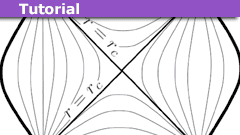
A Short Proof of Birkhoff's Theorem

birktheo.png


Continue reading the Original PF Insights Post.
 
Last edited:
  • Like
Likes   Reactions: vanhees71, martinbn, PAllen and 1 other person
Physics news on Phys.org
Nice job. For comparison, I have a proof in my GR book http://www.lightandmatter.com/genrel/ , section 7.4, but it's really very similar. Some other statements and proofs of the theorem that I've seen:

Birkhoff's original proof, in Birkhoff, Relativity and Modern Physics, 1923. A horrible, long monstrosity with an out of date attitude toward the significance of coordinates.

Hawking and Ellis: "Any C^2 solution of Einstein's empty space equations which is spherically symmetric in an open set V, is locally equivalent to part of the maximally extended Schwarzschild solution in V." The part about "maximally extended" is a good point -- I always tend to think about just part of the Schwarzschild spacetime (2 of the 4 regions) and forget that it can be extended.

http://arxiv.org/abs/gr-qc/0408067 -- "Schwarzschild and Birkhoff a la Weyl," Deser and Franklin. Birkhoff's thm is equivalent to proving that the m in the Schwarzschild metric is constant.

As you point out, the existence of the ##\partial_t## Killing vector doesn't mean that the spacetime is static. However, it *is* asymptotically static, which is kind of the only nontrivial thing being proved. If we knew in advance that it was asymptotically static, then Birkhoff's theorem would amount to no more than the usual derivation of the Schwarzschild metric. Essentially we're seeing that there's no such thing as gravitational monopole radiation.

For a really rigorous proof, I think one needs to deal with the possibility that the metric coefficients blow up or go to zero, and show that these would be only coordinate singularities-- but I don't do that either, just mention it in a footnote.
 
  • Like
Likes   Reactions: vanhees71 and atyy
bcrowell said:
Nice job.

Thanks!

bcrowell said:
For a really rigorous proof, I think one needs to deal with the possibility that the metric coefficients blow up or go to zero

Yes, this is true, and IIRC MTW do deal with this in their proof. I think what they do still goes the same way once the wart in their proof is removed as I (and you) remove it. :wink:
 
Very nice indeed, but you can save MTW's ansatz (which I never understood, why it is made in so many textbooks and not your way, which is more general) by allowing the exponents to become complex. Since the exponentials must be real in the pseudometric, this amounts to adding ##2 n \pi \mathrm{i}## (which changes nothing) or ##(2n+1) \pi \mathrm{i}## with ##n \in \mathbb{Z}##. Then the Minkowskian signature of the metric constrains these possibilities to the solutions you gave. Of course, it's much more simple to just use your ansatz and staying with real quantities all the time during the derivation.
 
Here's a question: How does this compare with Schwarzschild's original derivation? Is the only difference that Schwarzschild started out assuming a time-independent solution, while this derivation proves that time-independence follows from the assumption of spherical symmetry?
 
stevendaryl said:
Is the only difference that Schwarzschild started out assuming a time-independent solution, while this derivation proves that time-independence follows from the assumption of spherical symmetry?

No, although that's one difference. The other, more important difference is that Schwarzschild's original derivation used different coordinates; his radial coordinate, which I'll call ##\rho##, was defined in such a way that ##\rho = 0## corresponded to the horizon, not the singularity at what we now call ##r = 0##. This led to several decades of confusion because it was not fully appreciated that (a) a given coordinate chart might not cover all of a given spacetime, and (b) coordinates in themselves have no physical meaning; the physics of any solution is contained in the invariants.
 
  • Like
Likes   Reactions: vanhees71
Here's a previous PF discussion on Schwarzschild's original solution:

https://www.physicsforums.com/threads/schwarzschilds-metric-1916.708045/page-5

As you'll see from some of the links and posts in this thread, there are still people who make the same error that Schwarzschild originally made, thinking that if they defined a "radial coordinate" that had value zero at the horizon, that somehow meant that, physically, there couldn't be any other region of spacetime beneath the horizon.
 
PeterDonis said:
No, although that's one difference. The other, more important difference is that Schwarzschild's original derivation used different coordinates; his radial coordinate, which I'll call ##\rho##, was defined in such a way that ##\rho = 0## corresponded to the horizon, not the singularity at what we now call ##r = 0##. This led to several decades of confusion because it was not fully appreciated that (a) a given coordinate chart might not cover all of a given spacetime, and (b) coordinates in themselves have no physical meaning; the physics of any solution is contained in the invariants.

Thanks. With the hindsight of 100 years of GR, it's hard to get back into the frame of mind that glosses over the distinction between coordinate-dependent features of a solution and physically meaningful features.
 

Similar threads

  • · Replies 22 ·
Replies
22
Views
2K
  • · Replies 7 ·
Replies
7
Views
1K
  • · Replies 20 ·
Replies
20
Views
3K
  • · Replies 23 ·
Replies
23
Views
5K
  • · Replies 33 ·
2
Replies
33
Views
5K
  • · Replies 39 ·
2
Replies
39
Views
6K
  • · Replies 2 ·
Replies
2
Views
2K
  • · Replies 26 ·
Replies
26
Views
5K
  • · Replies 4 ·
Replies
4
Views
3K
  • · Replies 29 ·
Replies
29
Views
3K