A steady-state solution for the flow in the Boussineq approximation in a star

Click For Summary
SUMMARY

The discussion focuses on finding a steady-state solution for flow in the Boussinesq approximation, specifically directing flow along the vector ##\vec{e_y}##. The equations presented include the time derivatives of velocity components in three dimensions, highlighting the influence of the Coriolis force and buoyancy on flow direction. The participants suggest that the solution can be found in a textbook, indicating that the relevant definitions and solutions are likely emphasized in bold print. Memorizing these definitions is recommended for test preparation.

PREREQUISITES
  • Understanding of the Boussinesq approximation in fluid dynamics
  • Familiarity with the Coriolis force and its effects on flow
  • Knowledge of partial differential equations related to fluid flow
  • Experience with vector calculus and directional flow analysis
NEXT STEPS
  • Review the Boussinesq approximation and its applications in fluid dynamics
  • Study the effects of the Coriolis force on flow direction
  • Examine textbook solutions related to steady-state flow problems
  • Learn how to partition total flow into perpendicular directions using relevant equations
USEFUL FOR

Students and researchers in fluid dynamics, particularly those studying the Boussinesq approximation, as well as educators preparing for assessments involving these concepts.

fab13
Messages
300
Reaction score
7
Hello,

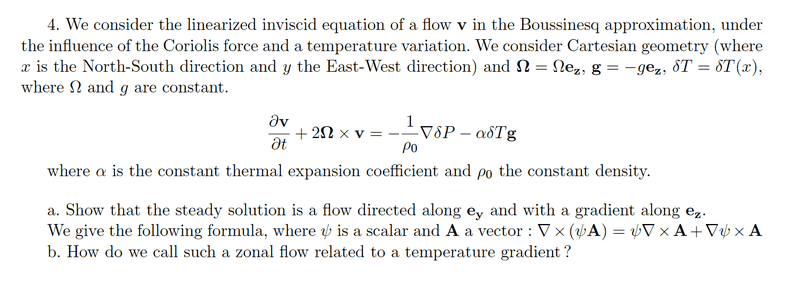
I am trying desperately to find the solution indicated in this question :
V8zBal6.png


If I compute the equations on the 3 axis, I can't get the flow to be directed along ##\vec{e_y}##.

I have only :

##\dfrac{\partial v_{z}}{\partial t} = -\dfrac{1}{\rho_0}\dfrac{\partial \delta P}{\partial z}+\alpha g \delta T\quad(1)##

##\dfrac{\partial v_{x}}{\partial t} - 2\Omega_{z} v_{y}=0\quad(2)##

##\dfrac{\partial v_{y}}{\partial t} + 2\Omega_{z} v_{x}=0\quad(3)##

Anyone could see how to prove a flow directed along ##\vec{e_{y}}## for the steady solution of this equation ?

and with a gradient along ##\vec{e_{z}}## ?

Any help would be kind.
 

Attachments

  • V8zBal6.png
    V8zBal6.png
    35.3 KB · Views: 994
Astronomy news on Phys.org
There must be a flow along the y direction caused by the Coriolis force. The boussinesq approximation gives you buoyancy which fits with vertical flow. Use the given formula to partition total flow into the 2 perpendicular directions.

The solution to b should be in a few pages back in the textbook. I do not know what textbook you got that from. That wording of a question usually means the authors definition was in bold print or something similar. Also a likely test question so you might as well memorize that definition.
 

Similar threads

  • · Replies 10 ·
Replies
10
Views
1K
  • · Replies 2 ·
Replies
2
Views
3K
  • · Replies 6 ·
Replies
6
Views
2K
  • · Replies 3 ·
Replies
3
Views
4K
  • · Replies 8 ·
Replies
8
Views
2K
  • · Replies 9 ·
Replies
9
Views
2K
  • · Replies 3 ·
Replies
3
Views
2K
  • · Replies 0 ·
Replies
0
Views
2K
Replies
49
Views
4K
  • · Replies 20 ·
Replies
20
Views
2K