About charge inside a spherical metallic shell

Join the discussion
Ask a follow-up here, or get your own question answered by working scientists, mathematicians and engineers — people, not an autocomplete.
Real named experts · corrections over time · the nuance an AI answer skips
10 replies · 3K views
kenok1216
Messages
58
Reaction score
1
Poster has been reminded to use the HH Template and show their work
where are the charge =0? please help...no idea how to do
擷取.PNG
 
Last edited by a moderator:
Physics news on Phys.org
Hi kenok, :welcome:

Please read and observe the PF guidelines -- the mentors will discard your posts if you don't...
Charge = 0 on the outer shell, but that doesn't mean it's zero everywhere!
What do you know about induced charges ? And about the Gauss Law ?
 
Last edited:
BvU said:
Hi kenok, :welcome:

Please read and observe the PF guidelines -- the mentors will discard your posts if you don't...
Charge = 0 on the outer shell, but that doesn't mean it's zero everywhere!
What do you knwo about induced charges ? And about the Gauss Law ?
inside the met
BvU said:
Hi kenok, :welcome:

Please read and observe the PF guidelines -- the mentors will discard your posts if you don't...
Charge = 0 on the outer shell, but that doesn't mean it's zero everywhere!
What do you knwo about induced charges ? And about the Gauss Law ?
let say shell1 =metallic shell which radius=ra, shell2=metallic shell which radius=rb
the charge on outshell of shell1=+Q,since -Q charge inside shell1 ,net charge must be=0(since shell 1 is conductor)
then the inner shell of shell 2=-Q and outshell of shell2 =+Q?(i do not know how to explan, but it is correct?)
finally draw guess surface at ra<r<rb
qin=-Q ,so E=k-Q/r^2 when ra<r<rb
 
kenok1216 said:
inside the met

let say shell1 =metallic shell which radius=ra, shell2=metallic shell which radius=rb
the charge on outshell of shell1=+Q,since -Q charge inside shell1 ,net charge must be=0(since shell 1 is conductor)
then the inner shell of shell 2=-Q and outshell of shell2 =+Q?(i do not know how to explan, but it is correct)
final draw guess surface at ra<r<rb
qin=-Q ,so E=k-Q/r^2 when ra<r<rb
kenok1216 said:
inside the met

let say shell1 =metallic shell which radius=ra, shell2=metallic shell which radius=rb
the charge on outshell of shell1=+Q,since -Q charge inside shell1 ,net charge must be=0(since shell 1 is conductor)
then the inner shell of shell 2=-Q and outshell of shell2 =+Q?(i do not know how to explan, but it is correct?)
finally draw guess surface at ra<r<rb
qin=-Q ,so E=k-Q/r^2 when ra<r<rb
13059860_1087111158027025_1619544614_n.jpg

it is correct?
 
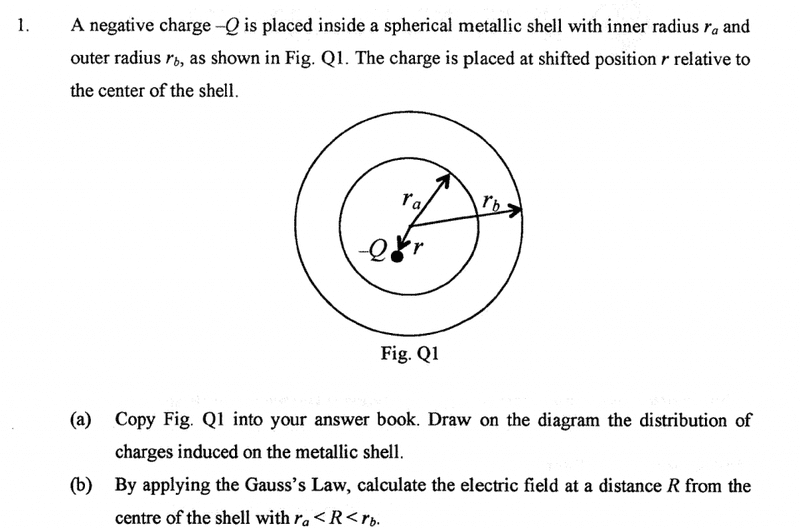
(a) There is only one shell. Its inner radius is ra and its outer radius is rb.

The induced charge on the inner side of the shell is indeed +Q -- it mirrors the -Q of the charge at r.
kenok1216 said:
finally draw guess surface at ra<R<rb
qin=-Q ,so E=k(-Q)/R^2 when ra<R<rb
(the symbol r is already in use for something else!)

This can't be right! You forget the -Q at r from the origin !
 
BvU said:
(a) There is only one shell. Its inner radius is ra and its outer radius is rb.

The induced charge on the inner side of the shell is indeed +Q -- it mirrors the -Q of the charge at r.
(the symbol r is already in use for something else!)

This can't be right! You forget the -Q at r from the origin !
which range of r such that E=0? i feel so confuse
 
No reason to feel confused ! Understanding will break through soon enough :smile:.

The -Q charge at r 'pulls' positive charge towards the inner surface of the metallic conducting shell. That positive charge will be distributed in such a way that the electric field lines inside the shell all are perpendicular to the surface. Why ? Well, if the field lines were not, the component of the electric field along the surface would cause motion of the charges until that component no longer is present.

The shell was uncharged and remains uncharged. The negative charges are repelled from the inner surface and don't hang about in the metal: they sit on the outer surface because there they have the most room (they repel each other!).

Inside a (ideal) conductor you have no electric field (reason as above: charge can move freely until there is no driving force qE left over).

And you can check this: any sphere with radius ##r_a<R<r_b## has zero charge inside, so no field !

So parts a and b of this exercise are more or less a giveaway !
 
BvU said:
No reason to feel confused ! Understanding will break through soon enough :smile:.

The -Q charge at r 'pulls' positive charge towards the inner surface of the metallic conducting shell. That positive charge will be distributed in such a way that the electric field lines inside the shell all are perpendicular to the surface. Why ? Well, if the field lines were not, the component of the electric field along the surface would cause motion of the charges until that component no longer is present.

The shell was uncharged and remains uncharged. The negative charges are repelled from the inner surface and don't hang about in the metal: they sit on the outer surface because there they have the most room (they repel each other!).

Inside a (ideal) conductor you have no electric field (reason as above: charge can move freely until there is no driving force qE left over).

And you can check this: any sphere with radius ##r_a<R<r_b## has zero charge inside, so no field !

So parts a and b of this exercise are more or less a giveaway !

so inside the shell1 q=-Q and inner shell have charge +Q , outershell have -Q
at ra<R<rb qin= -Q+Q=0 so E=0
finally i have two question below
at R<ra and R>rb E=K-Q/r^2?
between shell1 and shell2, q=0?
thanks for you help!
 
Last edited by a moderator:
kenok1216 said:
1) at R<ra and R>rb E=K-Q/r^2?
2) between shell1 and shell2, q=+Q?
1) No and 2) No !

##R>r_b## is the easiest: ##|\vec E| = k {-Q\over R^2}## (capital R) : the charge is evenly distributed over the outer surface.
##R<r_a## is not as you describe. Check at the origin ! Is the exercise asking for this field ?

2) there is no charge between ra and rb
 
BvU said:
1) No and 2) No !

##R>r_b## is the easiest: ##|\vec E| = k {-Q\over R^2}## (capital R) : the charge is evenly distributed over the outer surface.
##R<r_a## is not as you describe. Check at the origin ! Is the exercise asking for this field ?

2) there is no charge between ra and rb
i got you point now, for R<ra just ask for the interest
 
For ##R<r_a## you need to find a field that has an equipotential surface at ##R=r_a##. Close to the charge -Q at r it has to be approximately like the field from a single charge.
A dipole field has such a property; the method to find it is the method of images (one of the last examples - you can swap q inside and outside)